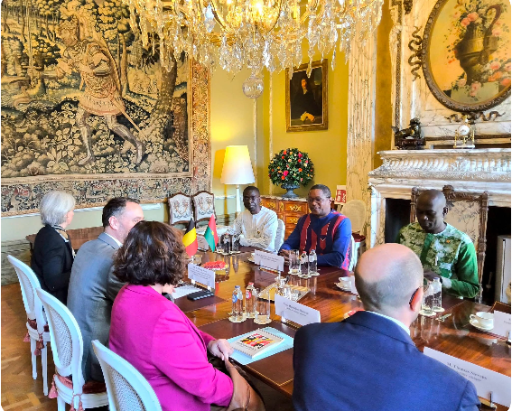
A decisive moment in Burkina Faso-Belgium relations unfolded as Foreign Minister Karamoko Jean-Marie Traoré concluded a landmark visit to Brussels, setting the stage for a strengthened partnership despite regional turbulence. The visit, which concluded on November 5, 2026, delivered a concrete financial commitment from Belgium: €40 million in development aid earmarked for the post-2027 period, signaling a bold step forward for a nation navigating complex geopolitical currents.
The turning point in cooperation with new European funding
The announcement from Brussels comes at a critical juncture for Burkina Faso, a country facing profound challenges—economic instability, social unrest, and escalating security threats. The €40 million pledge, to be channeled through Belgium’s international cooperation agency Enabel, represents more than financial support; it’s a statement of intent to preserve a longstanding bilateral relationship.
During two days of high-level discussions, Traoré and his Belgian counterpart Maxime Prévot explored ways to reinforce collaboration across key sectors, including health, education, and rural development. While the funds are slated for the period beyond 2027, their announcement carries immediate symbolic weight, reinforcing the message that Ouagadougou remains open to constructive partnerships despite shifting allegiances.
Breaking down the €40 million commitment
- A continuation of past efforts: The new funding builds on the existing 2023–2027 cooperation program, which totaled €34.5 million. Together, these resources aim to sustain essential services and development initiatives across Burkina Faso.
- Timing matters: Though the €40 million is not yet fully disbursed, its formal pledge sends a strong signal of Belgium’s long-term commitment to the region.
- Strategic flexibility: Unlike conditional aid from some Western partners, this funding appears designed to support Burkina Faso’s own development priorities without imposing political strings.
Diplomatic bridges remain open between Ouagadougou and Brussels
The Brussels visit was more than a financial agreement—it was a reaffirmation of diplomatic channels. On November 4, Traoré met with Kaja Kallas, the EU High Representative for Foreign Affairs and Security Policy, discussing Burkina Faso’s evolving role in the Sahel and its vision for international partnerships.
The following day, his meeting with Prévot focused on regional stability, bilateral trade, and shared priorities such as counter-terrorism cooperation. These exchanges underscore a pragmatic approach: while Burkina Faso redefines its alliances—most notably with Russia—it continues to engage with traditional Western partners on practical terms.
How Ibrahim Traoré balances sovereignty and international support
Since taking power in 2022, President Ibrahim Traoré has championed a foreign policy rooted in national sovereignty, including the withdrawal of French forces and a pivot toward non-Western allies. Yet the continuation of Belgian development aid reveals a nuanced strategy: asserting independence does not necessarily mean severing all ties.
- Selective engagement: Burkina Faso can simultaneously pursue closer ties with Moscow and maintain channels with Brussels, as long as cooperation serves distinct national interests.
- Economic realism: Despite rhetorical distancing from Western powers, the need for external financing remains urgent. Development projects funded by Belgium can operate independently of political alignment.
- Risk and reward: For Belgium, maintaining dialogue with Ouagadougou ensures influence in the Sahel. For Burkina Faso, the €40 million infusion offers breathing room amid economic strain.
What’s next for Burkina Faso and its international partnerships?
The €40 million aid package is not a full reconciliation with the West—but it is a significant gesture. Future indicators of a broader shift could include:
- New cooperation agreements: beyond development aid, potential ventures in energy, infrastructure, or technology transfer.
- Enhanced diplomatic missions: more frequent exchanges at ministerial or presidential level.
- Policy alignment: if Belgium’s aid leads to visible improvements in public services, it may encourage Burkina Faso to deepen engagement.
Yet the path forward remains uncertain. The country’s leadership must navigate a delicate balance: asserting sovereignty while leveraging external support. Meanwhile, Brussels faces a challenge of its own—how to foster cooperation with a partner that voices strong anti-Western rhetoric but still seeks pragmatic collaboration.
One thing is clear: the announcement of €40 million marks more than just a financial transfer. It signals a turning point—one where both nations are recalibrating their relationship, testing new ground, and seeking momentum in a rapidly changing diplomatic landscape.
A moment of strategic recalibration
As Burkina Faso charts its independent course, the continued cooperation with Belgium illustrates a broader truth: in international relations, complete rupture is rare. Instead, states often navigate between assertion and pragmatism, ideology and necessity. The €40 million aid deal is a tangible example of that balance in action—proof that even in times of shifting tectonic plates, dialogue and development can still find a way forward.