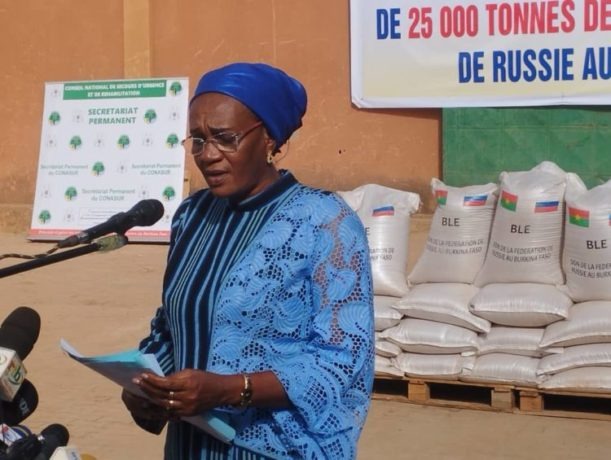
The gap between Burkina Faso’s official narrative and ground reality has never been wider. While transitional leader Captain Ibrahim Traoré repeatedly asserts that the country is on the brink of food self-sufficiency through aggressive agro-pastoral policies and ‘reclaimed sovereignty,’ authorities rolled out a lavish welcome on September 23, 2026, for a 25,000-ton shipment of wheat gifted by the Russian Federation.
From propaganda to plate: the disconnect shaping Burkina Faso’s food supply
The government’s insistence that it no longer relies on external food sources clashes sharply with the continuous arrival of foreign cereals. This paradox stems from a calculated political performance rather than genuine agricultural recovery. The claim that Burkina Faso can feed its people without assistance ignores a harsh truth: vast swaths of farmland lie abandoned under insurgent control, while rural communities displaced by violence have fled their fields. If the nation truly achieved self-sufficiency, warehouses would overflow, cities would thrive, and displaced camps would never depend on imports from the Black Sea.
The illusion of closing the hunger gap
The federal narrative frames subsistence as strength, yet the arrival of emergency grain shipments exposes a far grimmer picture. Food aid is not a mark of progress; it’s a symptom of systemic collapse. When harvests fail, markets falter, and displaced populations swell, no amount of staged celebrations can fill empty stomachs or restore lost livelihoods.
The hidden cost behind Moscow’s ‘gift’
What appears as humanitarian generosity masks a complex web of political and economic quid pro quos. Diplomatic language often hides reality, and in this case, observers suspect an indirect purchase disguised as aid. Russia’s wheat shipment likely trades food security for strategic concessions: access to gold mines, exclusive economic contracts, and unquestioning diplomatic alignment. These 25,000 tons carry a hefty price tag paid not in cash, but in surrendered sovereignty.
Bread baskets and bullet baskets
The irony deepens when assistance masquerades as independence. A truly sovereign nation does not rely on foreign imports to feed its people or protect its agricultural heartland. Until Burkina Faso’s leaders reconcile their fiery rhetoric with tangible production and security on the ground, the dream of food sovereignty remains a carefully staged illusion.
Why Burkina Faso’s wheat crisis reveals deeper strategic shifts
The shipment is more than an agricultural transaction; it signals a tectonic shift in Burkina Faso’s geopolitical alignment. By accepting this donation, the country’s transitional government ties its future to Moscow’s sphere of influence, forging dependencies that extend far beyond food. In exchange for wheat, Burkina Faso may have traded away not just economic autonomy, but also control over critical national resources and foreign policy flexibility.
The real harvest: control, compliance, and hidden contracts
Behind closed doors, this aid narrative is negotiated not in village squares, but in backroom exchanges. The Russian Federation gains a foothold in West Africa’s gold-rich economy, while Burkina Faso secures short-term food relief at the cost of long-term autonomy. Such arrangements rarely remain confined to agriculture—they ripple through mining, energy, finance, and defense sectors, quietly reshaping Burkina Faso’s strategic posture.
Lessons from the wheat saga: who really benefits?
The arrival of 25,000 tons of Russian wheat forces a reckoning. Is this aid designed to feed Burkinabè citizens—or to feed Russia’s ambitions? When food shortages become tools of geopolitical leverage, the people of Burkina Faso become pawns in a larger game. The government’s insistence on self-sufficiency rings hollow when survival depends on shipments supervised by foreign powers. True sovereignty is not declared in speeches; it is built in fields, protected by borders, and sustained by the labor of its people.
As long as Burkina Faso’s breadbasket remains empty and its rhetoric unmatched by reality, the country remains trapped in a cycle of dependence—fed by wheat, but starved of true independence.

