The Burkina Faso government’s recent unveiling of its so-called Nanga armored vehicles has sparked intense debate not just about their military utility, but about the very foundations of their production. Promoted as a symbol of the country’s growing defense autonomy, the vehicles’ origins remain shrouded in secrecy, raising serious questions about what is truly being manufactured within Burkina Faso’s borders.
From announcement to ambiguity: the evolution of the Nanga narrative
On September 21, Burkina Faso’s military leader Ibrahim Traoré declared that nearly 300 Nanga armored vehicles had been produced or modified locally since November 2025. The claim was framed as a milestone for national security and industrial self-sufficiency. Yet, despite these bold assertions, the public has been offered no tangible proof of an operational manufacturing facility capable of such output.
The government has justified this opacity by invoking national security, arguing that Faso Armored, the entity reportedly overseeing the program, will remain inaccessible to the public. Traoré also referenced several other reportedly discreet defense contractors operating in the shadows. But does such secrecy truly justify the absence of any verifiable industrial footprint?
The limits of secrecy in demonstrating industrial capability
Security concerns can justify the safeguarding of sensitive technical details. However, they do not inherently preclude the disclosure of a facility’s existence, its operational capacity, or even general indicators of production. A credible claim of domestic manufacturing should be supported by observable infrastructure: assembly lines, material stockpiles, or even basic documentation of output. To date, none of these have been presented.
Turkish connections: a pattern worth examining
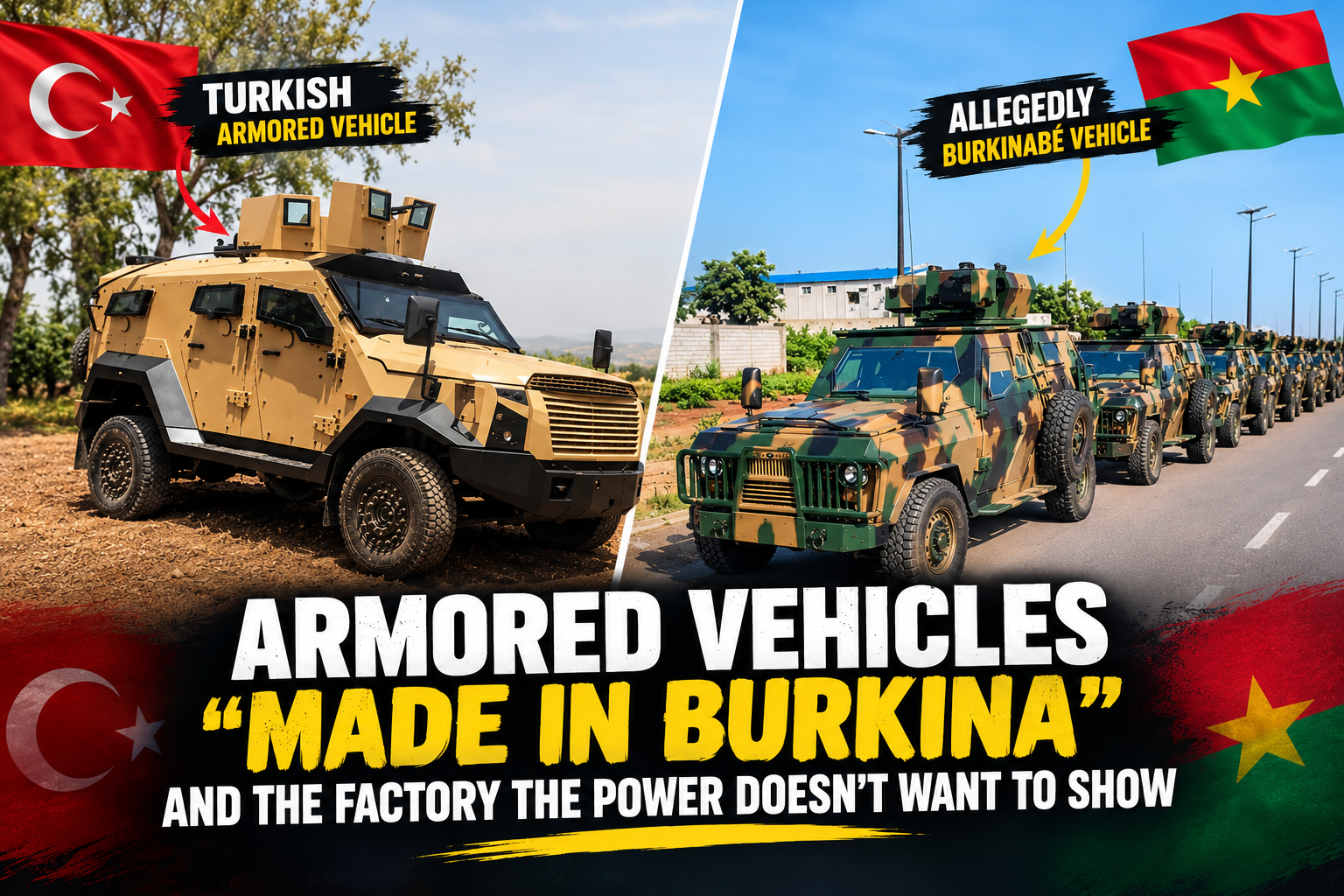
The mystery deepens when one examines Burkina Faso’s prior military acquisitions. In late 2022, four Nurol Ejder 6×6 armored vehicles manufactured by the Turkish company Nurol Makina were reportedly delivered to Burkina Faso. Images from the period confirm their Turkish origin and distinctive design.
While this does not confirm that the Nanga vehicles are repurposed Ejder models, it introduces a plausible scenario: could the Nanga be foreign platforms that have undergone local modifications such as enhanced armor plating, modified chassis, or customized interiors and then rebranded as domestic products?
Such a process would not constitute full local manufacturing but rather adaptation a critical distinction when assessing national industrial capacity.
Adapted or manufactured? The semantic trap in the official narrative
Official communications describe the Nanga as vehicles whose original bodies have been replaced with locally engineered armored structures, tailored to Burkina Faso’s operational needs. Some reports even use the phrases “adapted and transformed in Burkina Faso” a carefully chosen wording that sidesteps the notion of complete domestic fabrication.
This linguistic precision reveals more than it admits. If key components like engines, transmissions, and chassis originate abroad, while only the armor and certain modifications are done locally, then the claim of “made in Burkina Faso” is technically misleading. The integrity of the production process and the percentage of Burkinabè contribution remains undefined.
The missing factory: why visibility matters in defense production
Government transparency in military matters is not a matter of convenience it is a cornerstone of public trust in national defense initiatives. Yet, in the case of the Nanga, the contrast between visible results and invisible means is striking.
Consider the case of TEXFORCES-BF, the factory commissioned to produce military uniforms. This facility, inaugurated in Bobo-Dioulasso on September 9, 2026, was showcased openly: its location, investment, and operational launch were all documented with photographs and official statements. Such openness strengthens credibility.
Why, then, is Faso Armored granted total invisibility? A single verified image of an assembly line, or a basic schematic of production stages, would significantly bolster the government’s claims. Without such evidence, the “300 vehicles in less than a year” statement remains an unverified assertion however ambitious it may sound.
Key questions the government must answer
Where exactly is Faso Armored located? A general region or district would suffice security would not be compromised by such disclosure.
What is the monthly production capacity? Is there a verifiable assembly line, or is output improvised?
Who supplies the base platforms? Are the chassis, engines, and transmissions imported?
What percentage of each vehicle is manufactured locally? Is it 5% armor and 95% foreign components, or closer to parity?
Are there standardized technical specifications? Without documentation, how can one confirm uniformity in quality and performance?
Between myth and reality: what do the Nanga truly represent?
It is premature to label the Nanga program a fabrication fraud. However, it is also premature to accept it as definitive proof of Burkina Faso’s industrial sovereignty in defense manufacturing. The facts suggest a more complex picture: a blend of foreign technology, local adaptation, and strategic rebranding.
The core issue is not whether Burkinabè technicians and engineers contributed to the vehicles’ development it is whether those contributions constitute true domestic production.
Until Faso Armored or an equivalent facility is opened for partial inspection, or until independent verification of the production process is conducted, the slogan “made in Burkina Faso” remains a political declaration, not an established industrial fact.
The public deserves clarity. And in matters of national defense, clarity is not a luxury it is a necessity.
By Ramatou Soumana — Reporter