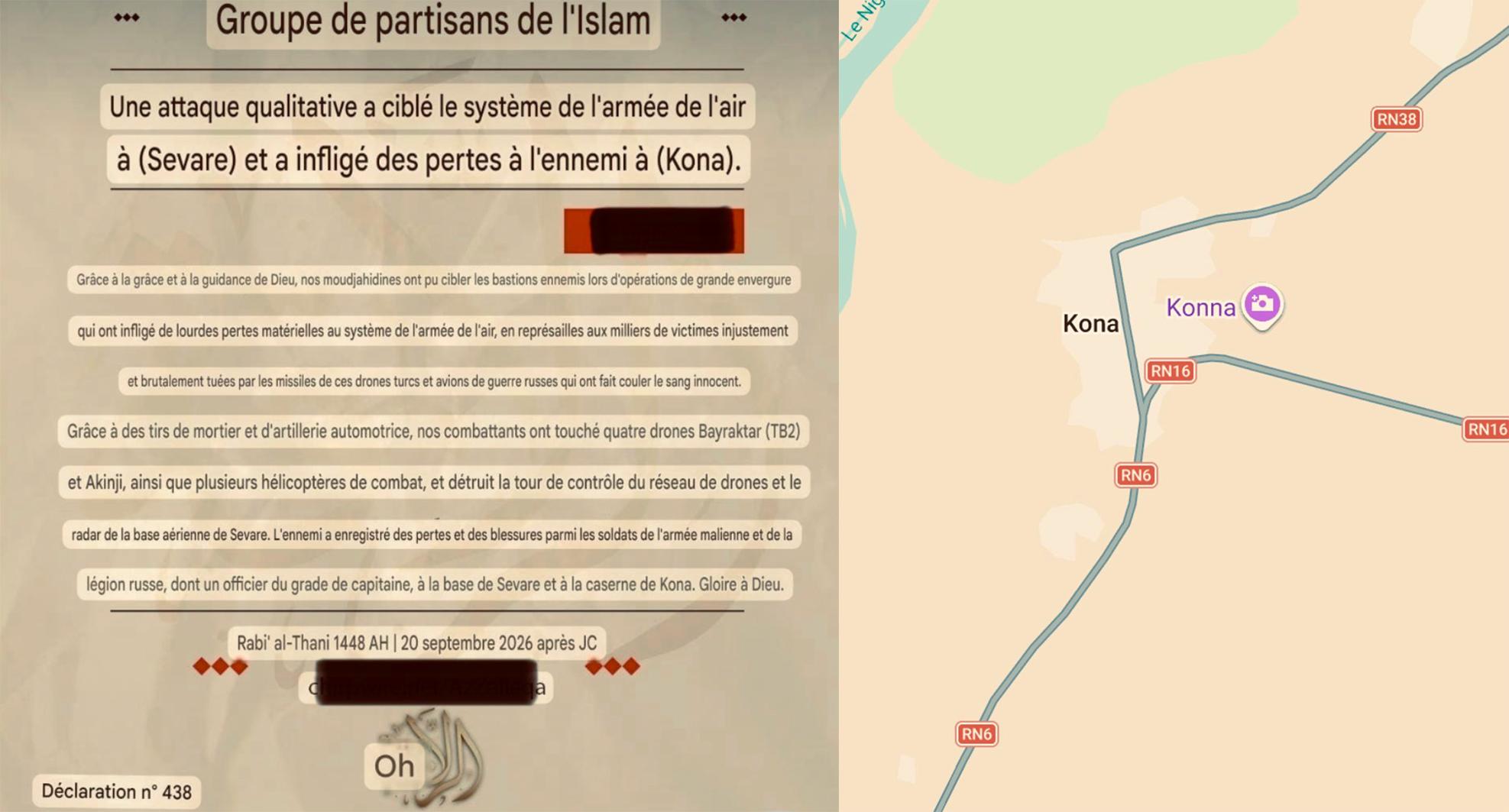
The September 20 raid on Sévaré’s airbase and nearby Konna barracks wasn’t just another militant assault—it was a tactical gauntlet thrown down by the Group for the Support of Islam and Muslims (JNIM), Al-Qaeda’s Sahelian stronghold. Claiming destruction of four drones, multiple helicopters, a radar installation and a control tower, the attack laid bare the gaping holes in Bamako’s military strategy despite heavy investment in advanced weaponry and foreign partnerships.
The roots of a strategy built on shifting alliances
The 2020 and 2021 coups marked a turning point in Mali’s security doctrine. Walking away from Western partners, particularly France, Bamako pivoted toward Moscow and Ankara, framing the shift as a bold assertion of sovereignty. The narrative sold well politically, but the battlefield told a different story. With Russian fighters from the Africa Corps joining newly acquired Turkish drones and helicopters, the military’s firepower increased dramatically. Yet the jihadist threat didn’t vanish—it adapted, proving that raw technical superiority is no substitute for ground-level control.
Asymmetric warfare: why technology alone can’t win a shadow war
The JNIM operates like a guerrilla force deeply embedded in local communities. They know the terrain, blend into the population and strike where visibility is high and defenses are static—exactly what Sévaré represented. Turkish Bayraktar drones, Russian air support and advanced radar systems all failed to detect or deter the assault. The lesson? A high-tech arsenal is only as strong as the human intelligence, mobility and persistent presence behind it. Mali’s military might now be louder on paper, but it remains alarmingly quiet where it matters most: the villages, roads and trade routes where civilians bear the brunt of the insecurity.
Sévaré’s fall: a case study in military hub vulnerability
As the central Mali nerve center for aerial surveillance and combat operations, Sévaré houses some of the country’s most critical military assets. The JNIM’s precision strike on this fortified site wasn’t just a logistical blow—it exposed a structural flaw. Mali’s forces are concentrated around key bases, but vast rural areas and communication arteries remain dangerously exposed. Every successful assault on such a sensitive location chips away at public trust in the junta’s ability to protect what it claims to govern. With repeated raids, the message is clear: firepower alone can’t impose authority where the state is absent.
From drones to distrust: the hidden cost of high-tech hubris
The Bayraktar fleet has become a symbol of Mali’s new military posture. These drones deliver real-time intelligence and precision strikes, offering a clear operational edge. Yet their Achilles’ heel lies in their fixed, easily identifiable bases. If the JNIM’s claims about destroying or damaging drones and helicopters on the ground are accurate, the attack wasn’t just physical—it was symbolic. It shattered the illusion that advanced equipment automatically translates into invincibility. For a regime banking its legitimacy on being tougher, smarter and more independent than its predecessors, Sévaré became a brutal reality check.
What really matters: security beyond the barracks
For ordinary Malians, the debate over French withdrawals, Russian Wagner successors or drone diplomacy is secondary. What counts is whether roads are safe to travel, markets stay open without fear and villages don’t fall under militant control overnight. Military parades and weapons displays don’t feed children or protect farmers. The junta’s gamble on foreign partnerships and high-tech firepower hasn’t translated into daily security. Until Bamako can guarantee unbroken state presence in every district, control every critical route and neutralize jihadist operations without relying solely on foreign firepower, the Sévaré model will remain a high-cost illusion.
The road ahead: turning strength into lasting stability
The junta insists its policy is working, pointing to newly acquired assets and strengthened alliances. But effectiveness is measured in outcomes, not announcements. Mali doesn’t need more drones—it needs a security strategy that puts people first. That means robust human intelligence networks, mobile rapid-response units, protected supply lines and genuine civilian protection. Without these, every Sévaré-style assault becomes another wound to the junta’s credibility. The world watches as Bamako wagers its future on firepower, but history suggests that in asymmetric wars, hearts and minds hold the real advantage.