Why Paris’s chaos is fueling Sahel’s military regimes
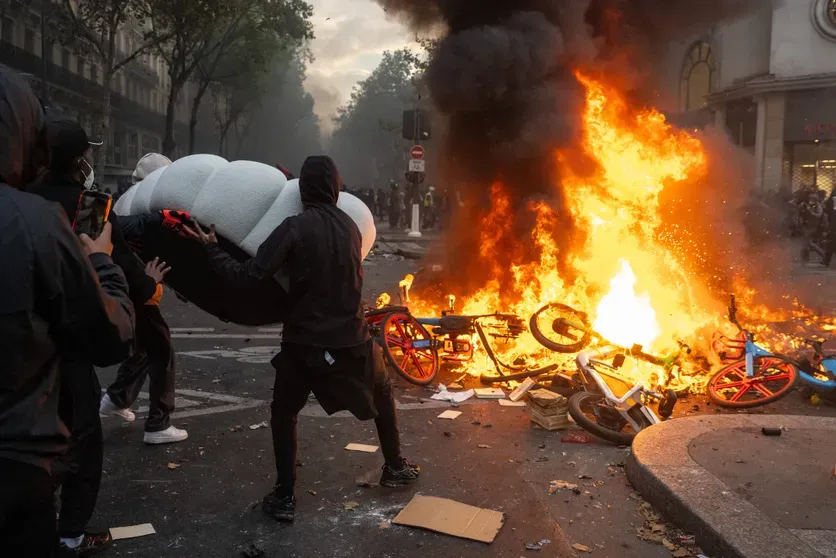
The recurring scenes of unrest in France—shattered storefronts, police charges, burning barricades, and tear gas—have become the most potent ammunition in the propaganda arsenal of Sahel’s military juntas. What began as domestic contention has evolved into a geopolitical windfall for regimes that have staked their legitimacy on dismantling western influence.
From moral authority to propaganda gold
Scroll through social feeds in Bamako, Ouagadougou, or Niamey and the perspective flips. Western media frame the turmoil as a domestic crisis; pro-junta narratives seize on these images as proof that the tide of history has turned. Since Assimi Goïta, Ibrahim Traoré, and Abdourahamane Tiani consolidated power, their opposition to Paris has been matched by an aggressive information campaign. The unraveling of France’s social fabric is exactly the storyline their communications teams have waited for.
For decades, Paris tied diplomatic support to democratic norms, human rights standards, and the right to protest. Now, sovereignty activists and online influencers are calling out what they describe as a glaring double standard. They contrast France’s use of dispersal grenades and emergency parliamentary maneuvers with the criticism leveled at transitional Sahel governments, presenting both as two sides of the same coin.
More than just schadenfreude: a calculated strategy
Beyond the satisfaction of seeing a former colonial power struggle, the instrumentalisation of French unrest serves clear tactical ends within the Alliance of Sahel States:
- Undermining democratic credibility: By portraying liberal democracy as a decaying, chaotic system, junta-aligned outlets position military rule as the only viable guardian of national sovereignty.
- Eclipsing local crises: Highlighting France’s difficulties monopolises media attention at a time when Sahel populations face relentless insecurity, soaring inflation, and rolling blackouts.
- Accelerating the decline-of-the-west narrative: Amplified by networks with ties to Moscow, these viral images reinforce the notion of a West in terminal decline—justifying the pivot toward new partners such as Russia, Turkey, and Iran.
The mirror’s flaw: why the comparison falls short
Independent analysts caution against accepting the junta narrative at face value. They point to a fundamental paradox: the very freedom with which French citizens openly protest, strike, and criticise their government testifies to an open civic space—and one that simply does not exist in regimes where dissent is swiftly labelled ‘subversive’ or silenced altogether.
Still, in the court of public opinion the damage is done. Each stone thrown on the boulevards of Paris chips away at France’s diplomatic capital south of the Sahara. For juntas that have built their survival on defiance of Paris, French unrest is less a symbol of western decline than a propaganda triumph in real time.
What’s next: the long shadow of Paris’s protests
The coming months will show whether France’s domestic turbulence becomes a persistent albatross around its diplomatic neck or merely a fleeting rhetorical advantage for Sahel’s military rulers. One thing is certain: the images now circulating across the Sahel are no longer just news footage; they are weapons reshaping the region’s geopolitical landscape.