
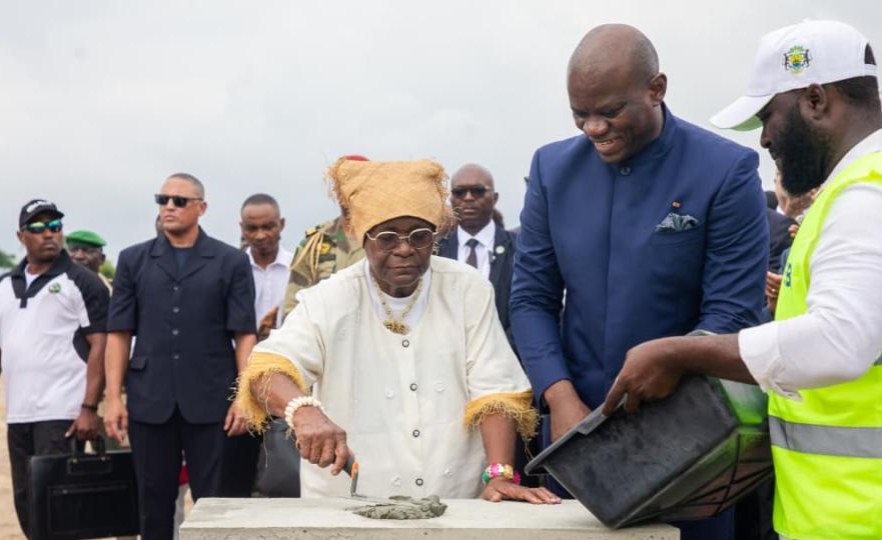
Gabon is laying the groundwork for its post-oil industrial independence. Under the decisive leadership of the President of the Republic, General Brice Clotaire Oligui Nguema, construction has officially commenced on the Kobé-Kobé deep-water port. This monumental, integrated initiative, strategically connected to one of the planet’s most significant iron ore deposits and bolstered by new railway and energy infrastructure, aims to profoundly reshape the nation’s economic growth paradigm by the year 2030.
Gabon’s Atlantic coastline is poised to become home to a premier logistical hub. Situated within the Estuaire province, the upcoming Kobé-Kobé deep-water port terminal will boast a remarkable draft of 14 to 16 meters. This impressive technical depth will enable it to accommodate very large capacity commercial vessels, significantly enhancing Gabon’s competitive edge against rival port cities in the Gulf of Guinea, such as Kribi in Cameroon or Pointe-Noire in Congo.
However, the distinctive feature of Kobé-Kobé lies in its interconnected design. This infrastructure will not operate in isolation but will serve as the crucial maritime gateway for an extensive national value chain. The industrial complex is meticulously structured around three other major undertakings:
- The exploitation of the Belinga iron ore deposit, located in the Ogooué-Ivindo province, recognized by geologists as one of the world’s most massive and yet untapped reserves of high-quality iron ore.
- The construction of an entirely new railway corridor, directly linking the mineral heartland of Belinga to the port complex in Estuaire.
- The development of the future Booué hydroelectric dam, which is essential for ensuring the energy self-sufficiency of the extractive facilities and processing plants.
This coordinated strategy seeks to break away from the historical model of an extractive rent economy by mandating local metallurgical processing before any export. The operational implementation of this pivotal hub reached a critical milestone in April 2026 with the signing of a strategic partnership agreement between the Gabonese State and the logistics behemoth, Africa Global Logistics (AGL).
Beyond its purely infrastructural aspects, authorities in Libreville present the Kobé-Kobé project as a powerful engine for social inclusion. Economic impact projections anticipate the creation of up to 160,000 direct and indirect jobs throughout the complex’s deployment and operational phases.
For Gabon’s youth, this extensive job creation represents a vital opportunity for professional integration across diverse technical sectors, including civil engineering, port logistics, energy engineering, railway maintenance, and metallurgy. The national government intends to generate a systemic ripple effect on the local private sector by actively integrating national small and medium-sized enterprises (SMEs) into the project’s subcontracting and service supply chains.
The activation of the Kobé-Kobé construction site also carries significant political and geopolitical weight. Initiated under the constitutional leadership of Brice Clotaire Oligui Nguema, this project embodies the doctrine of restoring national economic sovereignty through the reassertion of control over the nation’s critical infrastructure. For Libreville, it represents an active preparation for the gradual depletion of oil reserves, which currently underpin the state budget, by pivoting towards a sustainable mining industry. Should the project consortiums meticulously adhere to the execution timeline, Kobé-Kobé is poised to emerge as the primary driver of Gabon’s industrial transformation by 2030.



More Stories
Mamadi Doumbouya de retour à Conakry après sa visite d’État en Côte d’Ivoire
Elversberg vs Bayern Munich: where to watch the Bundesliga clash
Mali: près de 80 soldats tués dans l’attaque de Dioura