From football field to prison cell: a political heavyweight’s fall from grace
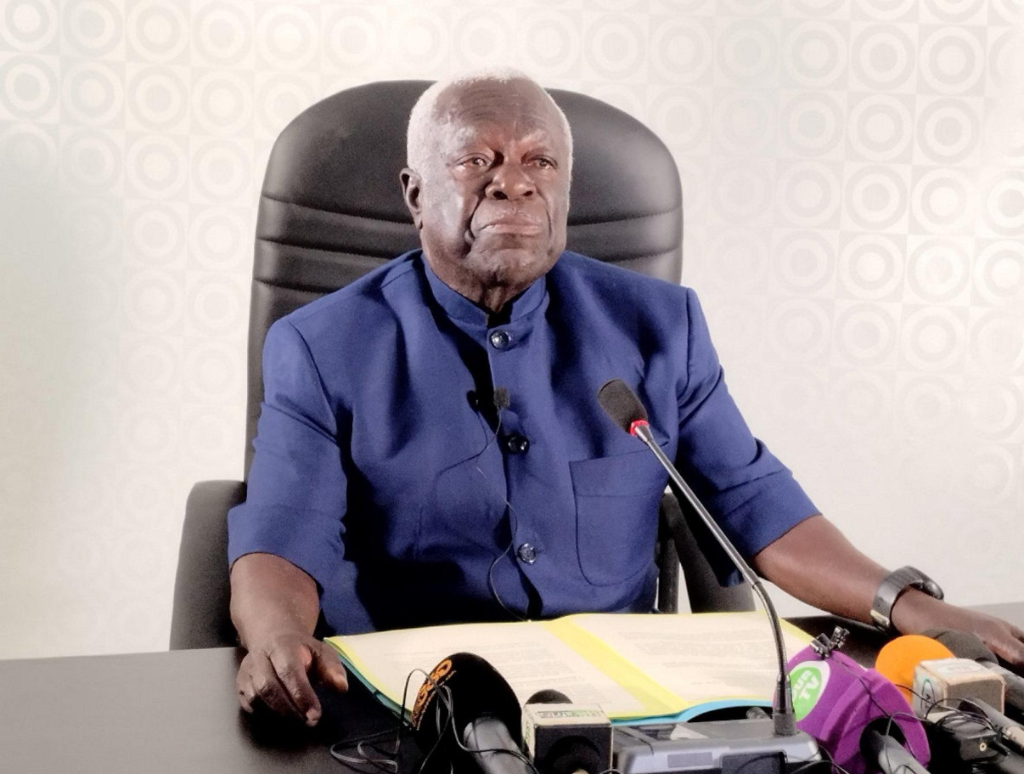
In a stunning reversal of fortune, Jean-Boniface Assélé — once a towering figure in Gabon’s political and security landscape — now faces the consequences of his actions after a tragic shooting on a Libreville football field left a 12-year-old boy fighting for his life. The former police general, multiple-time cabinet minister, and influential elder statesman has been remanded in custody awaiting trial, marking a rare moment where a high-profile Gabonese official faces accountability in the judicial system.
The incident occurred during a routine youth football match at Sibang’s Augustin-Monedan Stadium in Libreville’s sixth arrondissement. What began as an afternoon of sport turned into a national controversy when a single gunshot altered the course of the game—and multiple lives. The young victim, Jason Merlin Midioko — widely known as Dylan — remains hospitalized under critical care, his condition fluctuating as surgeons work to remove a bullet lodged near vital organs.
The gravity of this episode transcends a mere accident. It has ignited a national conversation about whether justice, long perceived as uneven, can truly reach those who once wielded unchecked power. With Assélé now behind bars at Libreville’s Central Prison in Gros-Bouquet, Gabon stands at a turning point: will this be a moment of systemic change, or another fleeting instance of high-profile accountability?
How a football match led to a judicial reckoning
On the evening of November 13, 2026, Dylan Midioko was playing football with friends on a community field adjacent to a sports complex owned by Jean-Boniface Assélé. Eyewitness accounts describe a confrontation between the former minister and the children, during which tensions escalated. According to prosecutorial sources, Assélé arrived on site in a vehicle driven by his son, armed with a 16-gauge hunting rifle.
Following an altercation, Assélé allegedly discharged his firearm once. The bullet struck Dylan, piercing his right flank with life-threatening force. What followed was not flight or concealment, but a calculated decision: the retired general voluntarily surrendered to judicial authorities less than 24 hours later.
The Public Prosecutor’s Office in Libreville opened a preliminary investigation, focusing on two primary charges: attempted murder and illegal firearm possession. As the state examines the evidence, forensic analysis and witness testimonies are being compiled to reconstruct the exact sequence of events and clarify motivations behind the discharge of the weapon.
The decision to open an information case signifies a critical shift in how Gabon’s justice system handles high-profile defendants. While some view Assélé’s surrender as an act of accountability, others question whether it reflects genuine remorse or calculated legal strategy in the face of overwhelming public pressure.
A nation watches as Dylan fights for recovery
While the legal machinery grinds forward, all eyes are on Dylan Midioko. The adolescent was rushed to the Mère-Enfant Fondation Jeanne-Ebori Hospital in Libreville, where he underwent emergency surgery. His condition, initially critical, has shown cautious improvement, though doctors report that a fragment of the bullet remains lodged near a sensitive nerve cluster, complicating recovery.
Dylan’s case has become a rallying cry online, with the hashtag #JusticeForDylan trending across Gabonese social platforms. Every day, thousands share updates on his health and demand full transparency in the prosecution of the former minister. The public’s emotional investment reflects a deeper unease: in a country where power and privilege often shield the elite, can justice ever be blind?In a symbolic gesture, President Brice Clotaire Oligui Nguema visited Dylan in hospital on November 16, pledging full state-funded support for his medical evacuation and treatment. The President’s presence underscored the case’s national significance, reinforcing a message that has resonated far beyond courtrooms: no one is above the law.
Government response and family outreach
Health and Social Affairs ministers swiftly mobilized support for Dylan and his family, coordinating with the hospital to ensure continuous, high-level care. The State has taken full responsibility for Dylan’s medical evacuation and ongoing treatment, signaling a departure from the traditional disconnect between public institutions and affected families in such cases.
Meanwhile, the Assélé family has publicly expressed regret over the shooting, though without acknowledging specific fault. Their statement called for calm and emphasized their cooperation with judicial proceedings. While such remarks are expected in high-stakes cases, they do little to assuage public skepticism regarding the family’s actual influence over the legal process.
From corridors of power to prison block: the fall of Jean-Boniface Assélé
Jean-Boniface Assélé’s life story reads like a chronicle of Gabon’s post-independence political saga. Born in 1939, he rose through the ranks of the national police force, eventually serving as its commander-in-chief. His career spanned over five decades, marked by senior ministerial portfolios under Omar Bongo’s long presidency. He also held a seat in parliament and led the liberal reform movement known as the Cercle des Libéraux Réformateurs.
As one of Gabon’s most enduring political operatives, Assélé was a bridge between the Bongo era and the new generation. His name evoked stability, authority, and statecraft. But on November 16 — just days after the shooting — the retired general was paraded before a Libréville investigative magistrate. Without ceremony or delay, he was placed under provisional detention at the Central Prison of Libreville, known as Prison de Gros-Bouquet.The court formally charged him with attempted murder and illegal firearm possession under aggravating circumstances. The charges carry potential life imprisonment, should the prosecution succeed in proving intent and criminal negligence.Yet, amid the legal storm, a fundamental question persists: could a man of Assélé’s prominence and connections have evaded justice in Gabon under different circumstances? The answer, now being tested in a court of law, may reshape public trust in the rule of law.
Breaking the wall of impunity: justice caught between reform and tradition
This case has evolved from a tragic football field incident into a defining test for Gabon’s judicial system. It comes at a time when President Oligui Nguema has repeatedly emphasized governance reform, transparency, and breaking with historical patterns of impunity. The President’s own public statement during Dylan’s hospital visit — declaring that “justice is the same for all” — was widely interpreted as a direct challenge to the old guard.
The incident has also exposed deep societal fractures. While urban centers and youth-led movements demand accountability, rural communities and traditional power networks may view Assélé’s prosecution with skepticism, seeing it as either overdue or politically motivated. The outcome of this trial will not only determine Dylan’s justice — it will signal whether Gabon is truly entering an era of equitable governance.What lies ahead: legal proceedings and national reflectionAs the investigation deepens, three key areas are under scrutiny:
- Intent and motive: Was the shooting deliberate, accidental, or a reckless act of intimidation?
- Weapon and access: How did Assélé obtain and transport a firearm classified as restricted?
- Site governance: Was the field improperly secured or used, and did negligence contribute to the tragedy?
The investigative judge now holds the delicate task of balancing thoroughness with impartiality. International observers note that while the wheels of justice have turned with unusual speed, the process must remain untainted by external influence — no matter how powerful the defendant.
For now, Dylan remains a symbol — not just of resilience, but of a nation asking itself: Can we finally demand accountability from those who once ruled above the law?
As Jean-Boniface Assélé awaits trial in his prison cell, one truth is undeniable: Gabon’s justice system has reached a turning point. Whether this momentum sustains itself will define the country’s democratic future for generations to come.
A reminder: the presumption of innocence remains
It is essential to uphold the principle of presumption of innocence. While the charges are serious and the circumstances grave, Jean-Boniface Assélé has not been convicted. His guilt or innocence will be determined through a fair, transparent trial governed by law. Until then, the integrity of the judicial process remains paramount.