
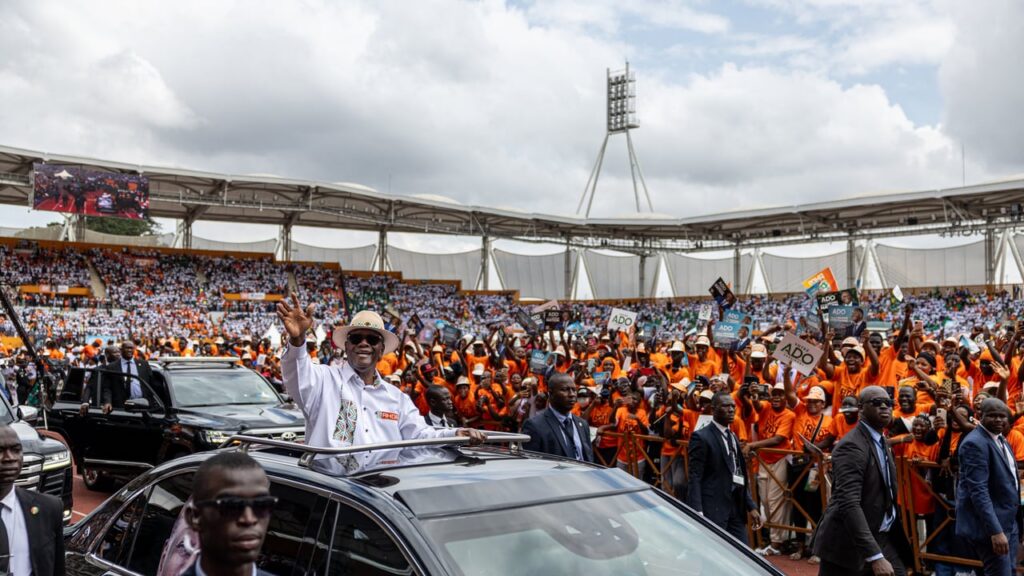
For decades, Côte d’Ivoire’s political landscape has been shaped by shifting alliances, ideological battles, and the enduring influence of historical figures. Yet few parties have left as indelible a mark on the nation’s governance as the Rassemblement des Houphouëtistes pour la Démocratie et la Paix (RHDP). Born from a merger of key political movements, the RHDP has evolved into a political machine that redefined Ivorian democracy, consolidating power through strategic leadership and electoral dominance.
The origins of a political titan
The RHDP’s foundation traces back to the vision of Félix Houphouët-Boigny, Côte d’Ivoire’s first president and a towering figure in African post-colonial politics. His legacy of stability and economic growth laid the groundwork for the party’s emergence. Decades later, the RHDP was formally established as a coalition of the Rassemblement des Républicains (RDR) and the Parti Démocratique de Côte d’Ivoire (PDCI), uniting factions that had once been rivals under the banner of Houphouët-Boigny’s ideals.
The merger was not merely a tactical alliance but a strategic consolidation of political capital. By bringing together supporters of Alassane Ouattara’s RDR and Henri Konan Bédié’s PDCI, the RHDP created a formidable force capable of navigating the complexities of Ivorian politics. This unity, though fragile at times, has been the cornerstone of the party’s resilience and longevity.
A legacy of leadership and electoral success
The RHDP’s rise to dominance began with the election of Alassane Ouattara in 2010, a pivotal moment that marked the end of a turbulent post-electoral crisis. Ouattara’s leadership, rooted in the party’s core values, brought a renewed sense of stability and progress to Côte d’Ivoire. His re-election in 2015 and 2020 further cemented the RHDP’s grip on power, demonstrating the party’s ability to maintain broad-based support across the country.
The party’s electoral success is not merely a product of charismatic leadership but also of a well-oiled political machine. The RHDP has mastered the art of mobilizing voters, leveraging grassroots networks, and adapting to the evolving demands of Ivorian society. Its ability to integrate diverse factions while maintaining a unified front has been instrumental in its sustained electoral victories.
Challenges and the future of the RHDP
Despite its dominance, the RHDP faces ongoing challenges. Internal divisions, generational shifts, and the need to address pressing socio-economic issues threaten to destabilize the party’s unity. The legacy of Laurent Gbagbo, a former president whose political career remains a potent symbol of opposition, continues to loom large, reminding the RHDP of the fragility of political power in Côte d’Ivoire.
Yet, the RHDP’s adaptability and deep-rooted support base suggest that it remains a formidable force in Ivorian politics. As the party navigates these challenges, its ability to evolve while staying true to its founding principles will determine its future trajectory. For Côte d’Ivoire, the RHDP’s story is one of resilience, transformation, and the enduring power of political vision.


More Stories
Gabon : la participation citoyenne devient un enjeu de gouvernance
Gabon : Force ouvre sa rentrée associative à Akanda sur des propositions citoyennes
Dakar 2026 : Diomaye Faye invite la jeunesse sénégalaise à incarner l’Afrique