
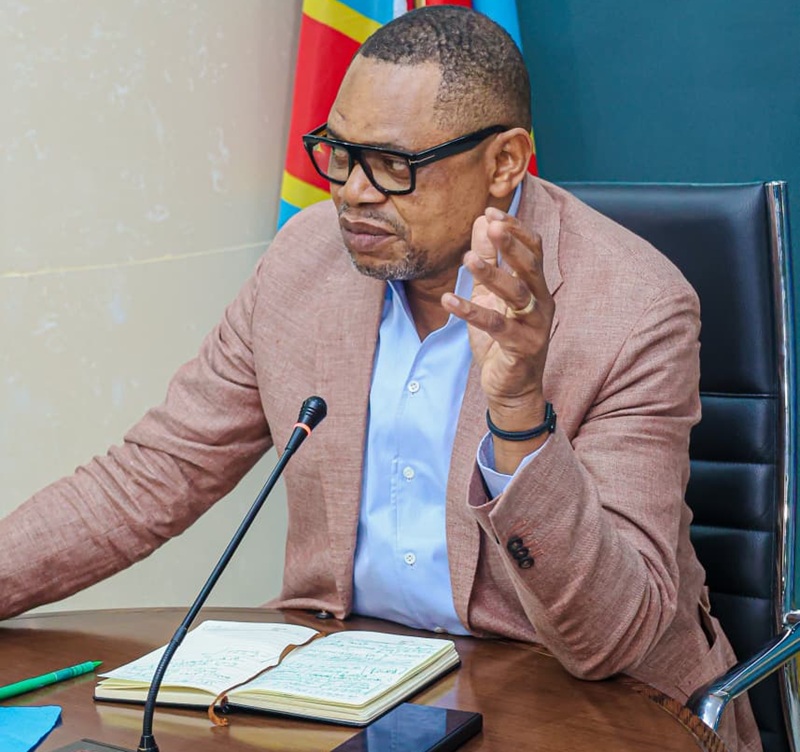
“Musuminyina katu wabula” – a Luba proverb meaning “he who perseveres always gets what he wants.” And Me José Mpanda Kabangu, the minister of Posts and Telecommunications, embodies this spirit. He is determined to achieve what he could not secure during his first tenure as minister of Scientific Research and Technological Innovation in September 2019: equipping the Democratic Republic of Congo with its own sovereign satellite.
On Friday, June 5, 2026, José Mpanda Kabangu took a decisive step by granting an audience to a Chinese delegation from China Unicom and Genew Technologies. The discussions focused on constructing a sovereign satellite for the DRC and deploying fiber-optic infrastructure nationwide. This meeting followed up on the minister’s mission to China in April 2026.
Alongside the Chinese firms, experts from several Congolese institutions participated: the General Secretariat of PTNTIC, the Regulatory Authority for Posts and Telecommunications of Congo (ARPTC), the Congolese Fiber Company (SOCOF), the National Telecommunications Satellite Network (RENATELSAT), the National Remote Sensing Center (CNT), as well as senior advisors to the Presidency and the Prime Minister’s office in charge of PTNTIC.
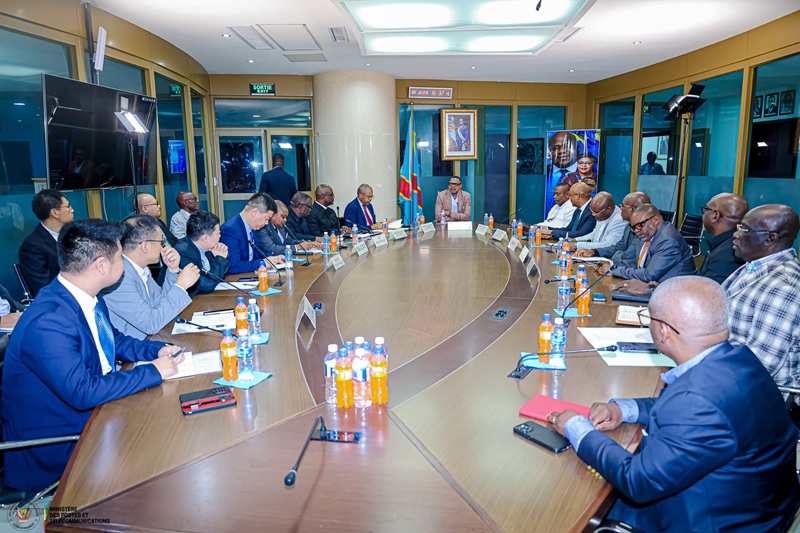
The minister explained that his trip to China was a political mission to seek solutions for his country, but the real technical discussions needed to be handled by domain experts. That explains why the two Chinese firms sent their representatives to Kinshasa, where they will stay until June 19, holding talks with Congolese experts on two flagship projects: the sovereign satellite (for which a memorandum of understanding was signed in April 2026) and the national fiber-optic backbone (whose agreement revision took place in 2025).
The exchanges, which began on Monday, June 8, pursue three objectives:
1. Technical and financial structuring
Validating the technical architecture of both projects, estimating costs, and finalizing financing arrangements with the ministries of Planning and Finance.
2. Consultation and institutional alignment
The two Chinese firms formally notify and present to stakeholders: RENATELSAT, SCPT, SOCOF, CNC, CNT, SG PTNTIC, ARPTC, the Presidency, and the Prime Minister’s office.
3. Preparing the due diligence mission to China and next steps
Defining the scope and timetable, selecting Congolese delegates and sites to visit, producing deliverables before departure, and identifying post-due-diligence milestones.
Minister José Mpanda expects four results from these discussions:
- Validated technical solutions
- Finalized financing approach
- Aligned stakeholders
- Scheduled due diligence mission
The Congolese institutions involved in this initiative include the Presidency, the Prime Minister’s office, the Ministry of Posts and Telecommunications, the Ministry of Planning, the Ministry of Finance, the Ministry of Infrastructure, the Ministry of Mines, and the National Cyber Defense Council (CNC), with technical entities such as the General Secretariat of PTNTIC, ARPTC, FDSU, SOCOF, SCPT, RENATELSAT, and CNT.



More Stories
Mamadi Doumbouya de retour à Conakry après sa visite d’État en Côte d’Ivoire
Elversberg vs Bayern Munich: where to watch the Bundesliga clash
Mali: près de 80 soldats tués dans l’attaque de Dioura