
Gabon’s economic strategy, aimed at delivering concrete results, appears to be paying off. The country has set its sights on becoming a mining and industrial hub in central Africa by 2030, and it is thinking big. Just over a month after signing a strategic agreement with Africa Global Logistics (AGL) for the Kobe-Kobe project, the government is also prioritising the development of national infrastructure.
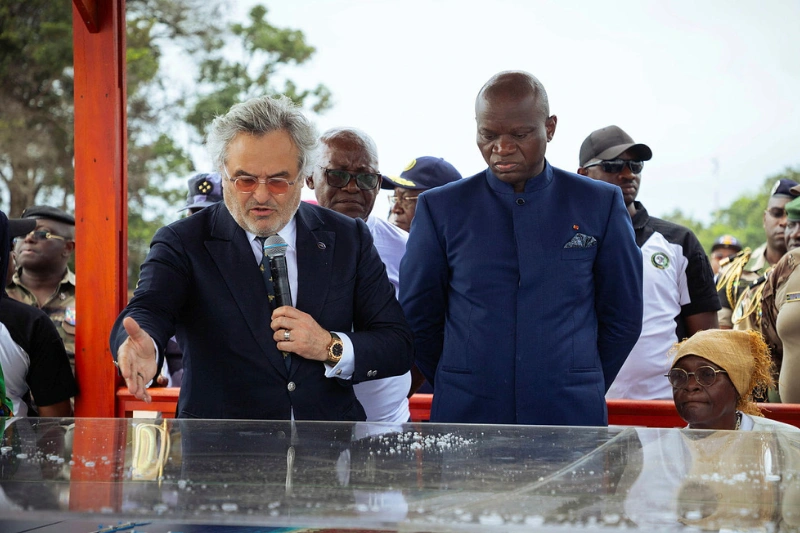
Determined to move from plans to action, President Brice Clotaire Oligui Nguema on Monday 8 June 2026 officially launched the construction of the Kobe-Kobe deep-water port with a cornerstone-laying ceremony.
This ambitious project will include a mineral terminal, a multipurpose and mineral quay, a railway loop, a residential zone, a cargo storage area, and office facilities. Through this integrative initiative, Gabon reaffirms its ambition to process its raw materials locally. In practice, this economic sovereignty is being built with international economic partners from all five continents. Each partner has a role to play: mining, iron, processing plants, and so on. The idea is to ensure cohesion in the work carried out. “Everyone must work and deliver results,” the head of state emphasised.
“Today, we are not just launching an infrastructure project. We are laying the foundations for a new development model based on industrialisation, local value creation, territorial integration, and Gabon’s logistical sovereignty. Your ambition is clear: to make Gabon a key player in regional logistics and a strategic hub in central Africa. That ambition is now taking concrete shape,” said the Minister of Transport and Merchant Marine, Ulrich Manfoumbi Manfoumbi.
This project is among the five largest mining projects globally. In his speech, Philippe Labone, AGL’s managing director, indicated that “exports from the Kobe-Kobe port will begin in April 2031.”
In detail, the railway corridor supporting the project will span nearly 550 km, linking production sites to the port complex with an estimated travel time of about eight hours.
Studies have already been launched, and AGL stated that young Gabonese will be sent for training to be at the heart of this process.
In figures, more than 100,000 jobs are expected, a more than 50% increase in gross domestic product (GDP), and an annual value forecast to exceed $10 billion per year.

More Stories
Is Chad truly heading towards political appeasement?
Bradley Barcola will adapt faster than Florian Wirtz at Liverpool, says Jermaine Pennant
Togo eyes nuclear power to secure future energy sovereignty