
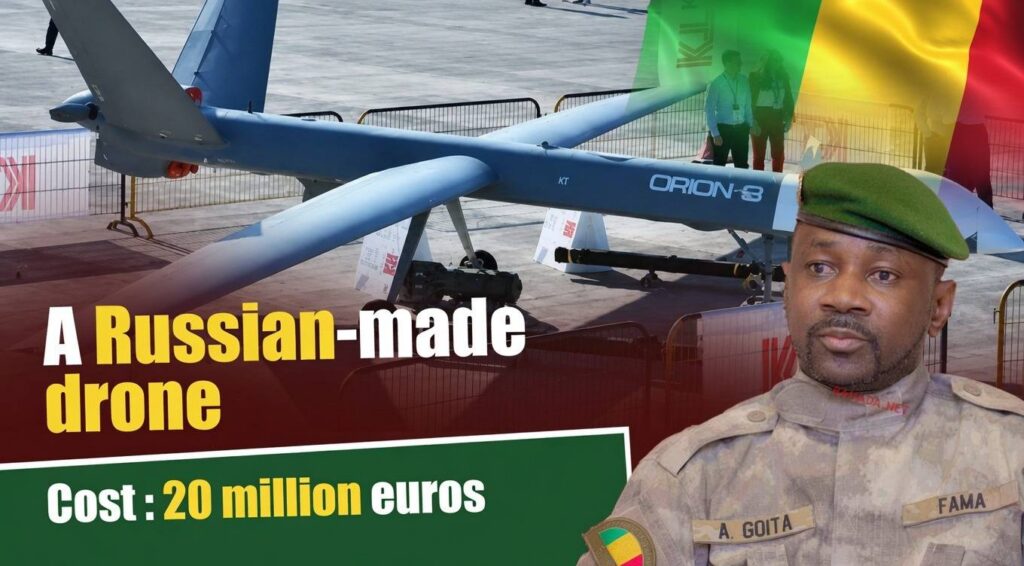
Bamako’s new military acquisition: a Russian Orion drone at a steep price
In its quest to bolster aerial capabilities, Bamako has recently taken delivery of a Russian-made reconnaissance and attack drone, the Orion. While transitional authorities hail this as a milestone in territorial reconquest, military experts are raising serious concerns. Between technical mismatches with asymmetric warfare and a potential financial sinkhole, the drone’s real-world impact remains uncertain.
A strategic partnership with Moscow yields a costly addition to Mali’s fleet
The Malian Armed Forces (FAMa) have welcomed a new member to their ranks: the Orion drone, a flagship of Russian aeronautical technology. Classified as a MALE (Medium Altitude Long Endurance) system, this aircraft is designed for prolonged surveillance and precision strikes. Its arrival follows years of equipment deliveries from Russia, reinforcing Bamako’s military ties with Moscow.
Proponents of the current military strategy argue that this acquisition symbolizes Mali’s growing military autonomy and its desire to move beyond Western influence. The Orion is touted as an ideal tool for monitoring the country’s vast desert expanses. Yet beneath the official celebrations, the harsh realities of the drone’s capabilities and Mali’s operational needs demand a far more critical examination.
The Orion’s fatal flaw: visibility in asymmetric warfare
Mali’s conflict is defined by asymmetric warfare, where the enemy consists of mobile, elusive terrorist groups rather than conventional armies. Here lies the Orion’s most glaring weakness: its high acoustic signature. The drone’s loud operational noise makes it detectable long before it reaches its target area. For terrorists accustomed to blending into terrain and using natural cover, this sound is an early warning, giving them time to disperse or camouflage themselves.
Additionally, the belief in total air superiority is dangerously misplaced. Armed groups in northern and central Mali have demonstrated their ability to acquire and deploy anti-aircraft systems capable of targeting low- and mid-altitude aircraft. A large, slow-moving drone like the Orion becomes an easy target for MANPADS (Man-Portable Air-Defense Systems) or concentrated gunfire. The risk of losing this single asset to enemy fire is alarmingly high.
A €20 million gamble: investment or financial misstep?
The drone’s price tag—nearly €20 million (over 13 billion CFA francs)—has sparked intense debate among economic and military analysts. In a country grappling with budget constraints and pressing social needs, such an expenditure raises serious questions. Many experts argue that this single purchase is not just a poor investment but a misuse of public funds. The same budget could have secured an entire fleet of lighter, quieter, and more deployable tactical drones. By prioritizing a high-profile but impractical asset, Bamako may have favored political symbolism over tactical necessity.
One drone, one blind spot: the illusion of coverage across Mali’s vast terrain
Mali is a sprawling nation where large swathes of territory remain beyond state control, held hostage by terrorist groups. From the remote edges of Taoudénit to the forests of Kayes, threats are scattered and unpredictable. The limitations of this purchase are glaring: a single drone cannot cover the entire country. Despite its endurance capabilities, the Orion cannot be everywhere at once. While it patrols Gao, Tombouctou or Mopti may slip into darkness. Without a rotation of multiple aircraft, the Malian sky will remain empty whenever the Orion is grounded for maintenance or refueling, leaving the door open for enemy movements.
The hidden costs: infrastructure, maintenance, and operational dependence
The €20 million price tag is merely the beginning. Operating an Orion-class drone demands a heavy and continuous financial commitment that extends far beyond the initial purchase. Ground infrastructure is the first hurdle: sophisticated control stations, climate-controlled shelters to protect sensitive electronics from Sahelian heat, and dedicated landing strips are all essential. Ongoing expenses include specialized fuel, imported spare parts from Russia, and guided munitions—all of which drive costs higher still. Maintenance and technical expertise pose additional burdens, as Malian personnel must be trained, often requiring Russian contractors to remain on-site at great expense.
Without a steady financial stream to sustain these needs, the Orion risks becoming a grounded technological relic, a costly monument to poor strategic planning rather than a tool of defense.
A symbol of over-equipment or a step toward security?
The arrival of the Orion drone reflects Mali’s visible efforts to modernize its armed forces, yet it also exposes the pitfalls of a strategy fixated on prestige acquisitions. In a conflict defined by mobility and surprise, relying on a single, cumbersome, and exorbitantly priced aircraft is an inadequate response. To achieve lasting security, Mali’s military needs not high-cost symbols but a network of agile, discreet, and economically sustainable assets capable of sustained operations.




More Stories
Mamadi Doumbouya de retour à Conakry après sa visite d’État en Côte d’Ivoire
Elversberg vs Bayern Munich: where to watch the Bundesliga clash
Mali: près de 80 soldats tués dans l’attaque de Dioura