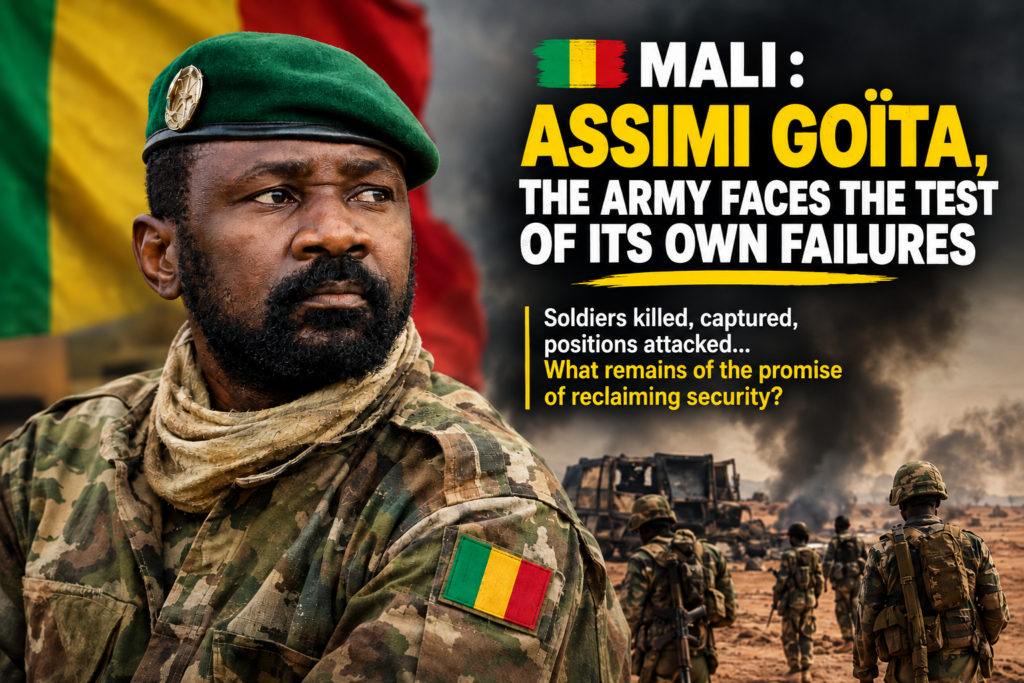
Behind the bold rhetoric emanating from Bamako, the Malian military’s recent battlefield losses reveal a deeper crisis one that transcends the courage of individual soldiers. The defeats at Dioura, Tabrichat, and Kati in 2026 have exposed systemic flaws in strategy, intelligence, and command, raising critical questions about the sustainability of Assimi Goïta’s security doctrine.
The Dioura catastrophe: more than a numerical loss
On September 10, 2026, the military camp at Dioura became the focal point of a devastating assault attributed to the Jama’at Nusrat al-Islam wal Muslimin (JNIM). While official reports confirmed the deaths of over 100 Malian soldiers and five Russian contractors from Africa Corps, the attack’s broader implications were equally alarming. The loss of the camp, alongside the capture of soldiers and the seizure of weapons and equipment, constituted a strategic failure of significant proportions. Independent verification of casualty figures remains elusive, but the operational and symbolic damage is undeniable.
Tabrichat’s ambush: intelligence and preparation in question
Less than two months prior, on July 18, a Malian military convoy en route to Anéfis was ambushed near Tabrichat. Reports, including evidence analyzed by human rights organizations, documented the execution of at least 19 captured soldiers a possible war crime. The army’s acknowledgment of the attack and its claim of a successful aerial intervention underscore a glaring vulnerability: the inability to protect forces during transit, a fundamental requirement for any operational strategy.
Kati and the audacity of assaults on Mali’s heartland
The April 25, 2026, coordinated attacks by JNIM and the Front for the Liberation of Azawad (FLA) targeted key military and civilian hubs, including Kati, Bamako, Gao, Mopti, and Sévaré. The assassination of Defense Minister Sadio Camara at his residence in Kati a city synonymous with military power sent a chilling message. The assaults demonstrated not only the militants’ operational reach but also the alarming gaps in intelligence and perimeter security around the capital’s critical installations.
Why the soldier cannot bear the weight of strategy
The narrative often shifts blame to frontline troops for their supposed lack of resolve. Yet the evidence suggests a more complex narrative. Captured soldiers, abandoned equipment, and failed evacuations point to systemic issues: inadequate intelligence, flawed logistics, and a command structure ill-prepared to adapt to evolving threats. These are not failures of individual bravery but of institutional design.
The fallacy of strategic reassurance: alliances and unmet promises
Since seizing power in 2020 and 2021, Assimi Goïta’s administration has positioned military sovereignty as a cornerstone of its legitimacy. The pivot toward Russian cooperation and the Africa Corps contingent were framed as remedies to prior vulnerabilities. However, 2026’s escalating violence even amid shifting alliances has rendered these reassurances hollow. The Sahel’s jihadist insurgency, far from abating, has intensified, challenging the efficacy of Bamako’s new security partnerships.
The unanswered question: can an army protect its own?
A military’s strength is measured not just by its arsenal or rhetoric but by its ability to safeguard its personnel. Dioura’s siege, Tabrichat’s ambush, and Kati’s assaults reveal a troubling pattern: forces left exposed, convoys vulnerable, and soldiers abandoned. The recurring losses force a reckoning. Is the current strategy fundamentally flawed, or are its architects failing to implement it effectively? The answer demands scrutiny beyond slogans a closer look at the decisions that leave soldiers as pawns in a larger, unmet campaign for security.
The human toll: why the cost extends beyond casualties
Every fallen soldier, every captured fighter, and every abandoned camp carries consequences that ripple through Malian society. Families grieve, communities lose faith, and the economy bears the strain of prolonged instability. The strategic missteps of 2026 have not only eroded military credibility but also deepened the broader crisis of trust in the state’s ability to ensure safety. The question now is whether lessons will be learned or if the cycle of loss will continue.
By Yacouba Boukari — Analyst


More Stories
Behind the legacy: how Abdoulaye Koné shaped Ivory Coast’s economic backbone
Niger’s August crisis: how Tiani’s reliance on Russia exposed deeper fractures in the military
Peering behind the curtain: how Benin’s CCI budget 2027 reshapes local economies