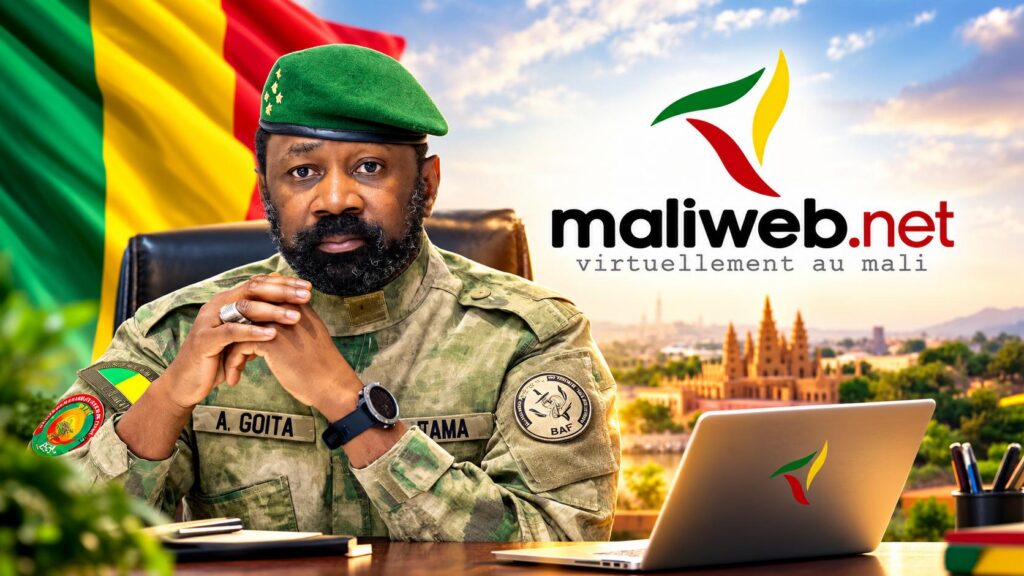
In Mali’s febrile media ecology, the line dividing verifiable war reporting from state-issued propaganda has not merely blurred—it has been systematically erased. At the eye of this storm sits Maliweb.net, a once-pluralistic news aggregator that has quietly metamorphosed into the government’s favored megaphone, recasting battlefield realities into tailor-made morale tales while airbrushing human cost.
The September 15 inflection point: when communiqués replaced corpses
On September 15, 2026, credible field sources and multiple observer networks documented heavy clashes in Dioura and Mondoro that left more than 150 Malian soldiers dead and dozens in militant captivity. Yet the version that reached readers via Maliweb.net omitted every trace of tragedy. Instead, the portal recycled the Armed Forces General Staff’s bulletin—unchallenged and unedited—spinning the episode as a heroic counter-offensive rather than a catastrophic failure.
From watchdog to loudspeaker: the mechanics of systematic distortion
The site’s pivot from neutral relay to state amplifier is not accidental; it operates through a set of repeatable distortions:
- Institutional echo chambers: Ninety percent of security coverage now mirrors verbatim releases from the military’s Directorate of Information and Public Relations (DIRPA) or government mouthpieces, leaving no space for cross-verification.
- Casualties erased from the count: Fatality figures on the Malian army side are routinely downplayed or entirely omitted, fostering the illusion of flawless operational performance.
- Dissent framed as betrayal: Any independent attempt to reconcile conflicting accounts is swiftly labeled “defeatist” or “subversive,” effectively muzzling scrutiny and stifling debate.
Democracy’s silent casualty: the asphyxiation of public debate
By abdicating the journalist’s duty to verify, contextualize, and balance, Maliweb.net no longer simply transmits official narratives—it manufactures consent. For Malian citizens, the quest for an unvarnished picture of the war is now a labyrinth of filtered pronouncements, where real casualties vanish behind polished communiqués and strategic missteps are rebranded as victories. The result? A steadily eroding trust in local media and a society deprived of the factual ground needed to navigate a war whose human toll remains largely invisible.
The way forward: restoring the public’s right to unfiltered truth
If Maliweb.net’s trajectory encapsulates a broader crisis, it also flags a path back to credibility. Returning to core editorial values—rigorous cross-checking, transparent sourcing, and open acknowledgment of setbacks—would reopen the oxygen valve that today’s suffocating information climate has nearly sealed. Until then, the site’s pages will continue to read less like news and more like scripted stage directions for a war that the public is no longer permitted to witness firsthand.

More Stories
Senegal’s palm oil revival: how Jakarta’s expertise could end a decade of stagnation
Behind the scenes: how Gabon is reshaping EU fishing talks for stronger sovereignty
Cotonou’s hidden savings: how west African households can power local financial independence