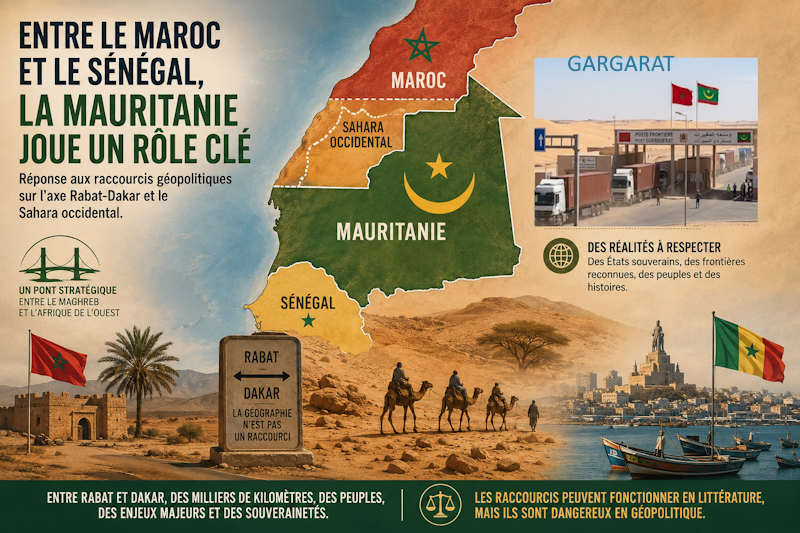

A late July 2026 diplomatic flare-up in Dakar has thrust Mauritania’s delicate balancing act over the Western Sahara question back into the spotlight. Between declared “positive neutrality,” economic imperatives, and the preservation of its own sovereignty, Nouakchott’s carefully calibrated ambiguity has become its signature diplomatic move—one designed to avoid offending Morocco.
Diplomatic fireworks in Dakar
An explosive moment during a Moroccan embassy reception in Dakar laid bare the simmering tensions across the region. Former Senegalese foreign minister Cheikh Tidiane Gadio ignited controversy by suggesting that, in Senegalese collective memory, Morocco lay “just a few kilometers away”—a veiled reference to pre-colonial borders. The remark immediately drew sharp rebuke from Mauritania’s ambassador, Mohamed Ould Abdellahi Ould Ethmane, who cut short the speech and accused Gadio of historical revisionism that erases Mauritania’s very existence.
Though Moroccan ambassador Hassan Naciri quickly stepped in to calm the waters, the incident revealed the razor-thin line Mauritania walks. The country found itself defending its attendance at an event celebrating Morocco’s claim to Western Sahara while insisting on strict neutrality in a decades-old conflict.
Gadio’s remarks kept the debate burning in Mauritania, where former foreign minister Isselmou Ahmed Izidbih took to social media to demand the former diplomat be declared persona non grata in Mauritania’s airspace, territorial waters, and on its soil.
Walking the diplomatic tightrope
This Dakar episode captures the contradictions inherent in Mauritania’s official stance. Officially, Nouakchott recognized the Sahrawi Arab Democratic Republic (SADR) back in 1984, maintains regular contact with the Polisario Front, and carefully avoids alienating Algeria—a key security partner to the north.
Yet Mauritania stops short of granting the SADR diplomatic status in Nouakchott, a major concession to Rabat, which views any recognition of the SADR as grounds for war. By attending Moroccan state ceremonies, Mauritania signals respect for its northern neighbor, provided Morocco does not revive even indirectly the old concept of a “Greater Morocco” that once included Mauritanian territory.
Guerguerat: the economic lifeline
Beyond symbolism, Mauritania’s actions are guided by hard-headed economic pragmatism. The Guerguerat border crossing, where Moroccan-controlled territory meets Mauritania, has become the region’s economic jugular.
Every day, hundreds of Moroccan trucks pass through Guerguerat, supplying Mauritanian, Senegalese, and Malian markets with food and manufactured goods. Nouakchott has no incentive to block this flow, which fuels its economy and stabilizes supplies. By keeping its border open, Mauritania tacitly endorses Morocco’s operational control over the area without ever recognizing it legally.
Ambiguity as survival strategy
For regional observers, Mauritania’s “both-and” policy is no indecision—it is a survival tactic. Sandwiched between an economically expansionist Morocco and an Algeria protective of its geopolitical interests, Mauritania cannot afford to pick a side without risking economic retaliation or border instability.
The clash sparked by Cheikh Tidiane Gadio’s words simply underlines how inflammable this neutrality remains. Whenever Mauritania’s national identity or territorial integrity appears threatened by its neighbors’ ambitions, Nouakchott swiftly abandons its reserve to remind everyone that it remains the indispensable—and sovereign—linchpin of Maghreb stability.

More Stories
Mali’s war of narratives: how a once-neutral news site became a megaphone for official military spin
Senegal’s palm oil revival: how Jakarta’s expertise could end a decade of stagnation
Behind the scenes: how Gabon is reshaping EU fishing talks for stronger sovereignty