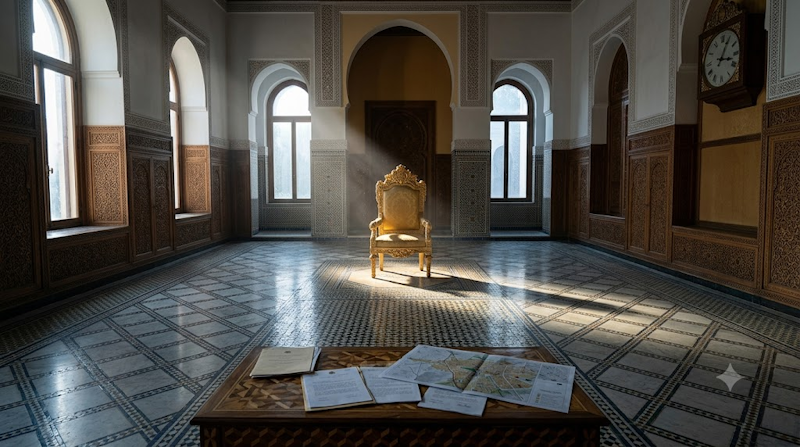
King Mohammed VI’s speech on the occasion of his 27th anniversary as king has been hailed as a major policy text, synthesizing two decades and a half of national strategy while hinting at the contours of the post-2026 era. Marked by a tone of ‘confidence and optimism’ in the face of regional instability, he asserts a continuity and stability of institutions as ‘strategic capital’ of the Kingdom.
However, behind this veneer of success, the speech opens up a question on the responsibility of governance, leaving an interrogatory air on the handling of accumulated failures.
The King has made it clear that he has never sought personal glory, but has always been concerned with fulfilling his duties to the best of his ability. He attributed the successes of the Kingdom to a ‘clear vision strategy’ and rigorous governance follow-up.
The economic balance sheet presented is substantial. The King highlighted a 4.9% growth rate in 2025, the Kingdom’s position as Africa’s top automobile exporter, or the remarkable performance of tourism with over 20 million visitors. He stressed that these ‘achievements transcend government and parliamentary mandates’, presenting them as the fruit of major choices and a ‘cumulative virtuous dynamic’ not inherent to any single executive.
But it is precisely this point that fuels political reflection. By attributing success to a clear vision strategy, the logic of the speech erects responsibility at the top of the state. In consequence, analysts ask: if the strategy is the mother of successes, how can we explain the persistence of ‘difficulties and constraints’ or social challenges after 27 years of the same vision?
The text stresses stability and institutional efficiency. It calls for cohesion and a shared sense of responsibility among institutions. However, this holistic view of power makes it difficult to confine failures within the realm of ‘governmental stories’ when successes are attributed to national scales. The King himself has evoked an ‘autocritique constructive’ as a pillar of his doctrine, but that remains implicit in the public account.
The speech does not close this debate; it opens it up by announcing a new cycle following elections. This cycle will be marked by the ‘preservation of achievements’ and the pursuit of reforms, confirming the current direction rather than introducing a rupture.
In conclusion, Mohammed VI’s speech appears as a text of consolidation of his political legitimacy. By claiming confidence for the future while appropriating the narrative of the past, it leaves hanging, for the political scene and media, the question of the accountability of 27 years of his reign.