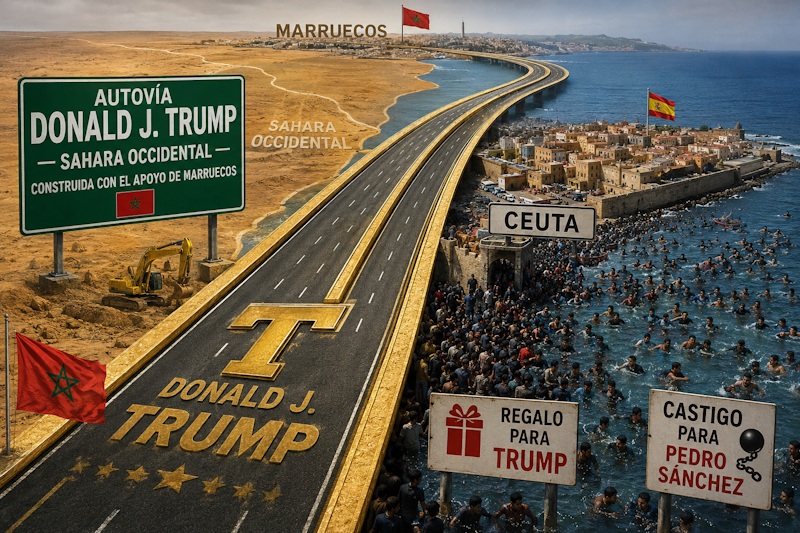
With a highway bearing his name and a sudden migration surge at Spain’s borders, Morocco is deploying a multi-pronged diplomatic offensive to secure Washington’s backing for its Western Sahara claims.
Rabat is leveraging two distinct yet interconnected strategies this summer. First, a symbolic gesture: the 1,055-kilometer Tiznit-Dakhla highway, Africa’s longest road infrastructure, was renamed in honor of former U.S. President Donald Trump. Second, an abrupt migration crisis at the Spanish enclave of Ceuta, where nearly 60,000 people crossed the border in hours, leaving at least 57 dead.
Symbolic homage meets geopolitical calculation
The highway dedication reflects more than ceremonial flattery. King Mohammed VI framed the renaming as a tribute to Trump’s 2020 recognition of Morocco’s sovereignty over Western Sahara—a move that followed the U.S. president’s earlier decision to recognize Moroccan claims. The road, which stretches from southern Morocco to Dakhla via Laâyoune in Western Sahara, serves as a strategic corridor connecting Europe to Africa and reinforcing Morocco’s territorial narrative.
Trump responded swiftly on Truth Social: « What a tremendous honor! I look forward to driving this great highway someday—hopefully soon! »
Ceuta: the human pressure tool in Morocco’s diplomacy
The migration crisis at Ceuta, however, is where Rabat’s strategy becomes more assertive. Within days, 60,000 migrants surged into the Spanish enclave, triggering a humanitarian and political emergency. Official Spanish figures reported 57 fatalities from drowning or trampling, though Morocco acknowledged only 11 deaths—acknowledging limited involvement of its border guards.
Ceuta, one of the EU’s two land borders with Africa, has long been a flashpoint in Moroccan-Spanish relations. Rabat has never recognized Spanish sovereignty over Ceuta and Melilla, viewing them as « occupied territories ». Analysts see the timing as deliberate: the surge followed Spanish Prime Minister Pedro Sánchez’s visit to Algiers, where Madrid sought to improve ties with Morocco’s regional rival.
Echoes of a familiar playbook
This is not the first time Morocco has used migration as leverage. In May 2021, a similar influx of 8,000 migrants forced Spain to shift its stance on Western Sahara, abandoning its historical neutrality after hosting Polisario leader Brahim Ghali for medical treatment.
« Morocco believed Spain supported its autonomy plan for Western Sahara, but that wasn’t enough. It wants full recognition of its sovereignty, » noted Carlos Ruiz Miguel, director of the Western Sahara Studies Center at the University of Santiago de Compostela.
A three-pronged diplomatic offensive
Analysts describe Morocco’s approach as a sophisticated blend of symbolism and pressure:
- Symbolic diplomacy: The Trump highway serves as tangible gratitude to Washington, reinforcing U.S. backing for Morocco’s territorial claims.
- Migration leverage: The Ceuta border crisis pressures Spain by exposing its vulnerability at one of Europe’s most contested borders.
- International support: Rabat seeks to secure U.S. endorsement in stalled UN negotiations over Western Sahara.
Washington’s unequivocal backing
U.S. support for Morocco has been unambiguous. Secretary of State Marco Rubio reiterated Washington’s stance: « The United States recognizes Moroccan sovereignty over Western Sahara. » Trump himself called Morocco’s autonomy proposal « the only basis for a just and lasting solution, » dismissing other paths as « unacceptable prolongations of the status quo. »
Washington has also criticized Spain’s migration policies, with a White House spokesperson warning that Spain risks « compromising its own survival » through its handling of the crisis.
Europe’s Schengen tremors
The Ceuta crisis has sent shockwaves across the European Union. Italy suspended Schengen agreements with Spain temporarily, joined by Finland and Denmark. Belgian MR party leader Georges-Louis Bouchez even called for a partial suspension of Spain from the Schengen Zone.
« Morocco has shown it will deploy migration pressure as a tool of retaliation against Spain, especially given its two North African enclaves, » observed Paul Melly, a researcher at Chatham House.
A clear message to Madrid and Brussels
While the Trump highway does not physically enter Ceuta, its symbolic weight and timing send a powerful message: Morocco holds the keys to Europe’s southern frontier. By intertwining symbolic diplomacy with hardline migration tactics, Rabat is weaving a strategy designed to strengthen its position in Western Sahara negotiations—a lesson not lost on Spanish or European policymakers.

More Stories
Unpacking the surge: why Nigeria’s farmer-herder clashes are driving 600 refugees into Cameroon’s Northwest
Why Paris Saint-Germain’s midfield dominance sank Marseille in Ligue 1
Niger’s general Tiani: from coup architect to prisoner of his own army