Deadly ambushes expose the fragility of Niger’s security transition
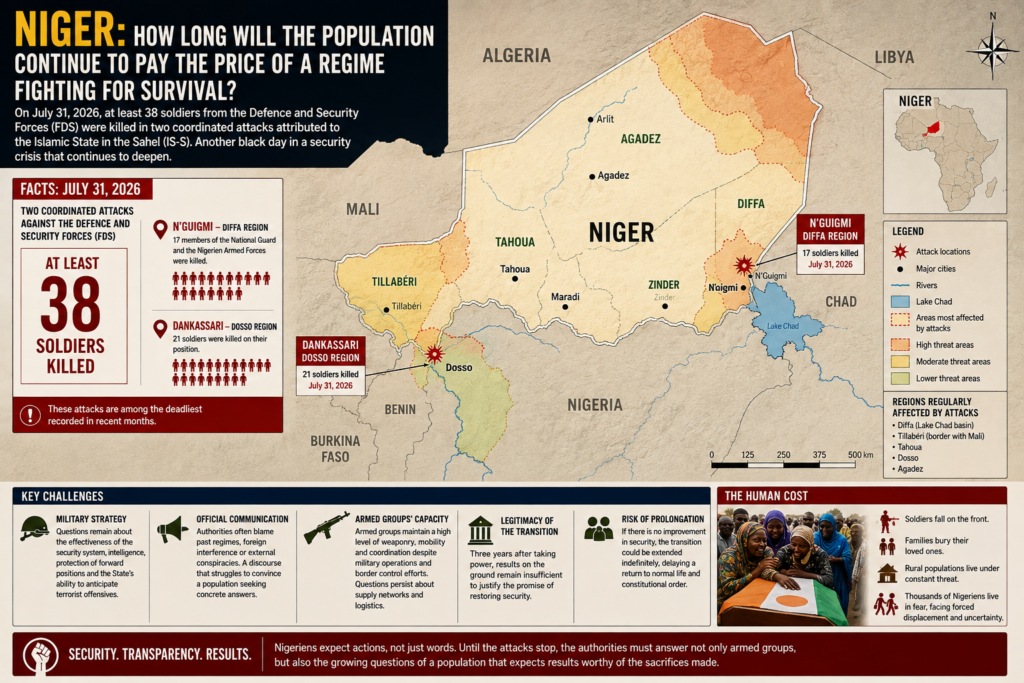
The final day of July 2026 will be etched in Niger’s recent history as one of its darkest. Military sources confirm that coordinated assaults by the Islamic State in the Sahel (IS-Sahel) claimed the lives of at least 38 soldiers from the country’s defense and security forces (FDS).
The first attack unfolded in N’Guigmi, within the Diffa region, where 17 members of the National Guard and Nigerien Armed Forces perished. Hours later, a second strike in Dankassari, Dosso region, resulted in 21 more fatalities among military personnel stationed there. These incidents rank among the deadliest in recent months, underscoring a grim trend: terrorism continues to expand its reach while civilian and military casualties mount.
A security vow tested by relentless violence
When General Abdourahamane Tiani led the coup in 2023, the primary justification was the urgent need to halt the country’s spiraling insecurity—a situation authorities claimed had spiraled beyond control under civilian leadership. The military’s pledge was unambiguous: reclaim territorial control, dismantle armed groups, and safeguard the population.
Three years on, the reality contrasts sharply with those promises. Attacks persist across the Lake Chad basin and regions such as Tillabéri, Tahoua, and Dosso. Armed factions continue to execute sophisticated, coordinated strikes on military outposts, despite repeated assurances of force reorganization and enhanced counterterrorism measures.
Strategic shortcomings under scrutiny
Each deadly assault raises pressing questions about military strategy, intelligence gathering, and the state’s ability to preempt terrorist offensives. The mounting frequency of these attacks has sparked public skepticism regarding the transition’s security-focused agenda.
Critics argue that the resources and attention devoted to consolidating political power may be diverting focus from the urgent demands of the battlefield. For a transitional government whose legitimacy hinges on restoring stability, tangible results in security are no longer optional—they are a necessity.
Official narratives fall short of addressing public anger
Following each attack, authorities frequently cite inherited challenges from prior regimes, external interference, or geopolitical complexities as contributing factors. While these elements may play a role in a broader regional conflict, they do little to address the immediate concerns of affected families and communities.
Bereaved relatives demand accountability for operational failures, clear corrective measures, and concrete steps to prevent future tragedies. Without visible progress on the ground, the government’s messaging risks eroding public trust.The war’s escalating stalemate
A particularly troubling aspect of the crisis is the sustained operational capacity of armed groups. Despite intensified military operations and border control efforts, these factions continue to launch large-scale attacks with alarming regularity. This persistence has fueled speculation about the effectiveness of counter-arms trafficking measures, terrorist logistics networks, and intelligence-sharing mechanisms.
With limited public transparency, rumors thrive, further deepening the rift between citizens and state institutions.A transition at risk of losing its mandate
The military government’s core justification for its rule remains its pledge to restore security. Yet, as attacks multiply, that promise increasingly clashes with reality. The prolonged instability not only delays any return to constitutional order but also exacerbates the suffering of local communities, many of whom live under constant threat of violence or displacement.
Analysts warn that the absence of visible improvement in security could prolong the transition indefinitely. Resolving this impasse will require not just rhetoric, but demonstrable progress, transparency, and a credible roadmap for crisis resolution.
The human cost of an unending crisis
Beyond the political and strategic debates, the most devastating consequence of this prolonged insecurity is the human toll. Soldiers continue to die in combat, families mourn their losses, and rural populations endure daily threats from armed groups. For thousands of Nigeriens, life remains a cycle of fear, forced displacement, and uncertainty.
The security pledge that once justified the military’s takeover remains unfulfilled. Until the attacks cease and meaningful protection is restored, the authorities will face mounting pressure—not only from armed factions but from a population that has sacrificed far too much for far too long.


More Stories
Behind the Molodo ambush: how Mali’s junta’s Russian gamble unraveled
Russia’s 2026 parliamentary vote: a landslide masked by a locked political arena
Behind the Moscow drone strikes: how Ukraine exposed Russia’s hidden vulnerabilities