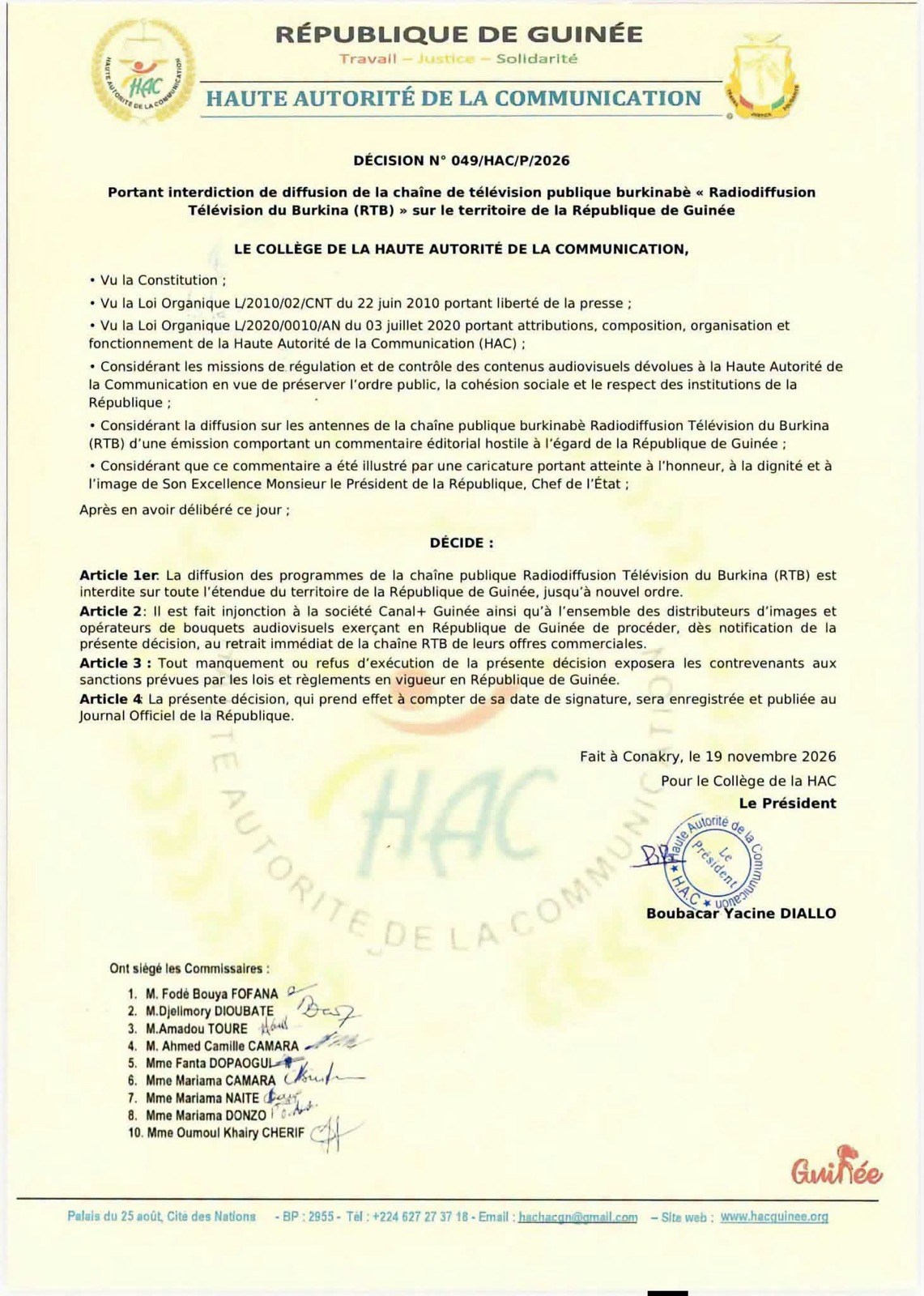
The suspension of Burkina Faso’s public broadcaster, the Radiodiffusion Télévision du Burkina (RTB), across the entire territory of Guinea marks a decisive turning point in how state-run media are perceived across West Africa. This bold administrative decision by the Guinean High Authority for Communication (HAC) signals a fundamental shift in expectations for public broadcasters, demanding that their primary allegiance remain to the citizenry rather than political agendas.
Beyond the ban: a critical moment for public broadcasting integrity
Guinean authorities have underscored a critical principle: a public broadcaster must not serve as a mouthpiece for political power. The RTB’s extensive coverage of Burkinabè affairs often framed through the lens of current political leadership had blurred the line between journalism and partisan advocacy. This boundary erosion eroded trust not only in the RTB but also in the broader ecosystem of state media across the region.
A public broadcaster is not a state asset to be mobilized in defense of a regime. It is a shared civic resource designed to inform, challenge, and empower. When editorial decisions align too closely with the official narrative, the public’s right to accurate and balanced information is undermined. The HAC’s suspension is not merely administrative; it is a call to restore the core values of public service broadcasting.
Why editorial neutrality matters in times of geopolitical tension
Regional relations have grown increasingly strained as state broadcasters adopt more overtly political stances. The RTB’s coverage consistently framing events in ways that bolster the current Burkinabè leadership raises serious questions about its adherence to professional journalistic standards. Such an approach risks turning news into propaganda, a dangerous precedent in an era of heightened political sensitivity.
When media outlets abandon objectivity, they do more than misinform they erode societal trust in institutions. This erosion is particularly concerning in fragile democracies, where balanced information is vital for stability and civic participation. The Guinean decision signals that public broadcasters must be held to higher ethical standards, especially during periods of heightened regional tension.
The broader impact on West African media landscapes
The consequences of this interruption extend beyond Guinea and Burkina Faso. It strikes at the heart of a shared challenge facing many West African nations: how to ensure that public broadcasters fulfill their democratic mandate rather than becoming instruments of political control. The RTB ban is a wake-up call for media governance across the continent.
Media as a civic pillar: Public broadcasters must prioritize truth over loyalty to any single political faction.
Sovereignty through transparency: Democratic societies depend on media that challenge power, not amplify its narratives.
Regional accountability: The HAC’s stance sets a precedent that could inspire similar measures in other countries grappling with media politicization.
Restoring balance: a path forward for public broadcasters
Restoring credibility will require more than a suspension. It demands structural reform editorial independence, regular audits, and a renewed commitment to pluralism. For the RTB and similar institutions, the path forward must prioritize journalistic integrity over political alignment. Only then can public broadcasters reclaim their role as trusted sources of information.
The HAC’s decision is a pivotal moment a chance to redefine the mission of public broadcasting in West Africa. Will other nations follow Guinea’s lead in demanding accountability, or will media remain shackled to the agendas of ruling elites? The answer will shape the future of democratic discourse across the region.
By Ramatou Soumana — Journalist