
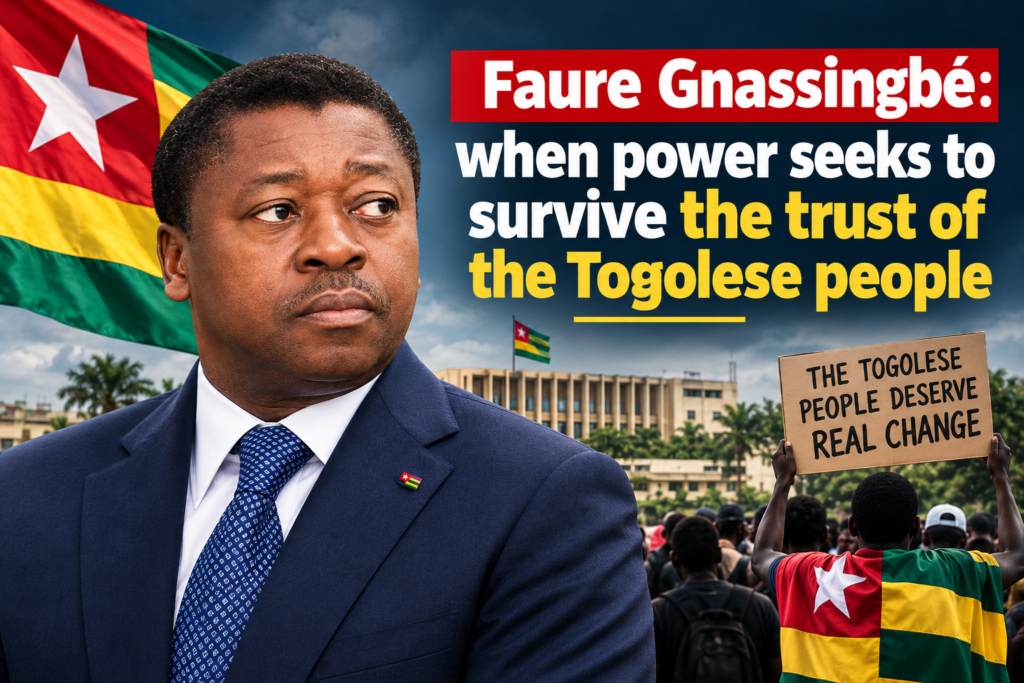
After more than twenty years at the helm of Togo, Faure Gnassingbé now faces an increasingly difficult equation: how can a leader hold on to power once popular confidence no longer suffices to guarantee legitimacy?
Since his accession in 2005, the Togolese head of state has weathered a series of political crises, bitterly contested elections and repeated mobilisations by the opposition. Over the years, criticism has not been confined to electoral results; it has also targeted the very conditions under which the political game is staged. For his detractors, the central question is no longer simply who wins an election, but whether the prevailing conditions genuinely permit an alternation of power.
It is against this backdrop that the successive institutional manoeuvres must be assessed. When a political system is repeatedly reshaped around the person who leads it, every constitutional or institutional amendment eventually gives rise to the same interrogation: is this a reform intended to strengthen institutions, or one further device for safeguarding the incumbent’s position?
The issue has grown more delicate with the recent institutional transformations. The shift to a new political system, the redistribution of powers and the creation of fresh posts at the summit of the state have fuelled criticism from those who perceive in them not a rupture, but a novel method of organising the continuity of the regime.
The most controversial point lies precisely there: the retention of power does not always depend on a victory at the ballot box. It may equally rest on mastery of the institutions that govern the exercise of power.
This explains the questions raised by the failure to hold presidential elections according to the expected timetable, and by the new institutional architecture that resulted from it. For his opponents, a change of mechanism does not automatically mean a change of power. On the contrary, it could enable Faure Gnassingbé to remain at the heart of the political arrangement while altering the function through which he exerts his influence.
The appointment of Jean-Lucien Savi de Tové to the presidency of the Republic has likewise stirred further controversy. Officially, this constitutes a new institutional configuration. Yet for the regime’s adversaries, the real question lies elsewhere: who truly holds power, and who determines the country’s principal political orientations?
It is precisely this interrogation that feeds the accusation that the officially installed president lacks sufficient political autonomy in relation to Faure Gnassingbé. His critics maintain that the genuine centre of decision-making remains in the hands of the former president, now president of the Council, and that the new institutional architecture has therefore preserved his influence without requiring a fresh presidential election.
If this reading is disputed by the authorities, it nevertheless exposes the persistent democratic malaise: when an institutional reform allows a leader who has already spent more than two decades at the summit of the state to remain the dominant political actor, the question of the reform’s true purpose becomes inescapable.
The problem thus extends well beyond Faure Gnassingbé as an individual. It touches the very functioning of the Togolese state. A robust democracy should not be conceived around one person’s capacity to remain indispensable, but around institutions capable of operating independently of the interests of those in power.
To this must be added the recurring accusations of a restricted political space, tensions with the opposition, contested elections and criticism of governance. Considered separately, each of these episodes may be interpreted differently. But set against the perspective of twenty-one years in power, they sketch out, for the regime’s opponents, a single trajectory: that of a system less intent on preparing alternation than on organising its own continuity.
Herein lies the true paradox of Faure Gnassingbé’s rule. After so many years at the country’s head, the question should no longer be how to remain in power through new institutional configurations, but how to durably persuade Togolese citizens that their choices can genuinely alter the direction of the nation.
For a democracy is not measured solely by the number of institutions it possesses, nor by the texts it adopts. It is measured above all by the real possibility of alternation, by the independence of institutions and by the capacity of citizens to sanction or renew their leaders through the ballot.
When institutional mechanisms become intricate enough for power to change its form without necessarily changing hands, suspicion takes hold.
And this is precisely the question Togo’s authorities will not be able to circumvent indefinitely: if Faure Gnassingbé is truly convinced that he enjoys the confidence of the Togolese people, why do so many transformations appear necessary to guarantee the continuity of his political influence?
At bottom, the Togolese debate is no longer merely that of a man seeking to retain power. It is that of a political system confronted with a simple demand: to finally allow citizens to determine freely, clearly and unambiguously who should govern the country.
More Stories
Niger : les remaniements militaires de Tiani trahissent-ils un sommet sous tension ?
Everest Finance dévoile Sama Naffa, une épargne accessible au Sénégal
Niger names new army chief after failed mutiny