
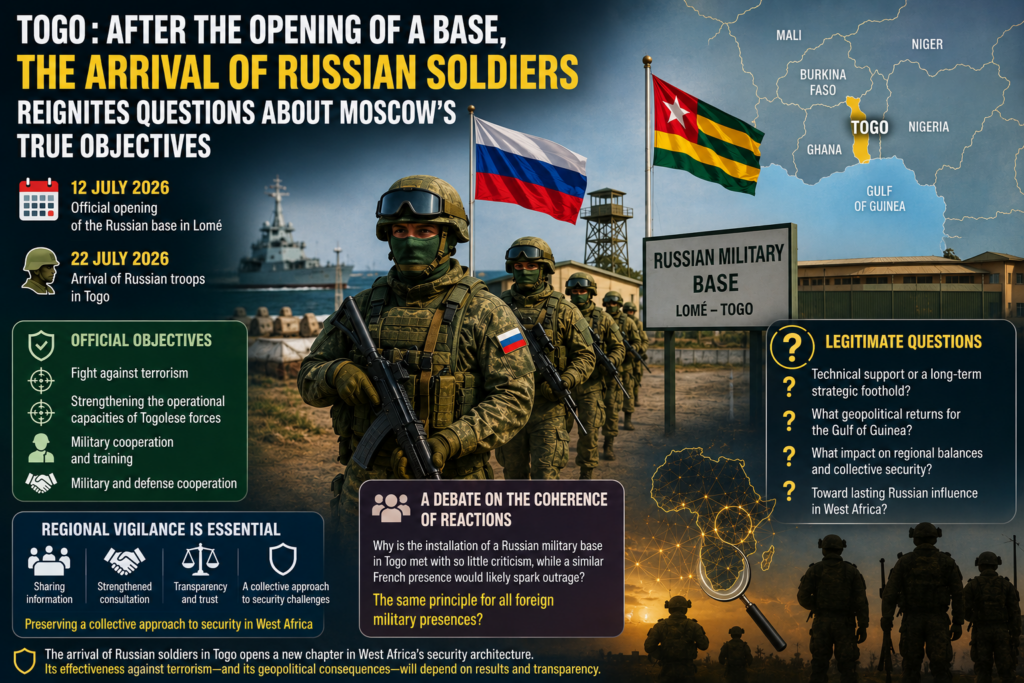
On July 22, 2026, the deployment of Russian military personnel to Togo marked a significant milestone in the deepening defense ties between Lomé and Moscow. Officially, these soldiers are positioned to assist in counterterrorism efforts and bolster the operational readiness of Togo‘s armed forces. The announcement followed the inauguration of a Russian military base in the country just ten days prior, underscoring the rapid progression of this strategic partnership.
Military cooperation raises strategic questions
The arrival of Russian troops in Togo has reignited discussions among security analysts across West Africa. While the move aligns with the sovereign decision of Togo‘s leadership, the long-term presence of foreign military forces in a region grappling with persistent terrorist threats could reshape the subregional power balance. This development is not an isolated incident but part of a broader pattern: Russia has been steadily expanding its footprint across Africa through defense agreements, training programs, arms deliveries, and, in select nations, the physical deployment of its military personnel.
Beyond combat support: broader implications
The central question now revolves around the true intentions behind this cooperation. Is the Russian military presence in Togo merely a technical and operational aid to combat armed groups operating in the northern regions of the country? Or does it signal a long-term strategic ambition to embed Russia deeper within the security landscape of the Gulf of Guinea? The implications could extend far beyond combat operations, potentially encompassing intelligence sharing, training initiatives, logistical support, industrial cooperation, and defense diplomacy—all of which carry geopolitical weight.
A debate fueled by double standards?
Public discourse has also been shaped by perceptions of inequality in how foreign military partnerships are scrutinized. Observers have noted a stark contrast in reactions to similar deployments. Had a French military base been established in Togo under comparable circumstances, the outcry—particularly on social media—would likely have been far more intense. Critics of foreign military presence in West Africa have repeatedly condemned the activities of French forces in the region, denouncing them as interference or destabilizing forces.
In contrast, the establishment of a Russian military base and the arrival of its troops in Togo have, thus far, elicited minimal criticism from the same circles. This disparity has prompted some analysts to question the consistency of these positions. If the presence of foreign troops is viewed as a threat to national sovereignty or a risk to regional stability, such concerns should apply uniformly, regardless of the foreign partner. Conversely, if certain military presences are deemed acceptable while others are not, there must be transparent criteria to justify these distinctions. This would foster a more fact-based public debate rather than one driven by geopolitical biases.
Regional implications and the call for transparency
For neighboring states, the evolving security dynamics in Togo demand heightened vigilance. While no one disputes Togo‘s right to select its defense partners, countries in the subregion must closely monitor the impact of this cooperation on collective security, regional cooperation mechanisms, and diplomatic balances in West Africa. In an environment where terrorist threats transcend borders and external powers intensify their rivalries, transparency is essential to building trust.
Regional partners would be wise to enhance information-sharing and consultation frameworks. This would help mitigate misunderstandings and ensure a unified approach to addressing shared security challenges. The effectiveness of the Russian military presence in Togo—both in combating terrorism and in its broader geopolitical consequences—will only become clear as developments unfold on the ground and in the evolving relationships between Lomé, Moscow, and other nations in the region.


More Stories
Mali: près de 80 soldats tués dans l’attaque de Dioura
Côte d’Ivoire : le Burida prépare une distribution record de 795,4 millions FCFA
Paris FC vs Lyon: kick-off time and TV channel for the Ligue 1 matchday 4 clash