Traditional Leaders in Benin: Balancing Cultural Authority and Political Neutrality
In Benin, traditional leaders hold a deeply rooted influence, serving as pillars of cultural identity and moral legitimacy within local communities. Their roles extend beyond mere symbolic representation, as they play active parts in conflict resolution, social cohesion, and the preservation of ancestral traditions. The state formally acknowledges their significance, embedding their authority within the nation’s institutional framework.
To solidify their legal standing, the Beninese government enacted Law No. 2025-09 of April 3, 2025, which establishes a structured framework for traditional chieftaincies. This legislation categorizes and legally recognizes 16 kingdoms and 90 traditional chefferies, formalizing their contributions to socio-economic development, social harmony, and cultural heritage preservation (Fatondji, 2025).
Public Trust vs. Political Temptations
Despite their respected positions, traditional leaders face increasing scrutiny over their involvement in partisan politics. Political parties frequently seek their endorsement to sway voter decisions, sometimes offering material or financial incentives in return. In response, Benin has enforced strict regulations prohibiting traditional rulers from engaging in partisan political activities (République du Bénin, 2025).
Recent surveys reveal a nuanced public perception of these leaders. Nearly a quarter of Beninese citizens reported interacting with traditional leaders in the past year, with an overwhelming majority expressing trust in their governance influence. However, concerns about integrity are growing. Approximately 75% of respondents believe that some traditional leaders are entangled in corruption, a sentiment that has intensified since 2022. While trust in their moral authority has slightly waned since 2020, citizens still advocate for their involvement in local governance—but not in electoral politics.
The Call for Political Detachment
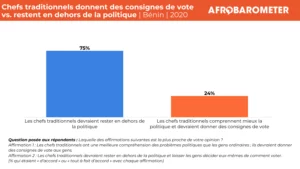
Beninese citizens overwhelmingly support the idea that traditional leaders should remain outside the political arena, allowing voters to exercise their choices freely. This stance reflects a growing demand for transparency and the separation of cultural leadership from partisan influence. The debate highlights the delicate balance between preserving traditional authority and ensuring democratic integrity in Benin’s evolving governance landscape.