The Molodo ambush: a microcosm of Bamako’s strategic collapse
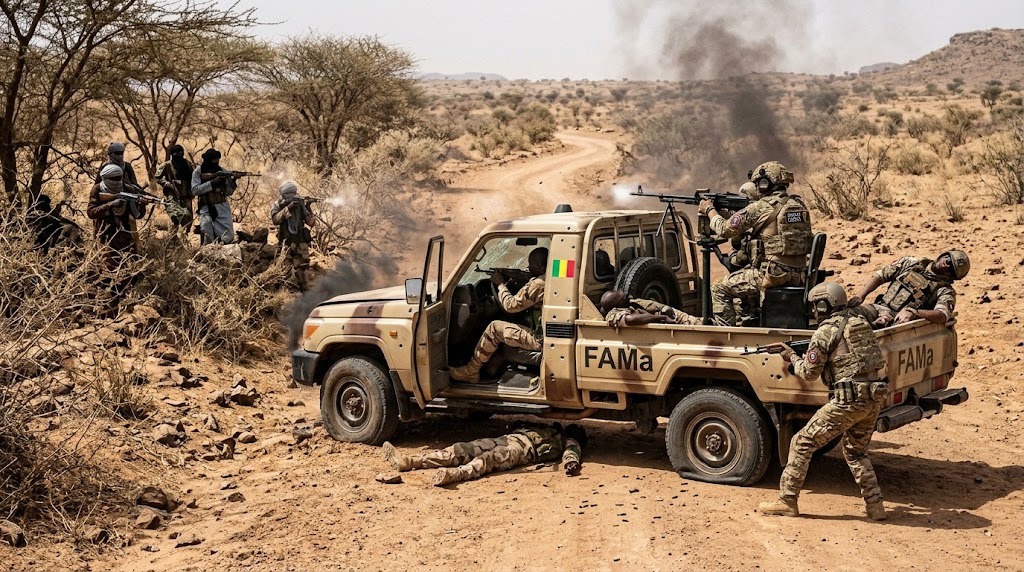
The dusty road from Diabali to Niono, a seemingly ordinary stretch of red earth in central Mali, became the stage for a humiliation that exposed the brittle foundations of the Malian junta’s rule. On September 20, 2026, a mixed patrol of Malian soldiers and Russian contractors from Africa Corps was ambushed by fighters of the Group for the Support of Islam and Muslims (JNIM), an Al-Qaeda affiliate. What followed was less a battle than a rout: within minutes, the poorly trained Russian recruits abandoned their post, fleeing on foot and leaving behind three armored vehicles emblazoned with the Africa Corps insignia. The vehicles, now trophies of war, stood as silent witnesses to the fragility of Bamako’s military partnership with Moscow.
The junta led by Colonel Assimi Goïta had staked its survival on a single, high-risk gamble: replacing Western security cooperation with a Russian alternative it claimed would restore Mali’s sovereignty and secure its territory. But the ambush at Molodo did more than deliver a tactical blow—it shattered the carefully constructed narrative of invincibility and competence that had propped up the regime’s legitimacy for years.
The Russian partnership: a toxic illusion sold to a desperate nation
The promise was clear: Moscow’s Africa Corps would do what European and UN forces had failed to achieve—restore peace and security across Mali. Yet four years into deployment, the engagement has yielded the opposite result. Far from eradicating the jihadist threat, the presence of Russian paramilitaries has fueled resentment, deepened insecurity, and turned vast regions of the country into contested zones. Insurgent recruitment has surged, and areas once considered stable now face daily attacks, roadblocks, and economic strangulation.
The junta’s decision to hand over territorial defense to foreign mercenaries—paid in cash and mineral concessions—has not only failed to curb violence but has accelerated it. Reports from rural communities speak of indiscriminate violence, mass displacements, and a collapsing social fabric. The once-centralized threat of jihadism has metastasized, spreading from the north into the heartland and now encircling Bamako, where fear and poverty are rising in tandem.
A regime built on retreat: the human cost of cowardice
The images of abandoned vehicles on the Molodo road are not just military setbacks—they are symbols of systemic failure. They reveal a junta that prioritizes regime survival over national protection, outsourcing the defense of its people to a force that flees at the first sign of danger. The Africa Corps, once touted as an elite counterterrorism unit, has proven incapable of adapting to Mali’s rugged terrain or the mobility of insurgent forces. Instead, its tactics rely on indiscriminate firepower, civilian casualties, and a culture of blame—all of which have alienated local populations.
The junta’s response to this unraveling has been equally revealing. To suppress dissent, it has intensified repression: silencing journalists, crushing civil society, and criminalizing any criticism of the Russian partnership. Dissent is now equated with treason, and the state has weaponized fear to maintain control. Yet no amount of propaganda can erase the reality on the ground—or the growing public anger.
The fall of a narrative: from sovereignty to subjugation
Bamako sold its alliance with Moscow as a path to liberation from neocolonial influence. In practice, it has led to a new form of dependence—one that is more costly and less accountable. The junta trades mineral wealth and public funds for the fleeting presence of mercenaries who treat Mali as a warzone to exploit, not a nation to protect. The abandoned vehicles at Molodo are the physical manifestation of this betrayal: a project built on illusion, now collapsing under the weight of its own failures.
As the junta digs in, clinging to power behind closed doors in Bamako, the rest of the country burns. Without a credible political strategy, without reconciliation, and with foreign troops that turn tail at the first gunshot, Mali’s future grows darker by the day. The people, abandoned between jihadists and a corrupt elite, are left to bear the cost of a leadership that has gambled away the nation’s security—and lost.
The human toll: communities caught in the crossfire
The humanitarian crisis in central and northern Mali has reached catastrophic levels. Entire villages have been emptied by violence, markets shuttered by fear, and aid convoys ambushed or diverted. The exodus has overwhelmed neighboring regions, straining resources and deepening regional instability. Children are pulled from schools, farmers abandon their fields, and traders flee to makeshift camps. The junta’s refusal to address root causes—poverty, marginalization, governance failures—has turned a security crisis into a humanitarian catastrophe.
What comes next: the limits of mercenary power
The Molodo ambush is more than a military debacle—it is a turning point. Africa Corps has demonstrated that it cannot deliver on its promises. The junta, stripped of its last credible ally, now faces a reckoning: either abandon the Russian gamble and seek a new path, or double down on repression and risk total collapse. With public trust eroding and insurgent groups growing bolder, the window for a strategic pivot is closing rapidly.
The vehicles left behind in Molodo will remain as reminders—not of strength, but of the folly of outsourcing national security to forces that answer only to Moscow’s interests and their own survival.

More Stories
Russia’s 2026 parliamentary vote: a landslide masked by a locked political arena
Behind the Moscow drone strikes: how Ukraine exposed Russia’s hidden vulnerabilities
Benin’s ARS second term: the strategic playbook behind stricter healthcare oversight