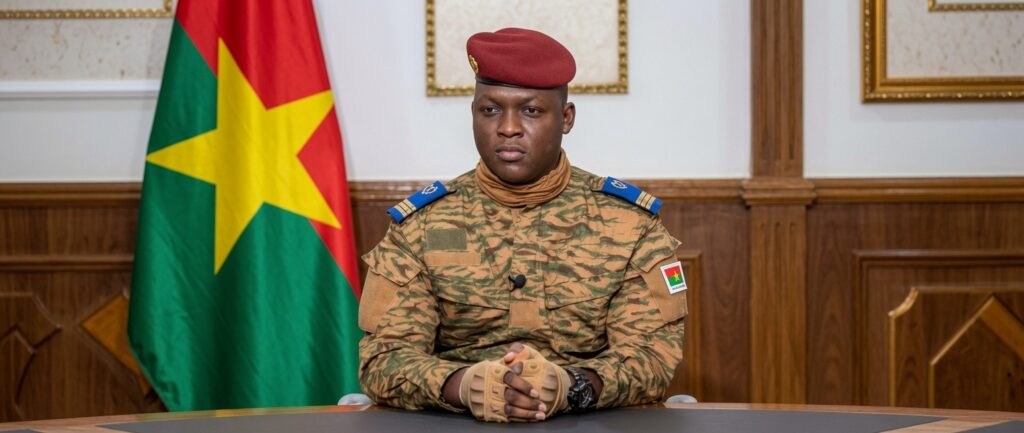
The Burkinabè transitional government recently announced that it now controls nearly 75% of the national territory (74.53% according to official figures), presenting this as a triumphant recovery. However, when cross-referenced with independent data, humanitarian assessments, and the daily realities faced by civilians, this official narrative appears less like a measurable military achievement and more like a carefully crafted political messaging campaign.
Redefining territorial control: presence versus actual governance
To justify such an ambitious figure, authorities have adopted an unusually broad interpretation of “control.” The mere deployment of military detachments, escorted convoys, or mobile patrols—including volunteer defense groups (VDP)—is now sufficient to classify a zone as “under control.” Yet, true territorial control demands far more: the uninterrupted exercise of state authority, functioning public administration, justice systems, safe civilian movement free from ambushes, and sustained protection for residents.
In practice, armed groups, particularly the Jama’at Nusrat al-Islam wal Muslimin (JNIM), continue to wield asymmetrical warfare tactics. They frequently disrupt major road networks, besiege key towns, and reassert dominance in areas left unguarded once military convoys withdraw. These persistent threats undermine any claim of effective governance.
Media restrictions and the absence of credible verification
The stark discrepancy between official claims and ground realities stems from a tightly controlled information environment:
- Suppression of independent data: Local security analysts, nongovernmental organizations, and independent journalists face strict oversight, with threats of prosecution for publishing security assessments that contradict state narratives—often framed as acts of “sapping troop morale.”
- Lack of third-party validation: No independent or international body has been granted access to verify the Defense Ministry’s territorial mapping. Research institutions and conflict-tracking platforms focused on the Sahel, such as the Armed Conflict Location & Event Data Project (ACLED), consistently record high concentrations of violent incidents across much of the country.
Humanitarian crisis persists despite official claims
A genuine recovery of 75% of the territory would logically result in a dramatic decline in displacement and humanitarian needs. Instead, the opposite is true:
- Internal displacement remains critical: Return movements to rural homes remain sporadic and perilous. The number of internally displaced persons (IDPs) reliant on emergency aid has not significantly decreased.
- Public services collapse: Even in areas labeled “under control,” thousands of schools remain shuttered, healthcare workers refuse to return without permanent security guarantees, and civil administration struggles to function beyond fortified regional capitals.
Political motivations behind the narrative
This optimistic framing appears driven primarily by domestic political considerations:
- Legitimizing the transition: Highlighting territorial gains helps justify the extended transition period and the social and economic burdens placed on civilians, including increased taxes and conscription efforts.
- Distracting from tactical setbacks: Focusing on aggregate percentages diverts attention from recurring losses suffered by isolated military units and local militias, particularly in the North, East, and the Boucle du Mouhoun region.