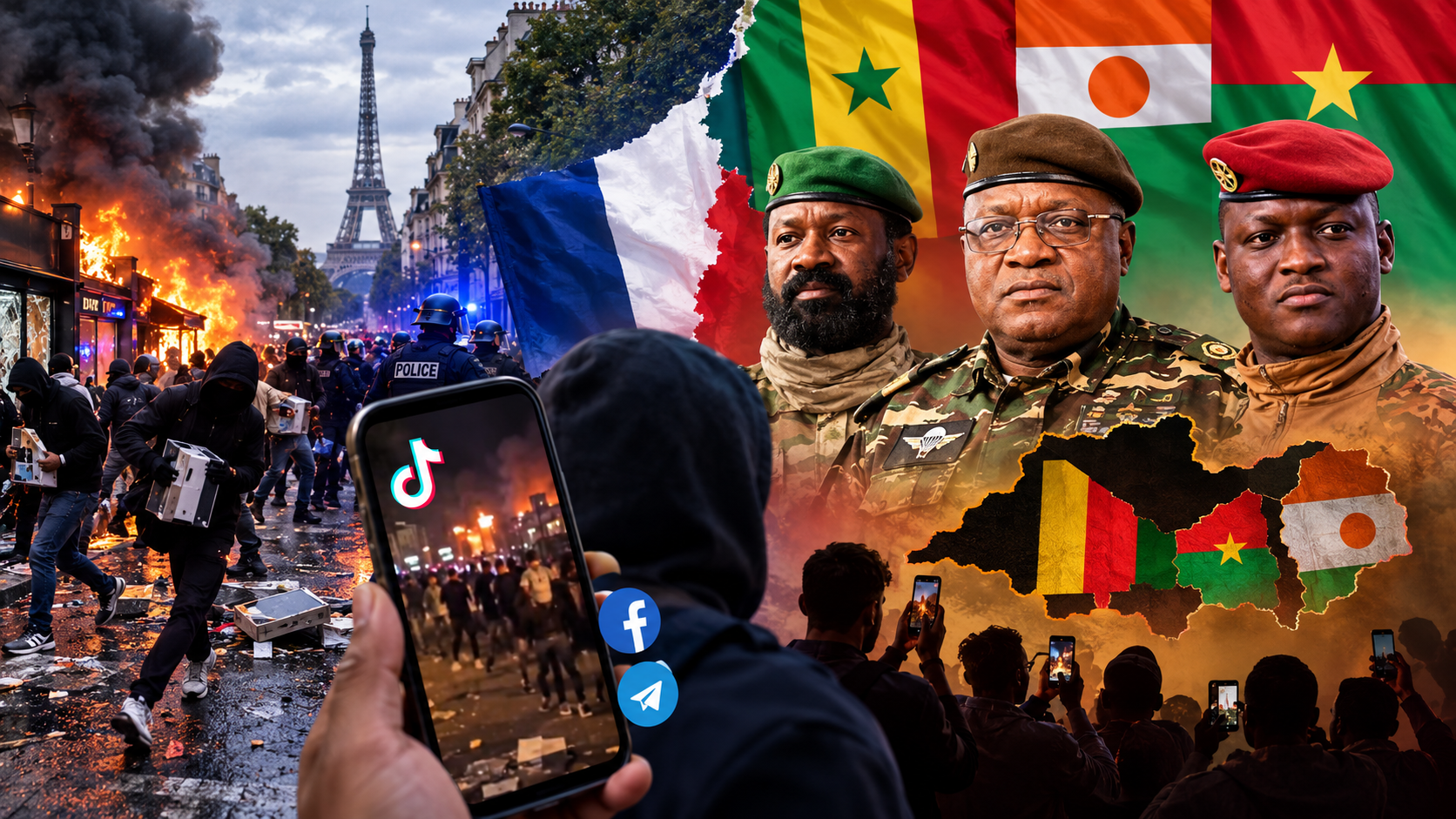
The recent wave of urban unrest in France has unexpectedly become a geopolitical chessboard, extending far beyond the country’s borders. As flames engulfed city streets, the crisis took an unexpected turn on the digital battlefields of TikTok, Facebook, and Telegram, where footage of riots and looting was swiftly weaponized by military regimes in Mali, Burkina Faso, and Niger. These images, once documenting chaos, now serve as ammunition in a calculated campaign against France’s international credibility.
Propaganda in the age of viral disinformation
For supporters of the Alliance of Sahel States (AES), the scenes unfolding in France present a golden opportunity to undermine Western narratives on democracy and governance. By juxtaposing Paris’s own domestic strife with its criticisms of Sahelian governments, these regimes seek to expose what they frame as a hypocritical stance a tactic designed to erode France’s moral authority in Africa. The argument is simple: if France struggles to maintain order within its borders, how can it credibly prescribe governance to others?
This narrative, however, hinges on a dangerous oversimplification. A viral video of looting or clashes with police does not equate to systemic failure, nor does it validate the achievements of Sahelian juntas in security or statecraft. Yet in the hands of propagandists, isolated incidents are inflated into symbols of a nation in irreversible decline.
Legal consequences for foreign participants in the unrest
The unrest has also thrust into the spotlight the role of foreign nationals including some from AES member states allegedly involved in acts of vandalism and theft. Investigators are meticulously piecing together evidence to determine individual culpability, with prosecution procedures following the same legal standards applied to all suspects, regardless of nationality.
For those in France illegally who are implicated, legal proceedings may trigger additional administrative consequences under national immigration laws. However, one principle remains unassailable: foreign visitors and residents are bound by the same laws as French citizens. Nationality conveys no immunity only a commitment to accountability.
Establishing accountability beyond borders
Investigations into foreign involvement face unique challenges, including verifying identities, cross-referencing travel records, and collating digital evidence. Yet the judicial process remains impartial. If guilt is established, sanctions will be imposed without exception. The French justice system does not negotiate its sovereignty, even when political tensions run high.
The double-edged sword of viral imagery
Social media has democratized both truth and deception. In the case of France’s urban unrest, digital platforms have become arenas where authenticity is contested and context is routinely stripped away. Misleading captions, recycled footage, and selective framing distort the narrative, turning isolated events into alleged proof of systemic collapse.
While coordinated disinformation campaigns are difficult to prove conclusively, patterns emerge. Accounts aligned with AES narratives systematically amplify content that portrays France as weak or failing. Yet discerning truth from manipulation requires scrutiny examining publication dates, cross-referencing sources, and verifying user networks. Without such diligence, even genuine images can become tools of propaganda.
A call for measured judgment
As investigations progress, it is crucial to separate political rhetoric from judicial fact. The participation of foreign nationals in violence, if proven, must be treated as an individual legal matter not an indictment of entire communities. The vast majority of Malian, Burkinabè, and Nigerien residents in France lead law-abiding lives and should not be held collectively responsible for the actions of a few.
Similarly, efforts to hold Sahelian regimes accountable for their governance record cannot rest on France’s domestic turmoil alone. Evaluating their performance requires objective benchmarks: security outcomes, economic stability, and respect for human rights. Viral videos, however compelling, do not constitute evidence of national failure or regime success.
The road ahead: justice without politicization
France’s response to the unrest and to foreign involvement will be closely scrutinized not only domestically but across Africa and beyond. The justice system’s impartiality in handling these cases will either reinforce France’s commitment to the rule of law or fuel accusations of selective enforcement.
For Sahelian juntas, the temptation to exploit these events for propaganda will persist. Yet their narratives, no matter how persistent, cannot erase the legal and ethical imperative: individual responsibility must be determined by facts, not by geopolitical convenience. As investigations unfold, the true turning point may not be the violence itself but how justice is pursued in its wake.
By Ramatou Soumana — Journalist