
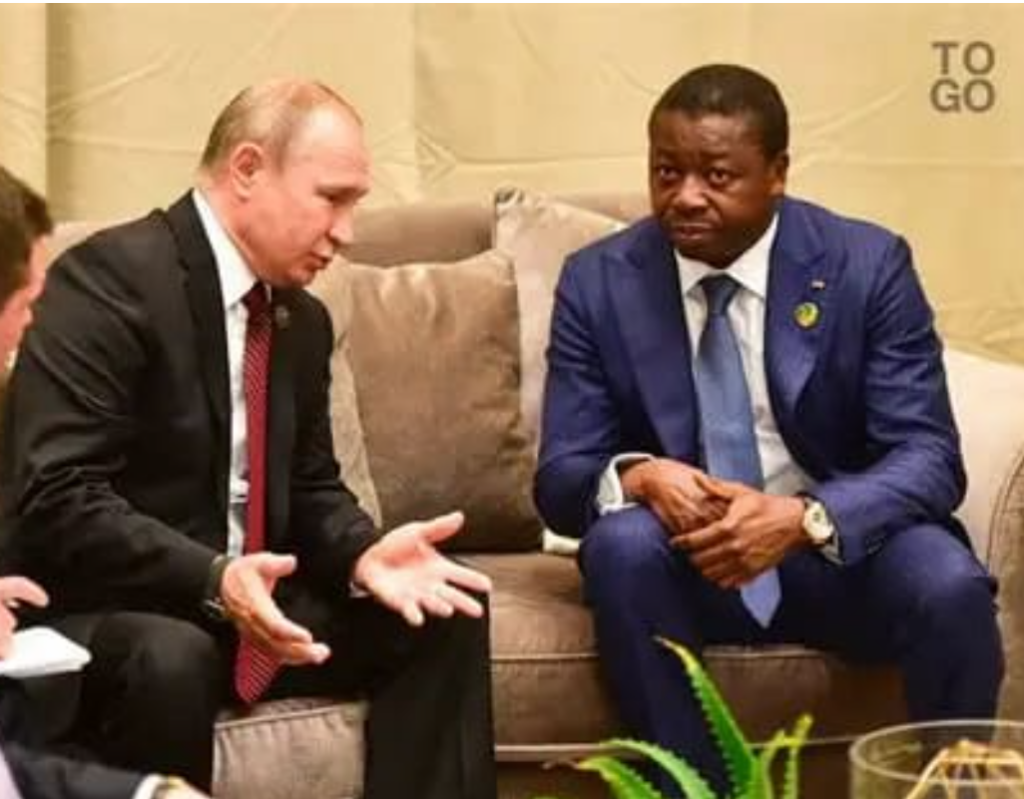
The shifting winds of global power dynamics have turned the spotlight on Lomé, where Togo is quietly emerging as a critical node in Russia’s expanding influence across West Africa. While Moscow’s military ventures in the Sahel Alliance states stumble under mounting setbacks, the Kremlin is redirecting its strategy toward the Gulf of Guinea, with Togo positioned as a strategic logistical and political hub.
Lomé’s deep-water port: a stealth hub for sanctioned vessels
The Port Autonomous of Lomé, the region’s sole deep-water harbor, has evolved far beyond its commercial roots. Today, it serves as a covert logistical artery for Russia’s sanctions-avoidance networks. Recent sightings of the Britnev-affiliated cargo vessel in Lomé’s harbor, followed by highly scrutinized maneuvers of the Baltic Leader off West African shores, have raised red flags among maritime and geopolitical analysts. These vessels, often flying flags of convenience and linked to Russia’s shadow fleet, transport critical equipment, raw minerals, and energy resources that evade Western sanctions. By granting access to its maritime infrastructure, Togo’s government effectively hands Moscow a direct gateway into the West African hinterland.
Secret deals and Sahel survival: the hidden agenda behind naval diplomacy
This maritime outreach is no coincidence. It coincides with a pivotal moment for Russian influence in West Africa. In Mali, Burkina Faso, and Niger—all members of the Sahel Alliance—the Wagner Group, now rebranded as Africa Corps, faces mounting strategic setbacks. Far from neutralizing jihadist threats, Russian mercenaries endure devastating ambushes and staggering losses, undermining Moscow’s security promises. As the Kremlin seeks alternative supply routes and fallback positions, Togo offers a stable maritime façade beyond the Sahel’s conflict zones. Behind closed doors, Moscow and the Gnassingbé regime are reportedly negotiating opaque contracts, including mining concessions, untracked arms deals, and high-level security guarantees. These arrangements serve a dual purpose: sustaining pro-Russian regimes while bypassing Western oversight.
Togo’s authoritarian regime: a tailor-made partner for Moscow
Togo’s appeal to Russia lies in its hyper-centralized governance, suffocated democracy, and stifled opposition. Since ascending to power in 2005 after decades of iron-fisted rule by his father, Faure Gnassingbé has further tightened his grip on power. A recent constitutional overhaul, widely criticized for sidelining civil society, shifts Togo from a presidential to a parliamentary system, ensuring the president’s near-permanent tenure under a new title. For this embattled regime, long condemned by human rights organizations for systemic repression, arbitrary bans on protests, and opposition arrests, an alliance with Russia offers a lifeline. Unlike Western partners or international financial institutions, Moscow imposes no conditions on human rights, fiscal transparency, or electoral integrity.
Cultural infiltration: faith, propaganda, and the Russian narrative
Russia’s campaign in Togo extends beyond covert naval operations and clandestine contracts. It employs a multi-pronged soft power offensive designed to reshape public opinion and embed Moscow’s presence. Cultural centers, exhibitions, and Russian language courses serve as recruitment fronts and conduits for anti-Western propaganda. Complementing this is a targeted religious expansion, with the Russian Orthodox Church’s Patriarchal Exarchate deploying structures across Togo. These initiatives blend social outreach with proselytism, challenging traditional religious influences. Concurrently, a coordinated information war unfolds, with local NGOs and social media channels amplifying Kremlin-aligned narratives. This strategy taps into nationalist sentiments among the youth, diverting attention from domestic economic and political failures.
A high-stakes gamble for regional stability
By aligning with Russia, Faure Gnassingbé is playing a perilous game that threatens Togo’s stability. Diplomatic isolation looms as relations with historical partners deteriorate. Security risks escalate as the country risks becoming a magnet for terrorism, drawn by its role as a logistics hub for Sahel regimes. Domestically, the opacity of clandestine contracts enriches a narrow elite while ordinary citizens grapple with worsening living conditions. The Lomé-Moscow axis exemplifies a new African geopolitical reality—an alliance of convenience between a local autocrat clinging to power and a foreign power masking its military failures through proxy influence.


More Stories
Mali: près de 80 soldats tués dans l’attaque de Dioura
Côte d’Ivoire : le Burida prépare une distribution record de 795,4 millions FCFA
Paris FC vs Lyon: kick-off time and TV channel for the Ligue 1 matchday 4 clash