
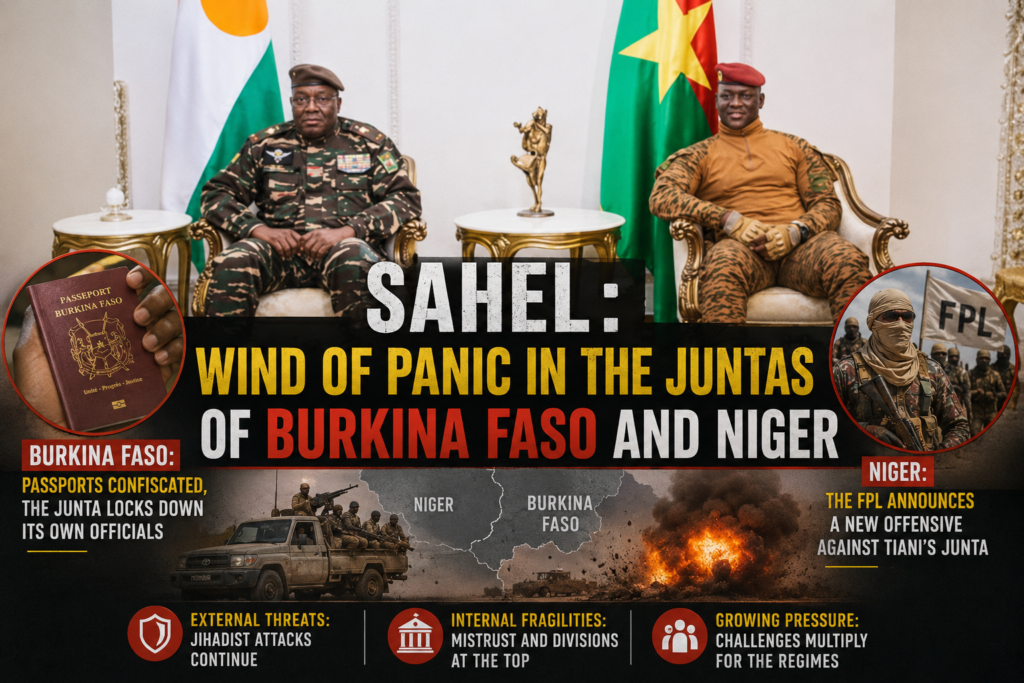
Escalating tensions in the Sahel-Saharan region are placing unprecedented strain on the military administrations of Niger and Burkina Faso. While both nations grapple with external threats, internal vulnerabilities are now emerging as a critical challenge to their stability. The evolving dynamics in Niamey and Ouagadougou underscore the dual pressures confronting these regimes: securing their territories against insurgent groups while managing fragile internal cohesion.
Ouagadougou tightens control amid growing distrust
In Burkina Faso, the transitional government has adopted extraordinary measures to reinforce its authority. Recent reports indicate that passports of senior government officials and military officers have been seized, effectively restricting their ability to travel abroad. This unprecedented move extends beyond cabinet ministers, encompassing high-ranking military personnel, signaling a deepening climate of suspicion within the state apparatus.
The decision reflects a strategic shift to mitigate risks of defection, unauthorized disclosures, or foreign alignments that could undermine the regime. Such actions typically arise when leadership confidence erodes, particularly in volatile political climates. The timing is particularly significant as Burkina Faso continues to face persistent jihadist violence, despite extensive military operations and the deployment of civilian defense volunteers. The unrelenting security crisis has intensified internal divisions, compelling authorities to centralize decision-making and impose stricter oversight on key figures.
Analysts suggest these measures reveal the inherent fragility of military governance. As power becomes increasingly concentrated, the risk of internal fractures, rivalries, or desertions grows, posing existential threats to the regime’s longevity.
Niamey braces for armed resistance
In Niger, the political landscape has taken a more confrontational turn following the recent release of Mohamed Salah, Secretary-General of the Patriotic Front for Liberation (FPL). Captured in a high-stakes hostage exchange involving Libyan factions, Salah’s liberation has emboldened the rebel movement to escalate its campaign against the military junta led by General Abdourahamane Tiani.
Salah, now vowing to launch a “major operation” to overthrow the current administration, has framed the FPL’s struggle as a fight to restore constitutional order. The group continues to demand the release of former President Mohamed Bazoum, whom it recognizes as the country’s democratically elected leader. This development marks a significant escalation in Niger’s crisis, as the government now faces not only jihadist insurgencies but also a well-organized armed opposition explicitly targeting regime change.
The dual pressures—securing the nation against terrorist threats while countering internal dissent—risk overstretching Niger’s already strained security apparatus. The junta’s preoccupation with maintaining power may divert critical resources from the fight against extremism, further destabilizing the country.
Regional instability deepens as juntas face mounting challenges
The situations in Burkina Faso and Niger highlight the multifaceted crises confronting Sahelian military regimes. In Ouagadougou, authorities are prioritizing internal control, while in Niamey, the focus has shifted to suppressing organized rebellion. Both scenarios underscore the precarious nature of governance established through coups, despite promises of restoring sovereignty and security.
As these regimes navigate a complex web of security threats, political opposition, economic hardships, and public discontent, their ability to stabilize their nations remains uncertain. The cumulative impact of these challenges could have far-reaching consequences for regional stability in the coming months, as the Sahel continues to grapple with an increasingly volatile environment.


More Stories
Mali: près de 80 soldats tués dans l’attaque de Dioura
Côte d’Ivoire : le Burida prépare une distribution record de 795,4 millions FCFA
Paris FC vs Lyon: kick-off time and TV channel for the Ligue 1 matchday 4 clash