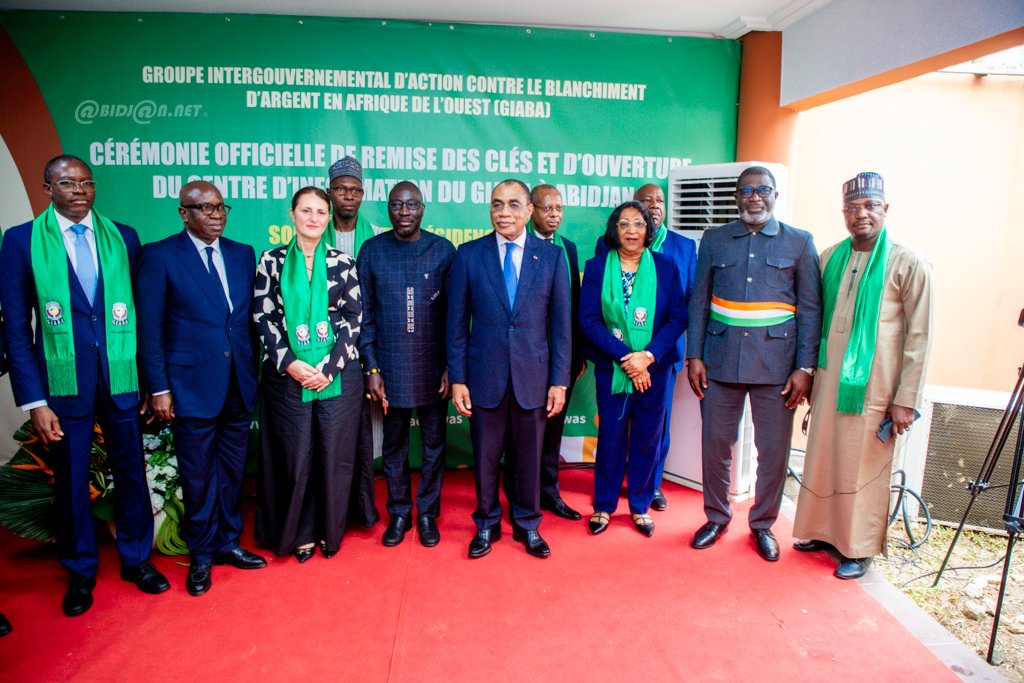
The Ivory Coast’s Minister of Economy, Finance and Budget, Adama Coulibaly, presided over the handover ceremony of the new GIABA Information Centre in Cocody on Wednesday, August 12, 2026. This state-of-the-art facility, provided by the Ivorian government under the terms of the Host Agreement, marks a major milestone in strengthening regional cooperation against financial crime across West Africa.
The decision to establish the GIABA Information Centre in Abidjan dates back to a November 26, 2010 resolution by the ECOWAS Council of Ministers during its 65th ordinary session in Abuja. The resolution called for the creation of two information hubs: one in Lagos (Nigeria) to serve Anglophone countries, and the other in Abidjan (Ivory Coast) to support Francophone and Lusophone member states.
The Abidjan centre officially launched on September 21, 2015, following the March 29, 2014 Host Agreement signed in Yamoussoukro between the Republic of Ivory Coast and GIABA, on the sidelines of the 44th ECOWAS Heads of State and Government Summit.
An evolving threat demands stronger regional action
Speaking at the inauguration, Minister Coulibaly emphasized that money laundering and terrorist financing schemes are growing increasingly complex, with new channels and tactics emerging regularly. He stressed that no single country can tackle these challenges alone, calling for shared intelligence, pooled resources and coordinated strategies across the region.
The new centre is designed to serve as a regional platform for awareness-raising, skills development, research, documentation and communication. Its mission is to equip ECOWAS member states and West African partners with the tools needed to combat illicit financial flows and enhance financial integrity.
GIABA chief highlights decade of impact and future vision
Edwin W. Harris Jr., outgoing Director General of GIABA, reflected on the centre’s achievements since 2015. Under its leadership, the facility has hosted open-house events for young people, public forums, regional public speaking competitions, and tailored training seminars for journalists, religious leaders and civil society organizations. It has also supported mutual evaluation processes that assess national compliance with anti-money laundering standards.
With its expanded, modernized premises, the centre is poised to take its work to the next level. Harris described the new space as a strategic investment for Francophone and Lusophone ECOWAS members, designed to become a regional hub for knowledge sharing, innovation and collaboration in the fight against financial crime.
A hub for all stakeholders
Harris urged government agencies, financial institutions, regulated professions, universities, research centres, media outlets, civil society groups and development partners to make full use of the centre’s offerings. Special focus will be placed on engaging youth, students, researchers and young professionals through learning, innovation and civic engagement programs that promote integrity, good governance and sustainable economic growth.
Cutting-edge training for today’s challenges
A key innovation in the new facility is the Computer-Based Training (CBT) centre. This platform will deliver specialized modules tailored to the needs of judges, investigators, financial institutions, compliance officers, academics, students and other professionals involved in anti-money laundering and counter-terrorist financing efforts. Participants will have the opportunity to earn certificates, helping to professionalize the field and build regional expertise.
The timing of the inauguration is particularly symbolic: Harris’s mandate concludes on August 31, 2026, and the opening of the new centre just days before his departure underscores a commitment to leaving behind a lasting tool for cooperation, information sharing and capacity building in the fight against illicit finance.