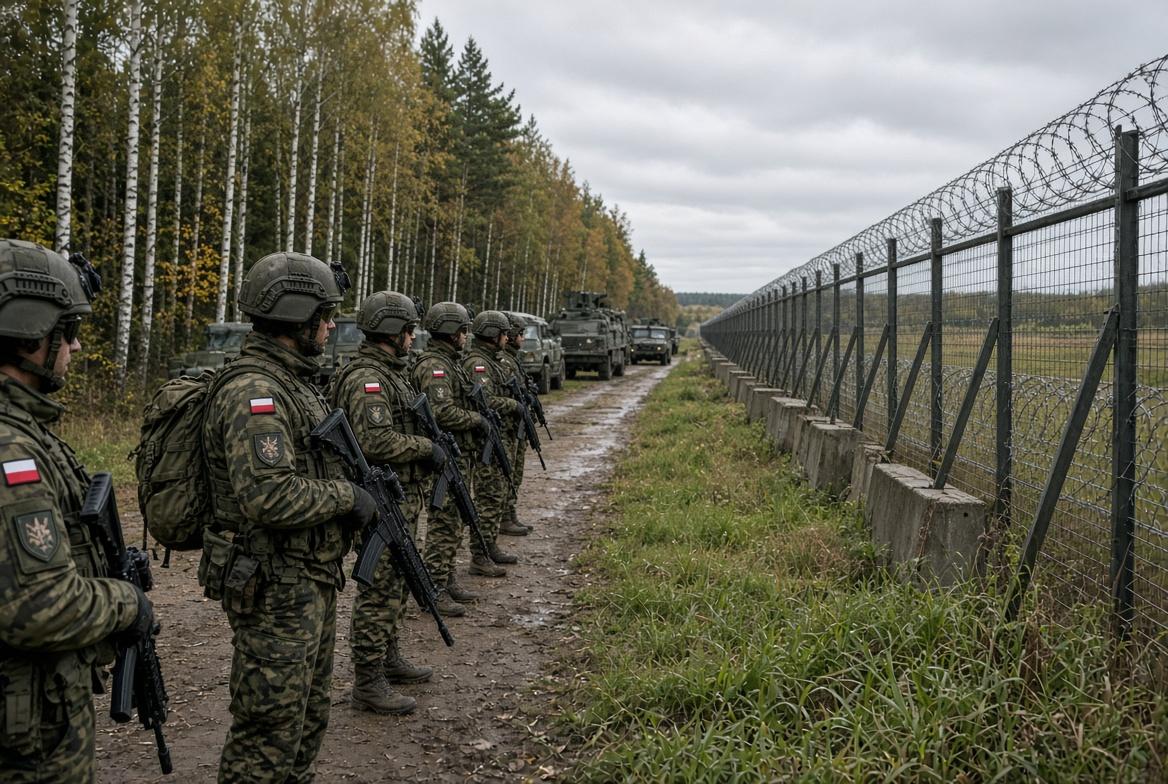
Poland’s bold move to secure its Baltic frontier
Europe’s security landscape just shifted dramatically along the Baltic Sea. Confronted with mounting evidence of clandestine operations, repeated provocations, and the looming threat of Moscow-orchestrated sabotage, Poland has launched an unprecedented security initiative along its northeastern border—right beside the heavily militarized Kaliningrad enclave. This decisive action underscores Warsaw’s commitment to fortify one of the continent’s most vulnerable geopolitical hotspots against Russian hybrid warfare tactics.
From passive defense to ironclad deterrence
The Polish government’s response is no ordinary border deployment. This coordinated operation integrates border guards, national police, elite counter-terrorism units, and regular army battalions into a single, seamless defense framework. The mission is twofold: slam the door shut on potential Russian sabotage cells and protect critical northern infrastructure—energy grids, transportation networks, and communication systems—that Moscow could target in asymmetric warfare.
The scale of this security surge is unmatched. Surveillance extends beyond traditional patrol routes, incorporating AI-driven monitoring, drone interdiction systems, and rapid-response strike teams. Analysts describe the approach as a ‘comprehensive shield’—one designed to neutralize threats before they materialize.
Kaliningrad as the epicenter of risk
Nestled between Poland and Lithuania, the Russian exclave of Kaliningrad has become a flashpoint in Europe’s shadow war. The area has seen an alarming rise in suspicious aerial activity: unauthorized drone incursions, repeated airspace violations, and intelligence-gathering sorties near sensitive installations. These developments have pushed Baltic nations into a state of constant vigilance, where every shadow in the sky could signal a prelude to escalation.
Poland’s new border strategy directly confronts this reality. By positioning military assets within operational distance of Kaliningrad, Warsaw is signaling that any attempt to destabilize the region will meet with overwhelming force. The message to the Kremlin is clear: the era of plausible deniability in hybrid warfare is over.
The hybrid tactics that forced Poland’s hand
Russia’s playbook against NATO has evolved. Gone are the days of straightforward conventional threats; today, Moscow deploys a complex toolkit:
- Disinformation campaigns: Sowing division through social media manipulation and fake narratives targeting Polish public opinion.
- Sabotage operations: Cyberattacks on critical infrastructure and physical incidents targeting logistics or energy networks.
- Migration pressure: Exploiting refugee flows as a political weapon to destabilize neighboring states.
- Electronic warfare: Jamming communications, intercepting signals, and disrupting GPS to cripple emergency responses.
Poland’s response neutralizes these threats through layered defense: intelligence fusion centers that correlate real-time data, rapid interdiction units trained for sabotage scenarios, and public-private partnerships to harden infrastructure resilience.
NATO’s eastern bastion takes a stand
As the conflict in Ukraine dominates global headlines, the Baltic States’ quiet but intense preparations tell a different story. NATO’s eastern flank is no longer a passive buffer—it has become a frontline of deterrence. Poland, with its historic resilience and strategic foresight, has positioned itself as the alliance’s first line of defense against Russian aggression. The country’s unwavering stance sends a powerful message across the alliance: deterrence is not just a strategy; it is the only path to peace.
What comes next?
The security measures deployed along Poland’s Baltic border represent more than a policy shift—they are a turning point. Warsaw has made it clear: hybrid warfare will be met with hybrid deterrence—equal parts strength, speed, and sophistication. In a world where threats evolve overnight, Poland’s new frontier security model may well become the blueprint for Europe’s future defenses.