
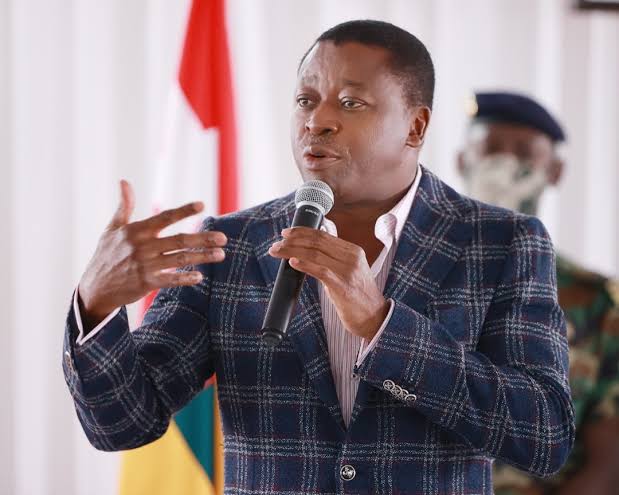
A quiet yet fierce strategic rivalry appears to be gradually unfolding in northern Togo. According to several converging sources cited in security circles, more than 300 operatives from the Russian African Corps the structure established by Moscow after Wagner’s original iteration faded are reportedly present or active in the country. In response to this Russian footprint, Turkey is also said to be bolstering its security presence, notably through actors linked to the private military company SADAT.
If these reports were to be fully confirmed, they would signal a major shift in Togo’s security doctrine: a state no longer content with ad hoc military partnerships, but increasingly becoming a theater for competition among foreign powers.
Moscow and Ankara can naturally frame their presence as contributions to counterterrorism and stabilization in the north. Yet behind the security rhetoric lies another battle: influence. Access to decision-makers, contracts, intelligence, military cooperation, equipment, training, and strategic positioning are all at stake in a region where foreign powers seek to entrench their footholds.
The issue, therefore, is not solely about who protects Togo. It is equally about who gains influence in Togo, at what cost, and with what guarantees for citizens.
A national army relegated to the sidelines?
This proliferation of foreign actors raises a central question: what real room remains for the Togolese Armed Forces?
Togo boasts a structured national army, experienced officers, and military personnel trained at various foreign military institutions. Thus, the growing reliance on external security partners cannot automatically be presented as a consequence of national forces’ incapacity.
Rather, it prompts scrutiny of the political choices accompanying this strategy.
When a state entrusts an increasing share of its security concerns to foreign actors, it risks creating a dependency that extends far beyond the military domain. The supplier of equipment can become indispensable. The provider of intelligence can gain privileged access to decision-making structures. The trainer of units can gradually shape operational doctrines.
In the long run, sovereignty is measured not only by the number of soldiers a country has, but also by its capacity to independently determine its defense policy.
It is precisely here that Togo’s debate becomes concerning.
The question is not whether Togo should cooperate with Russia, Turkey, France, or other partners. A sovereign state can forge multiple partnerships when they serve its national interest. The real question revolves around transparency, democratic oversight, and the equilibrium among these partnerships.
What contracts have been signed? What are their durations? How much do they cost the taxpayer? What powers are granted to foreign personnel? Under what chain of command do they operate? Which jurisdiction applies in case of an incident? Who controls their operations?
These questions become even more pertinent when private military companies or foreign structures operate in areas where civilian populations are directly exposed.
The risk of increasingly outsourced security
Outsourcing security presents another danger: it can gradually weaken the very national institutions it purports to strengthen.
A foreign power can quickly provide personnel, matériel, or specialized capabilities. But it cannot durably replace a national defense strategy.
If investments in Togo’s army, national intelligence, officer training, border surveillance, and development of vulnerable areas do not keep pace, reliance on external partners risks becoming structural.
Togo could then find itself in a vicious cycle: the more it depends on foreign capabilities, the harder it becomes to build its own; the weaker its national capabilities, the more it must rely on external sources.
Such a situation would be paradoxical for a country that claims to defend its sovereignty.
JNIM as justification: a threat that must be measured
The terrorist threat in northern Togo is real and must not be understated. Armed groups active in the Sahel have demonstrated their capacity to exploit porous borders, fragile rural areas, and economic frustrations.
But the fight against terrorism should not become a magic word that justifies any security policy.
This argument warrants closer examination, especially since the presence of the Group for the Support of Islam and Muslims (JNIM) on Togolese soil must be distinguished from its regional influence or capabilities. The existence of a cross-border threat does not necessarily imply that a permanent foreign military presence is the only viable response.
A serious security policy should combine intelligence, border surveillance, regional cooperation, professionalization of national forces, economic development of marginalized areas, and protection of populations.
For a border secured by arms but surrounded by poverty, unemployment, and administrative neglect remains vulnerable.
The question the authorities can no longer avoid: what does this strategy cost?
One blind spot in the debate is financial.
Foreign military partnerships come at a cost. Salaries, equipment, logistics, infrastructure, security contracts, maintenance, transportation, and technical assistance can amount to substantial sums.
However, when these expenditures fall under national security, they are often shrouded in particular opacity.
This is precisely why parliamentary and citizen oversight becomes essential.
Togolese citizens have the right to know how public resources are used. They also have the right to ask whether every security expenditure genuinely translates into improved daily safety.
For a sophisticated military apparatus cannot be deemed a success if populations continue to lack access to healthcare, clean water, education, infrastructure, and economic opportunities.
While powers negotiate, Togolese wait
Here the contrast becomes most striking.
While the authorities seek to consolidate ties with various foreign powers, the everyday concerns of Togolese remain far more grounded: purchasing power, employment, cost of essential goods, access to healthcare, quality of education, housing, clean water, electricity, and prospects for the youth.
The social question does not vanish because a security threat exists.
On the contrary, the experience of many countries shows that poverty, territorial marginalization, and weak public services can create fertile ground for instability.
Investing in northern populations is therefore not merely social policy; it is also security policy.
A jobless youth living in an area with little state presence represents a strategic vulnerability far greater than a simple budget line.
Democratic debate stifled by security logic
To this security question is added another concern: the country’s political trajectory.
For several years, criticisms regarding Togo’s democratic space, restrictions on mobilizations, and tensions over institutional reforms have fueled a sense of an increasingly closed political system.
The constitutional change and the new institutional architecture have notably sparked intense debate over power concentration and the actual role of popular suffrage in the functioning of institutions.
In this context, the growing prominence of the security apparatus warrants particular vigilance.
A democracy cannot be durably governed by security logic alone. When any dissent risks being equated with a threat to stability, the authorities eventually conflate political opposition with security danger.
It is precisely this slippage that must be avoided.
A strong army to defend the country, not to protect a regime
A national army’s role is fundamental: defend territorial integrity, protect citizens, and preserve national sovereignty.
It should not become the preferred instrument for sustaining a political system.
The distinction is fundamental.
An army that protects the state safeguards the institutions of the Republic. A force used primarily to protect a political power shields a regime.
The danger for Togo would be if the two functions become conflated.
The arrival of foreign actors in the security apparatus does not resolve this issue. It may even complicate it if the priority becomes protecting those in power rather than building a national defense architecture subject to oversight mechanisms.
Togo must not become a playground for powers
Togo holds a strategic position in the Gulf of Guinea and serves as a gateway to West Africa. This position naturally explains the interest shown by various powers.
Yet the strategic interests of other states must not become the compass for Togolese national policy.
The country should be able to cooperate with multiple partners without becoming dependent on any single one.
It should be able to purchase equipment without surrendering its decision-making autonomy. It should be able to receive foreign training without marginalizing its own officers. It should be able to fight terrorism without turning security into a permanent justification for opacity.
Above all, it must be able to answer to its foreign partners while answering first to its citizens.
Urgency is also political, social, and economic
The real threat to Togo is not limited to the potential advance of armed groups.
It also lies in the risk of constructing a state where the security apparatus grows faster than democratic institutions, where military spending evades public debate, and where foreign partnerships overshadow national capabilities.
What use is costly military cooperation if citizens do not feel more protected?
What use is active diplomacy with multiple powers if the population’s daily concerns remain unanswered?
What use is political stability if it is achieved at the cost of a lasting shrinkage of the democratic space?
Togolese authorities face a strategic choice.
They can continue to multiply security partnerships, play on rivalries among powers, and progressively strengthen the security apparatus.
Or they can invest more in genuine national sovereignty: a professional and autonomous army, democratically controlled institutions, transparent contracts, a credible judiciary, and above all, economic development capable of reducing the vulnerabilities that fuel instability.
The problem, therefore, is not that Russia is present, that Turkey is interested in Togo, or that other Western partners continue to cooperate with Lomé.
The problem begins when foreign and security policy becomes an end in itself, while the people’s urgent needs become a secondary variable.
By prioritizing geopolitical balances, the authorities risk losing sight of what matters most: a country’s sovereignty is measured not by the number of foreign powers vying for its territory, but by its institutions’ ability to serve its citizens.
And if Togo gradually becomes a competition ground among Moscow, Ankara, and other capitals, the question Togolese are entitled to ask is simple: who truly protects the country, and who truly protects the regime?
More Stories
Niger : les remaniements militaires de Tiani trahissent-ils un sommet sous tension ?
Everest Finance dévoile Sama Naffa, une épargne accessible au Sénégal
Niger names new army chief after failed mutiny