Benin is at a crossroads in its bid to secure sovereign control over its airspace. The military aviation school in Cana, embedded within the Cana Air Base, is emerging as the linchpin of that ambition. On Friday, October 9, 2026, Minister of National Defence Gildas Habib Bignon Agonkan stepped into the school’s classrooms, hangars and simulator halls for a first-hand assessment of the project’s progress and the hurdles still ahead. The visit has sparked public debate about what the nation should invest next—and whether the current pace is fast enough.
Reactions ripple across Benin’s defence and political spheres
The minister’s inspection of the École aéronautique militaire de Cana (EAM-Cana) touched a nerve with observers from every corner of the country. Social-media feeds, radio talk shows and local newspapers are now echoing the same questions: will Cana’s facilities ever meet the demands of modern aerial warfare? Can the school realistically train the 100 drone pilots already on the ministry’s payroll? Most pressing of all, why is the Cana airfield’s runway still unfit for today’s aircraft, despite repeated warnings?
Former military officers warn that delays in runway upgrades could erase years of pilot training gains. Meanwhile, opposition legislators have called for an emergency debate in parliament, demanding a clear timetable for infrastructure investments. Civil-society groups, for their part, applaud the long-term vision yet insist on transparency over fund allocation.
What Agonkan saw inside the classrooms and workshops
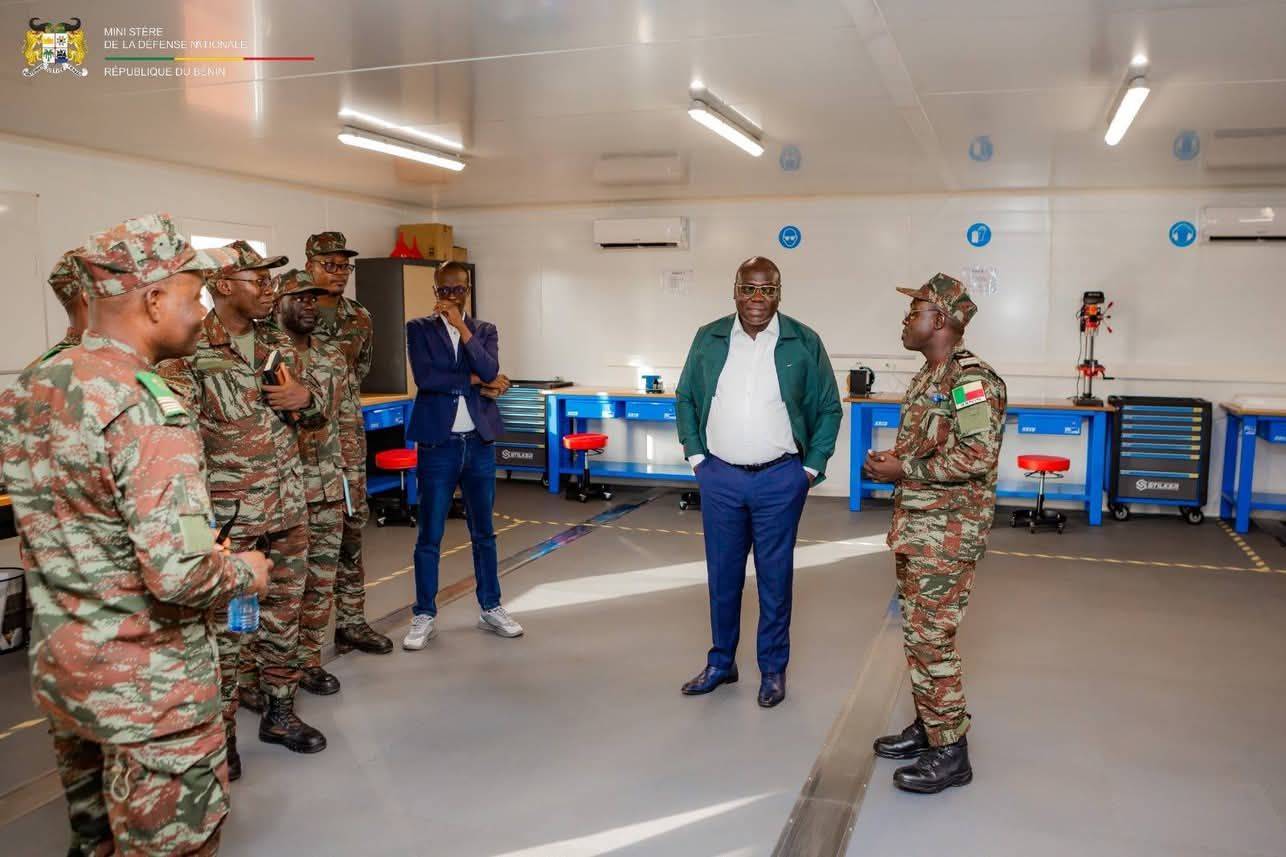
Accompanied by Lieutenant-Colonel Olayéni Thierry Monda, base commander and host of the visit, the minister toured the school’s three core pillars: training, maintenance and innovation. Inside the hangars, cadets demonstrated a reconnaissance drone they had assembled themselves, showcasing the practical skills now taught to every student. The simulator room—stacked with flight-training rigs identical to those in regional air forces—was next on the itinerary, followed by the maintenance bays where future technicians service turbines and avionics under instructor supervision.
The minister paused in the drone-operations bay to quiz the cadets on their navigation exercises. According to instructors, the students are now clocking more flight hours than at any point in the school’s six-year history, yet the hardware they handle remains a generation behind current NATO standards.
Runway deterioration takes centre stage on the national agenda
The field visit ended on the flight line, where the minister inspected the ageing asphalt of Cana’s runway. Base officials confirmed that the surface shows cracks at regular intervals, fails load-bearing tests and lacks the lighting and markings required for night operations. A provisional report, handed to Agonkan that morning, estimated renovation costs at roughly $8 million—less than 0.2 % of Benin’s annual defence budget.
The minister’s reaction was blunt: “We cannot train pilots to fly the skies of tomorrow with equipment from the 1980s.” He immediately tasked his technical staff to draft a prioritised upgrade plan within 30 days.
The minister’s road-map for Cana’s ascent as a sub-regional hub
Speaking to assembled officers, Agonkan laid out a three-stage strategy:
- Stage one (2027): emergency runway and lighting upgrades, plus installation of a perimeter fence to meet international security protocols.
- Stage two (2028-2029): procurement of six modern flight simulators, doubling of the engine-maintenance workshop capacity, and accreditation of the drone-pilot syllabus by the African Civil Aviation Commission.
- Stage three (2030): construction of a dedicated innovation lab and the launch of an officer-exchange programme with two West African air forces.
The ultimate target is clear: to transform EAM-Cana into a sub-regional aeronautical academy capable of certifying pilots, mechanics and air-traffic controllers who meet ICAO’s stringent requirements. In doing so, Benin would no longer need to send its recruits abroad for advanced training—a move projected to save $4 million annually in foreign-exchange outflows.
Public scepticism meets minister’s resolve
Critics argue that ambitious timelines rarely survive contact with budget realities. They point to past pledges—on vehicle fleets, cyber-defence and radar systems—that were announced with fanfare but delivered years late or not at all. Agonkan acknowledged the scepticism but insisted that this time the paperwork is already in motion. A special inter-ministerial task force has been created to cut red tape and monitor progress quarterly.
“The question is no longer if we can do it,” he told reporters after the visit, “but how quickly we can convince every partner—government, private sector and international allies—that Cana is worth every franc we invest.”
The day after the visit: what analysts predict next
Independent defence analysts now offer two contrasting outlooks:
- Scenario A: Rapid take-off – If the emergency runway repair begins within 90 days and the simulator contracts are signed before March 2027, Cana could host its first class of ICAO-certified pilots by 2029. This scenario would place Benin on track to become West Africa’s fourth operational drone hub, after Nigeria, Ghana and Senegal.
- Scenario B: Protracted stagnation – Delays in funding release or quarrels over tender procedures could push runway repairs into late 2027, effectively deferring any new certifications until after 2032. In this case, the country would remain dependent on foreign training slots and exposed to supply-chain disruptions in equipment procurement.
Either way, the minister’s visit has crystallised the debate: tomorrow’s aerial sovereignty is being shaped in the classrooms and hangars of Cana today. The nation now watches closely—and the clock is ticking.