The government’s restricted flour trade policy: balancing food security with economic impact
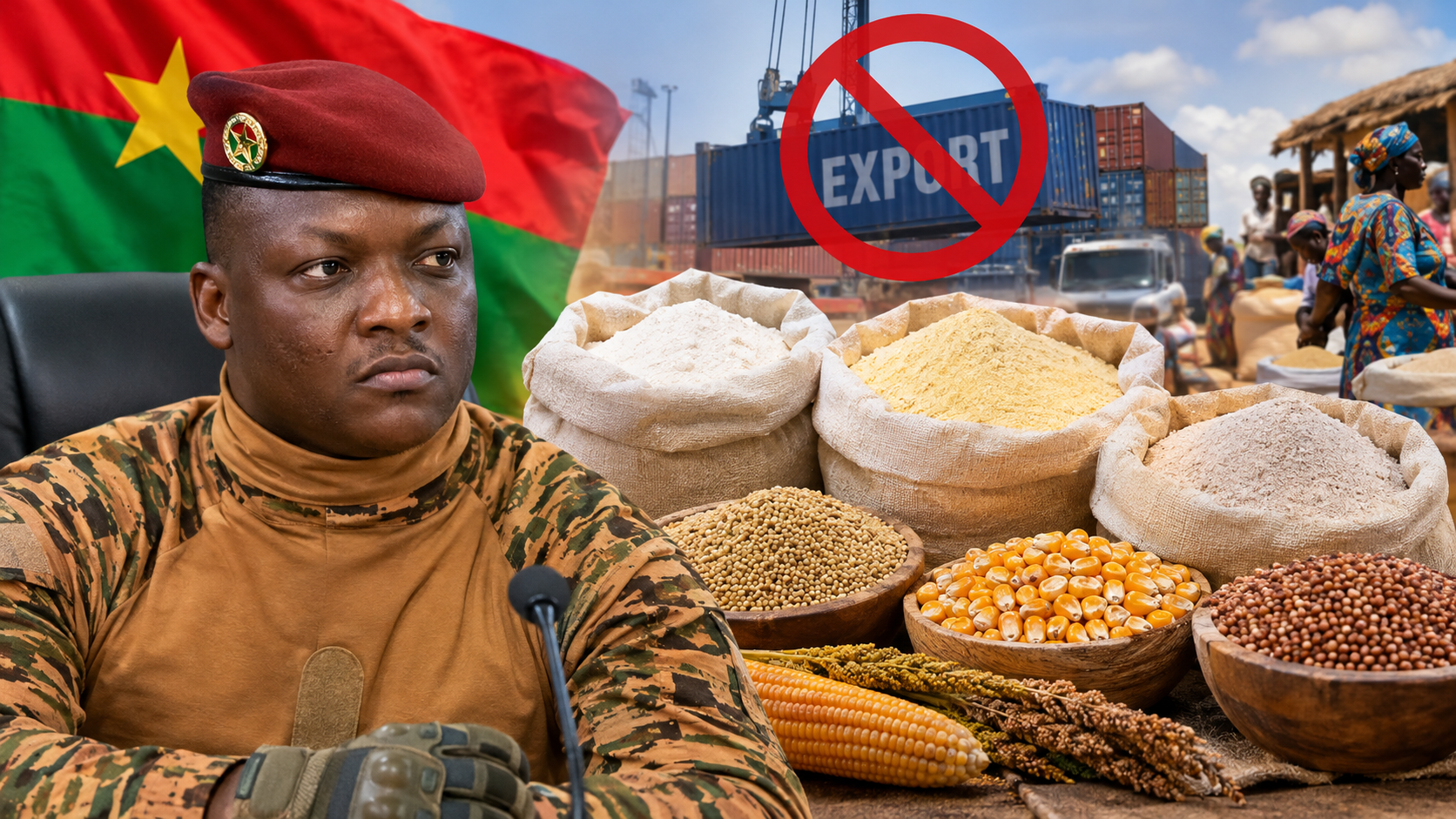
The Burkinabè authorities have announced an immediate suspension of export permits for millet, maize, and sorghum flours, as well as their derivatives. This decision, formalized in a ministerial circular, aims to ensure sufficient domestic supply amid ongoing food security concerns. While the stated objective is to stabilize the local market, the measure raises critical questions about the limits of governmental intervention and the protection of economic freedoms.
Can a state justifiably restrict trade to prioritize its citizens’ needs, or does such a move risk marginalizing key economic actors without delivering tangible benefits? The ban’s effectiveness hinges not only on supply availability but also on how well it is enforced and whether it inadvertently undermines the livelihoods of producers and traders who rely on international markets.
The debate extends beyond commerce. It touches on the transparency of policy-making, the government’s accountability to its citizens, and the long-term consequences of placing economic decision-making under state control. Critics argue that while food security is a legitimate goal, the manner in which this restriction was implemented without broader consultation sets a troubling precedent for how future economic measures may be rolled out.
Public reactions: A spectrum of support, skepticism, and resistance
The announcement has elicited mixed responses across Burkina Faso’s political, economic, and consumer landscapes. Some stakeholders, particularly those representing rural farming communities, argue that the ban could stabilize local grain prices and ensure affordable staples for households already struggling with inflation.
However, representatives from the milling and trading sectors express concerns over lost revenue streams. Exporters, many of whom have established cross-border supply chains, now face sudden disruptions that could jeopardize small-to-medium enterprises. Consumer advocacy groups add another layer to the discourse, questioning whether the ban alone will translate into lower retail prices or improved food accessibility, especially in urban areas where demand for diversified diets is high.
The lack of public consultation surrounding the decision has further fueled criticism. Economic analysts point out that while the intent may be protective, measures of this nature should be accompanied by clear frameworks for review, stakeholder engagement, and measurable outcomes lest they become yet another example of top-down policy-making that sidelines citizen participation.
What lies ahead: Potential consequences and policy expectations
The immediate impact of the flour export ban will unfold in the coming weeks as traders and consumers adjust to the new reality. Key to this transition will be the government’s ability to:
Monitor domestic price fluctuations and ensure fair distribution across regions
Support producers to maintain output and quality standards without reliance on export markets
Provide clear, data-backed justification for the measure and outline benchmarks for its eventual lifting
But beyond logistics, the real test lies in public perception. Will this policy be viewed as a necessary safeguard or as an overreach that erodes confidence in the government’s economic stewardship? The coming months may reveal whether it succeeds in stabilizing supply chains or if it merely redistributes scarcity without resolving underlying vulnerabilities in Burkina Faso’s food system.
The broader implication: A shift toward centralized economic control?
Some observers see the flour export ban as part of a wider trend in which Burkinabè authorities increasingly intervene in markets under the banner of national interest. While such measures may offer short-term stability, they risk normalizing centralized oversight with limited avenues for public feedback or appeal. As global supply chains continue to face disruptions, governments worldwide are grappling with the balance between protectionism and open trade.
In Burkina Faso, the decision forces a reckoning: Can a state protect its citizens from scarcity without undermining the very systems it depends on competitive markets, fair pricing, and economic opportunity? Or does today’s restriction pave the way for tomorrow’s broader controls, gradually eroding the freedoms that sustain both entrepreneurs and consumers?
The path forward demands more than restrictions it requires robust dialogue, transparent implementation, and tangible improvements in living standards. For the Burkinabè, the question isn’t just whether their flour will stay home. It’s whether their government’s approach to food security will leave them with dignity, choice, and economic resilience in the long run.
By Ramatou Soumana — Journalist