
Digital repression: Burkina Faso’s evolving censorship tactics
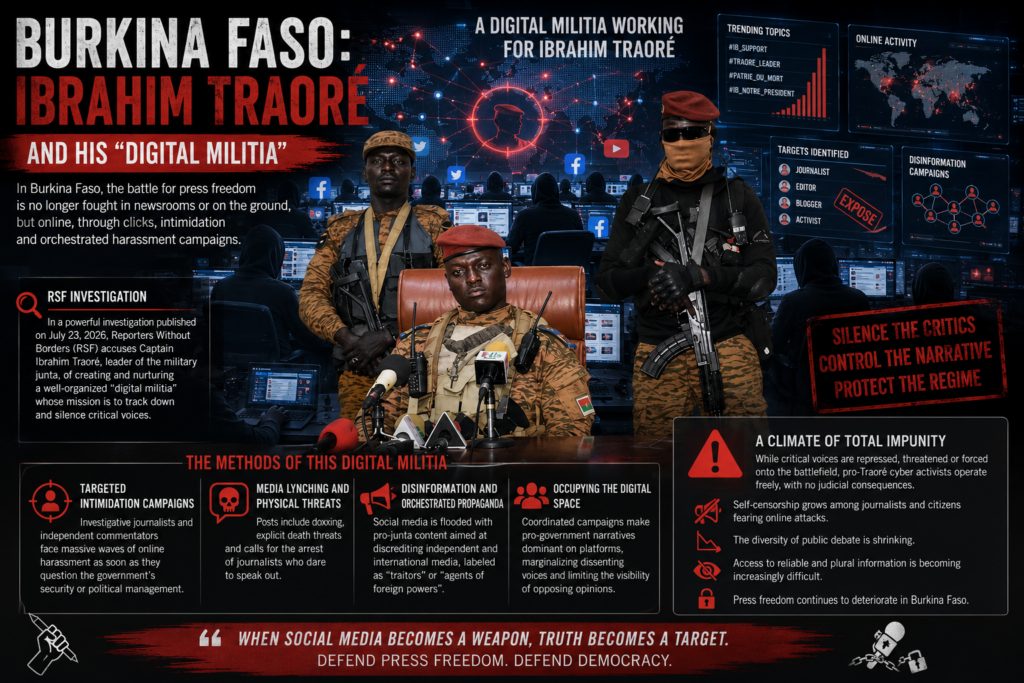
In Burkina Faso, the struggle for press freedom has expanded beyond traditional newsrooms and field reporting, entering the digital realm through coordinated online campaigns and targeted harassment. A comprehensive investigation reveals how the current military leadership has systematically cultivated a network of digital enforcers to silence dissenting voices.
The emergence of cyber-enforcement battalions
The heart of this suppression strategy lies in a well-organized group of online activists operating under the name Bataillons d’Intervention Rapide en Communication (BIR-C). While their title mirrors that of military units, their operations extend into the digital sphere, where they work to dominate public discourse and stifle opposing viewpoints.
The investigation highlights how these actors function with military precision to manipulate online narratives. Their coordinated efforts aim not only to defend government policies but also to create an environment where criticizing the regime carries severe consequences. This goes beyond typical political activism, representing a structured campaign to suppress independent journalism.
Tactics employed by the BIR-C network
The methods used by these digital enforcers include:
- Targeted intimidation campaigns: Investigative journalists and independent commentators face coordinated online harassment whenever they challenge government security policies or political decisions.
- Systematic doxxing and physical threats: Critics are not only subjected to smear campaigns but also face doxxing—where their personal information is exposed—and explicit threats of violence or arrest.
- State-sponsored disinformation: Pro-government content floods social media platforms to discredit independent and international media outlets, often labeling them as “traitors” or “foreign agents.”
- Occupation of digital spaces: Coordinated efforts ensure that pro-regime narratives dominate online conversations, drowning out critical perspectives and reducing the visibility of dissenting opinions.
A climate of unchecked impunity
The investigation underscores the absence of legal consequences for these actions. While critics face swift repression or forced conscription, pro-government cyberactivists operate with impunity, shielded by tacit state protection. This lack of accountability fosters an environment of self-censorship, where journalists, bloggers, and citizens refrain from addressing sensitive topics—particularly those related to security, governance, or military operations—due to fear of harassment.
Eroding democratic debate through digital control
Political communication experts warn that when online spaces become dominated by coordinated propaganda, public debate loses its pluralism. Diverging opinions become marginalized, while pro-government narratives gain disproportionate influence in digital conversations. This polarization further restricts citizens’ access to balanced information, a critical element for understanding national issues and evaluating public policies.
The tactics documented in Burkina Faso mirror strategies observed in other authoritarian or hybrid regimes, where coordinated cyberactivists are deployed to defend ruling powers, undermine independent media, and manipulate online discourse. International press freedom organizations now recognize these campaigns as a sophisticated form of pressure—less visible than traditional censorship but equally effective in silencing criticism.
A broader landscape of repression
This digital crackdown does not exist in isolation. It compounds existing restrictions on media freedom in Burkina Faso, where international outlets have faced suspensions or bans, and journalists report intimidation, forced appearances before authorities, or temporary disappearances. For press freedom advocates, the combination of administrative measures, security pressures, and online harassment progressively shrinks the space for independent expression.
International implications of Burkina Faso’s digital authoritarianism
The findings of this investigation highlight the deteriorating state of democratic freedoms and press independence in Burkina Faso since the military takeover. By weaponizing social media, the regime has transformed these platforms into tools of political coercion, making independent journalism increasingly perilous in the country.
This development raises concerns among international partners who assess press freedom indicators when evaluating governance quality and institutional environments. A sustained decline in these metrics could negatively impact Burkina Faso’s global standing, affecting investor perceptions and development partnerships.
Moreover, the investigation sheds light on a broader shift in information warfare. While propaganda once relied on state-controlled media, social networks now serve as critical battlegrounds where algorithms, viral content, and rapid dissemination amplify certain narratives while suppressing opposing views. For many observers, this evolution represents one of the greatest challenges to press freedom and democratic debate in politically unstable nations.


More Stories
Mali: près de 80 soldats tués dans l’attaque de Dioura
Côte d’Ivoire : le Burida prépare une distribution record de 795,4 millions FCFA
Paris FC vs Lyon: kick-off time and TV channel for the Ligue 1 matchday 4 clash