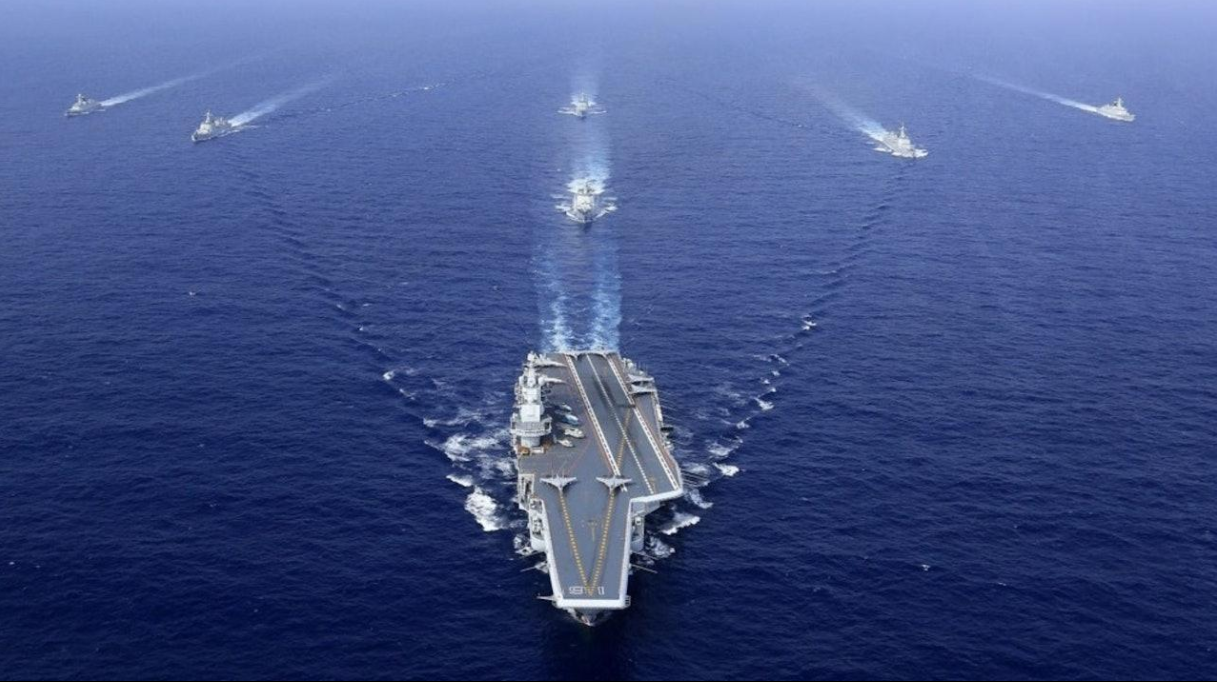
In a dramatic escalation that has sent shockwaves through the Asia-Pacific region, China has launched an unprecedented naval exercise involving over 100 warships near Taiwan—a move that analysts warn signals a critical turning point in regional military dynamics. The maneuvers, described by Taiwanese security officials as anything but routine, included what appears to be the first confirmed test launch of a submarine-launched ballistic missile in the Yellow Sea, a capability that could redefine the balance of power in the Pacific.
Unprecedented naval drill tests new Chinese military capabilities
The Chinese military’s sweeping operation, conducted under a veil of secrecy with no prior announcement, mobilized vessels from multiple fleets—the Eastern, Northern, and Southern Theater Commands—along with the carrier battle group centered around the Liaoning. More than 100 ships participated in what Taiwanese sources describe as a full-scale rehearsal for potential scenarios, including the encirclement of Taiwan, maritime blockade enforcement, and neutralization of adversarial forces.
The scale and coordination of the drill underscore Beijing’s growing ambition to project power beyond its immediate waters. By deploying assets from distant command regions simultaneously, China demonstrated its ability to sustain operations across vast distances—a capability traditionally associated with naval superpowers.
Military objectives reveal long-term strategic intentions
According to intelligence sources closely monitoring the situation, the exercises were designed to test several high-stakes military strategies:
- Taiwan encirclement drills: Simulations of blockading the island by controlling key maritime chokepoints.
- Anti-access/area denial (A2/AD): Exercises to restrict foreign naval movements in the Western Pacific.
- Nuclear deterrence messaging: The suspected submarine-launched missile test sent a clear signal about China’s expanding underwater strategic capabilities.
- Regional pressure tactics: Coercive maneuvers aimed at testing allied responses and signaling resolve without triggering direct conflict.
By the end of the second week of November, approximately 70 Chinese vessels remained positioned along the so-called first island chain, a critical barrier of islands stretching from Japan through Taiwan to the Philippines.
Submarine missile test heightens nuclear deterrence concerns
While most of the naval activity has drawn predictable scrutiny, the reported submarine-launched ballistic missile (SLBM) test has injected a new layer of urgency into regional security assessments. Taiwanese defense officials confirmed that a Chinese submarine conducted what they describe as an intercontinental ballistic missile (ICBM) launch in the Yellow Sea, though no independent technical verification has been publicly released.
The implications are profound: SLBMs are among the most survivable components of a nuclear arsenal, capable of remaining undetected during patrols and delivering a devastating second-strike capability. If confirmed, this would mark a significant leap in China’s strategic sea-based deterrent—a domain where it has historically lagged behind the United States and Russia.
Military analysts caution that while the missile’s precise specifications and trajectory remain unverified, even the perception of such a capability could alter the strategic calculus among Japan, the United States, and their allies in the Indo-Pacific.
Taiwan faces a mounting silent pressure campaign
Unlike traditional military posturing, Beijing appears to be employing what Taiwanese officials characterize as “silent intimidation”—a strategy designed to exert psychological and military pressure without triggering overt reactions. By conducting large-scale drills with no prior announcement, China forces Taipei to operate under constant uncertainty, while minimizing diplomatic fallout that could provoke international condemnation.
This approach allows Beijing to:
- Test the preparedness and reaction times of regional militaries.
- Assess the cohesion and coordination among U.S.-Japan alliances.
- Gradually normalize increased military presence around Taiwan, reducing the perceived legitimacy of external intervention.
The timing—just days before the APEC summit in Shenzhen—has fueled speculation that the drills may have been intended to signal strength in advance of high-level diplomatic engagements. However, no direct link between the two events has been established.
Regional allies brace for potential escalation
The fallout from China’s military maneuvers extends far beyond the Taiwan Strait. Japan stands at the epicenter of the crisis, given its proximity to the first island chain and its status as a key U.S. ally. A potential blockade or conflict near Taiwan could disrupt critical shipping lanes, threaten Japan’s energy supply routes, and complicate operations for American forces stationed in Okinawa.
Meanwhile, Washington has framed the situation as a direct challenge to freedom of navigation and regional stability. The G7 foreign ministers’ joint statement on November 11 condemned China’s maritime assertiveness, emphasizing threats to commercial shipping and international law. Yet, the effectiveness of such diplomatic rebukes in curbing Beijing’s military ambitions remains uncertain.
Despite these rising tensions, no evidence suggests that the suspected missile launch had Japan—or any other nation—as a target. The focus appears to be on demonstrating capability rather than immediate provocation.
What’s next for Taiwan and the Pacific theater?
Analysts warn that these maneuvers are not isolated incidents but part of a broader, long-term strategy to reshape the security architecture of East Asia. The combination of naval mass mobilization, simulated attacks on foreign targets, and a potential nuclear-capable SLBM test illustrates a shift from symbolic posturing to active deterrence.
For Taiwan, the challenge is clear: to counter Beijing’s incremental pressure without escalating into open conflict. The island nation must enhance its own asymmetric capabilities, deepen security ties with like-minded partners, and prepare for a future where military intimidation—not outright invasion—becomes the primary threat.
As the world watches, one question looms large: How far will China go to enforce its dominance in the Taiwan Strait—and how will the world respond to this new era of strategic maneuvering?