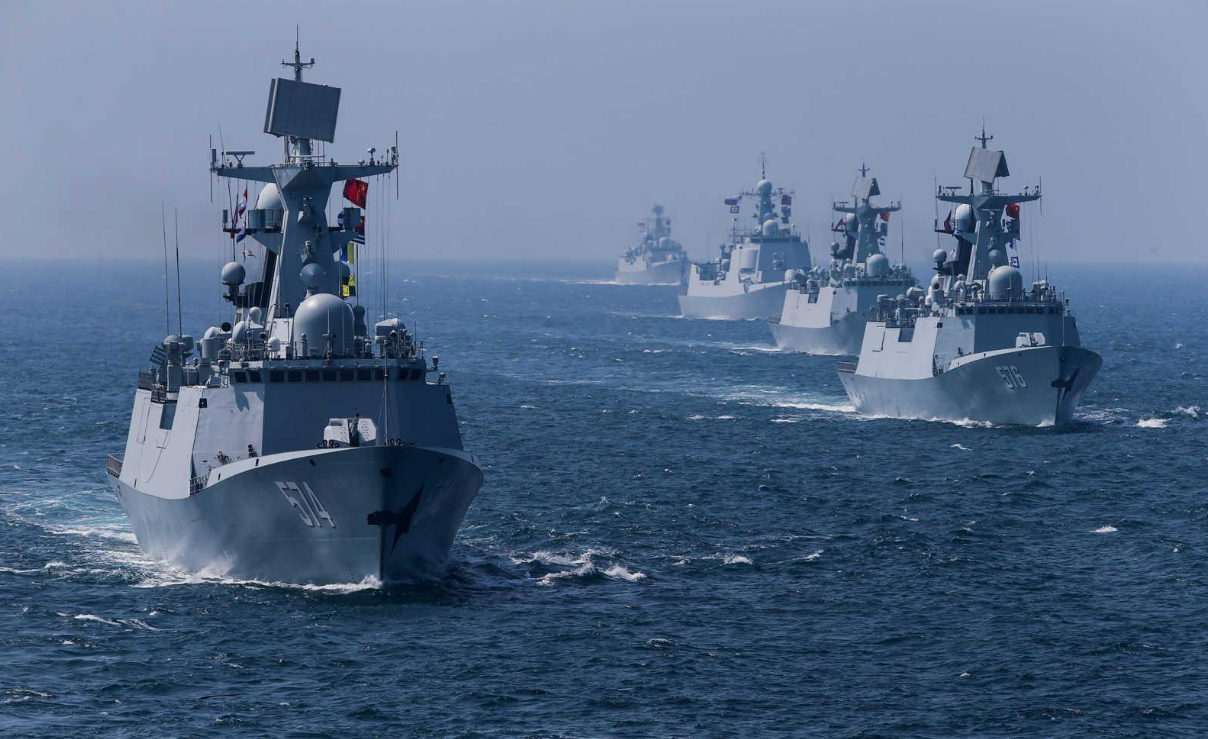
A decisive turning point in Asia-Pacific security dynamics unfolded in early November 2026 when China launched its most ambitious naval exercise in years around Taiwan, prompting an immediate US response. Over 100 Chinese warships and coast guard vessels—drawn from all three of Beijing’s naval commands—conducted large-scale operations stretching from the Taiwan Strait to the Western Pacific, signaling a major shift in military posture.
China’s naval show of force redefines regional power balance
The scale of the Chinese deployment caught regional observers off guard. More than 100 military and coast guard vessels participated in coordinated maneuvers that went beyond routine drills. For the first time, ships from the Eastern, Northern, and Southern Fleets operated simultaneously in a unified exercise, suggesting a breakthrough in inter-command cooperation.
The operations included simulated attacks on military targets and urban areas, with approximately 70 ships still present in the First Island Chain area days after the initial mobilization. While Beijing did not issue an official announcement, the demonstration of naval strength sent a clear message about China’s capacity to project power across maritime approaches to Taiwan.
Taipei braces for potential blockade scenarios
For Taiwanese authorities, the naval exercises represent more than just military posturing. Analysts warn that such coordinated movements could serve as a rehearsal for potential blockades designed to isolate the island—without the need for direct invasion. By controlling maritime and air access, Beijing could disrupt critical supply routes and complicate foreign intervention, turning the pressure dial to its maximum setting.
According to defense experts, these maneuvers align with long-standing Chinese military doctrine on “area denial” strategies. The Institute for the Study of War’s assessment highlighted how such exercises test Taiwan’s vulnerability to economic strangulation and logistical disruption, making every port and shipping lane a potential flashpoint.
US ‘nuclear sniffer’ aircraft takes center stage in high-stakes monitoring
Amid China’s naval surge, an unarmed WC-135R Constant Phoenix—dubbed the “Nuclear Sniffer”—conducted an aerial mission that deepened military tensions. The aircraft, specially modified for atmospheric sampling, took off from Kadena Air Base in Okinawa and flew south of Taiwan before heading toward the southwestern approaches of the strait.
Equipped with advanced radiation detection systems, the WC-135R is typically deployed to monitor nuclear test activities or detect unexpected radiological events. Its presence in a region undergoing Chinese military escalation raised immediate questions: Was it tracking possible nuclear-related developments, or was it gathering intelligence on China’s actual naval operations?
Washington’s strategic surveillance: intelligence gathering or deterrent signal?
While US officials have not confirmed the aircraft’s mission, its timing and route suggest a deliberate surveillance effort. Given Kadena’s role as a key US military hub in East Asia, the WC-135R could be part of a broader reconnaissance network monitoring Chinese military movements.
The flight’s trajectory—passing through a zone where Chinese ships were conducting anti-access maneuvers—hints at a possible link between the two events. However, without official disclosure, any direct connection remains speculative. Yet the very presence of advanced detection technology underscores Washington’s commitment to maintaining visibility over Beijing’s naval activities.
Taiwan’s future hangs in the balance as superpower tensions rise
The convergence of Chinese naval power and US intelligence operations places Taiwan at the center of a dangerous geopolitical equation. With Beijing refusing to rule out force to achieve reunification and Taipei refusing to compromise on sovereignty, the stakes could not be higher.
The island’s semiconductor industry—critical to global tech supply chains—adds another layer of urgency. Any prolonged disruption in the Taiwan Strait could ripple across industries from smartphones to electric vehicles, sending shockwaves through the world economy.
As military observers warn of a rapidly deteriorating security environment, one fact remains undeniable: the Western Pacific has become the epicenter of a new cold war. In this high-stakes chessboard, every movement—whether a ship, a plane, or a diplomatic statement—is now analyzed with unprecedented scrutiny.