
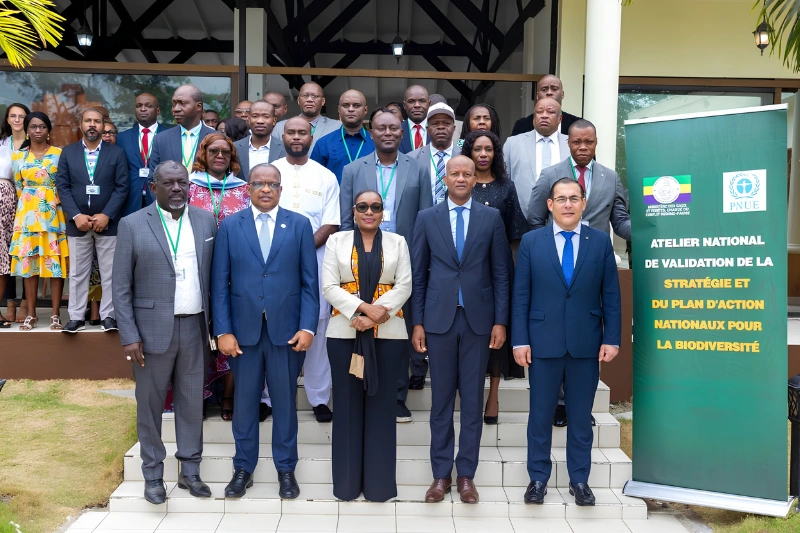
The future of Gabon’s lush forests, pristine coastlines, and diverse wildlife has just taken a monumental leap forward. Following intensive collaborative sessions, the national workshop for validating the National Biodiversity Strategy and Action Plan (NBSAP) 2022-2030 officially concluded in Libreville this week.
Setting the stage for ecological preservation
At the heart of this initiative lies a groundbreaking roadmap: safeguarding at least 30% of the country’s territory—including terrestrial, coastal, and marine zones—by 2030. This strategic document is designed to serve as a guiding compass for public policies, ensuring the sustainable management of Gabon’s unparalleled biological heritage while reinforcing ecosystem protection.
The NBSAP is Gabon’s direct response to the global commitments made under the Kunming-Montreal Global Biodiversity Framework, aligning the nation with four critical priorities:
- Expand protected areas: Ensuring that 30% of Gabon’s land and marine ecosystems fall under conservation measures.
- Restore degraded habitats: Reviving ecosystems that have suffered from human activity or environmental stress.
- Combat biodiversity threats: Addressing urgent challenges such as poaching, deforestation, and pollution.
- Secure sustainable funding: Mobilizing long-term financial resources to support conservation efforts.
From vision to action
After incorporating insights from stakeholders nationwide, the finalized NBSAP is set to be submitted to the Government for formal approval. Once validated, it will be formally presented to the Convention on Biological Diversity (CBD) Executive Secretariat, cementing Gabon’s leadership in global biodiversity conservation.
« The real challenge lies ahead, » emphasized Ms. Tsayi Mouvagha, the NBSAP coordinator. « Our next mission is to ensure this strategy is not just a document on paper but a living framework adopted by government agencies, private enterprises, local communities, and civil society across the country. »
Gabon’s ecological significance
With over 88% forest cover and 13 national parks, Gabon stands as a biodiversity hotspot in Central Africa. The NBSAP 2022-2030 aims to strike a delicate balance between economic progress, resource utilization, and environmental stewardship. Yet, the success of this ambitious plan hinges on one crucial factor: sustained funding and grassroots involvement.
Without dedicated budget allocations and active participation from local governments, businesses, and surrounding communities, this vision risks remaining an unfulfilled promise. The road to ecological sustainability demands collective commitment—from policymakers to citizens.




More Stories
Is Chad truly heading towards political appeasement?
Bradley Barcola will adapt faster than Florian Wirtz at Liverpool, says Jermaine Pennant
Togo eyes nuclear power to secure future energy sovereignty