
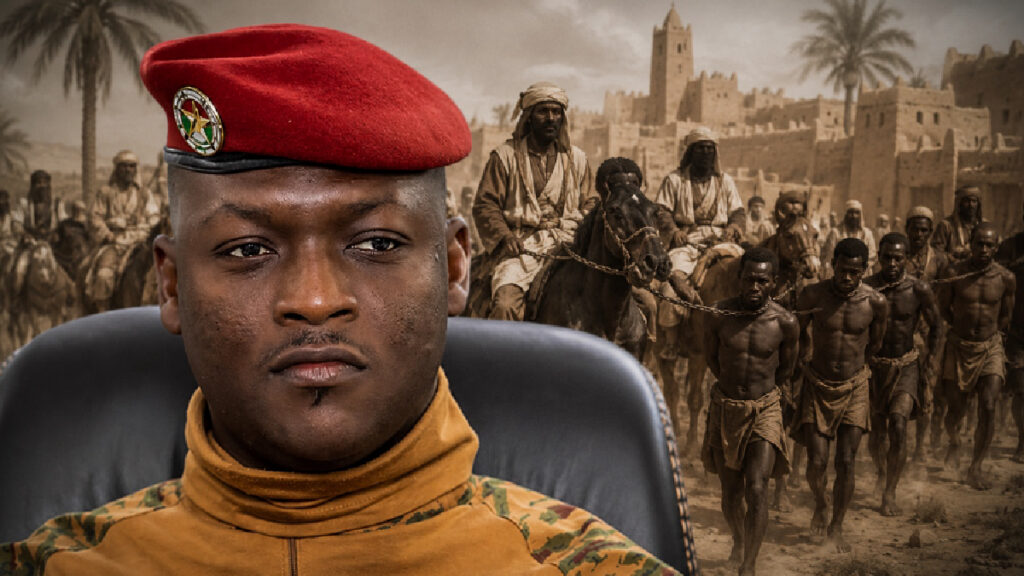
Ibrahim Traoré’s bold stance on Arab slavery and radical Islam in the Sahel
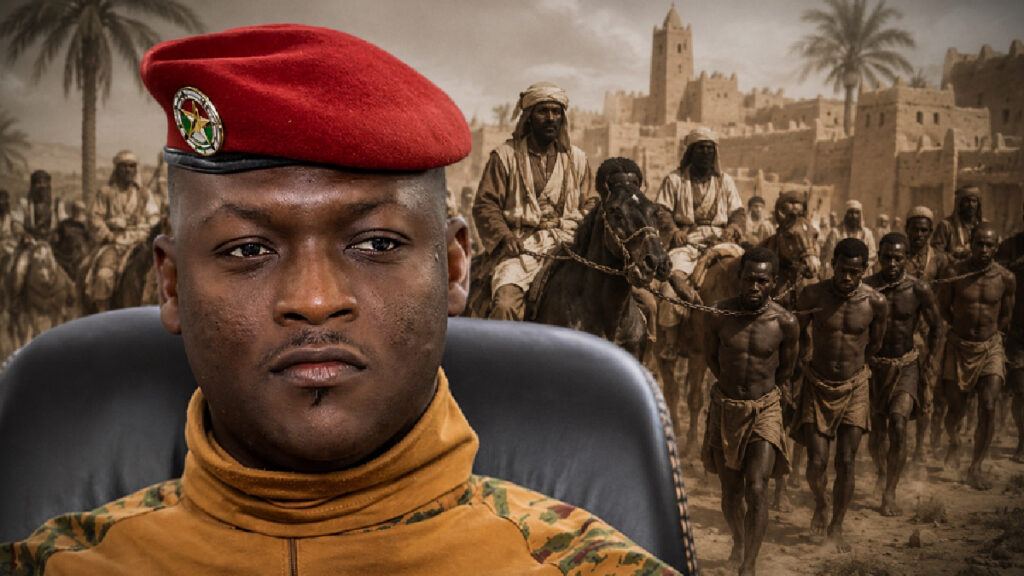
The captain, now leader of Burkina Faso, has shattered a long-standing taboo by linking the region’s ongoing jihadist violence to centuries of Arab slavery, exposing uncomfortable truths about Islam’s role in African history.
The unspoken burden of history
For years, African leaders—both civilian and military—have avoided addressing the dark legacy of Arab-led slave trade in the Sahel. When Ibrahim Traoré publicly connected this historical injustice to today’s extremist groups during a speech in Ouagadougou, he did more than provoke debate; he forced a reckoning with a past that many prefer to ignore.
Between the 7th and 19th centuries, millions of Africans were forcibly taken from the Sahel—from the shores of Lake Chad to the deserts of Mali and Niger—and sold in markets across Tripoli, Cairo, and Zanzibar. While Western academia has extensively documented the transatlantic slave trade, the Arab-dominated version remains largely absent from public discourse. Why? Because it challenges a narrative that frames Islam as a liberator, not an oppressor.
Traoré’s remarks expose a painful reality: the same religious ideology that once justified slavery now fuels modern jihadism. Groups like Jama’at Nasr al-Islam wal Muslimin (JNIM) and Islamic State in the Greater Sahara (ISGS) may present themselves as movements against colonialism, but their roots lie in a history of conquest and subjugation that predates European rule.
The politics of historical memory
Historical records—from the chronicles of Ibn Battuta to the manuscripts of Tombouctou—document the systematic nature of this trade. Yet, no truth commission in Agadez or Tombouctou has ever addressed it. No national museum in Ouagadougou, Bamako, or Niamey acknowledges its existence. Why? Because post-colonial elites, trained to unite against former colonizers, have chosen silence over confrontation.
This silence has allowed extremist groups to monopolize historical interpretation. By framing their struggle as resistance against neocolonialism, they’ve erased their ties to an ideology that has long justified violence in the name of religious supremacy. Traoré’s intervention disrupts this narrative, forcing Africans—and the world—to confront an uncomfortable truth: Islam’s expansion in the Sahel was not always a force for liberation.
A tactical gamble with high stakes
On the surface, Traoré’s strategy appears clever. By framing the fight against terrorism as a battle against foreign domination—both colonial and Arab—he seeks to rally rural communities, the primary victims of jihadist violence, who have long felt abandoned by urban elites tied to Qatari or Saudi funding.
But the move is risky. It risks alienating Gulf allies, whose religious influence has shaped the Sahel’s Islamic landscape for decades. It also risks splitting the pan-African front against Western domination, as some intellectuals may see Traoré’s words as an attempt to divide Black solidarity.
The captain is walking a tightrope. History is a minefield, and he’s stepping through it with the confidence of a soldier, not the caution of a diplomat.
Western hypocrisy and the politics of memory
What makes Traoré’s speech so unsettling for Western chancelleries is that it exposes the contradictions in their own memorial policies. Institutions like UNESCO and Western universities have mastered the art of selective remorse: they mourn the transatlantic slave trade but remain silent on the Arab version. The French political class, in particular, has perfected the art of celebrating diversity while stifling criticism of radical Islam under the guise of “Islamophobia.”
Traoré is not asking for reparations or apologies from France. He’s demanding that Africans confront their own history—even when it implicates allies in the Gulf. This demand for intellectual independence, however blunt, is perhaps what unsettles Parisian salons the most. It signals that Africa is no longer willing to let former colonial powers dictate its historical narrative.
A lesson for the West
What can we learn from this Sahelian reckoning? First, that rival memories cannot be pacified with subsidies or UN resolutions. They must be confronted head-on. Second, that political Islam in Africa is not merely an imported ideology—it is deeply rooted in a centuries-old history of conquest and enslavement that Africans have long chosen to overlook.
Traoré has taken a side. The question now is whether his exhausted nation, ravaged by a decade of asymmetric warfare, has the strength to endure this historical upheaval. Historians may argue that he oversimplified a complex tragedy. Politicians may claim he lacked nuance. But one truth remains: in Africa, as anywhere else, nations that fail to shape their own history are doomed to repeat it.
While Parisian pundits debate repentance and intersectionality, a Sahelian military leader with calloused hands is reminding them of the raw order of history. Truth may set people free, but in the Sahel, it is a lion that must be tamed. Ibrahim Traoré has just opened its cage. Whether he can bear its weight remains to be seen—especially as the guardians of political correctness will show no mercy.


More Stories
China expands military footprint in Gabon with strategic defense ties
How Cameroon’s leadership is shaped by a single hand
Exploring abéché’s sudanese soul in Chad’s heartland