
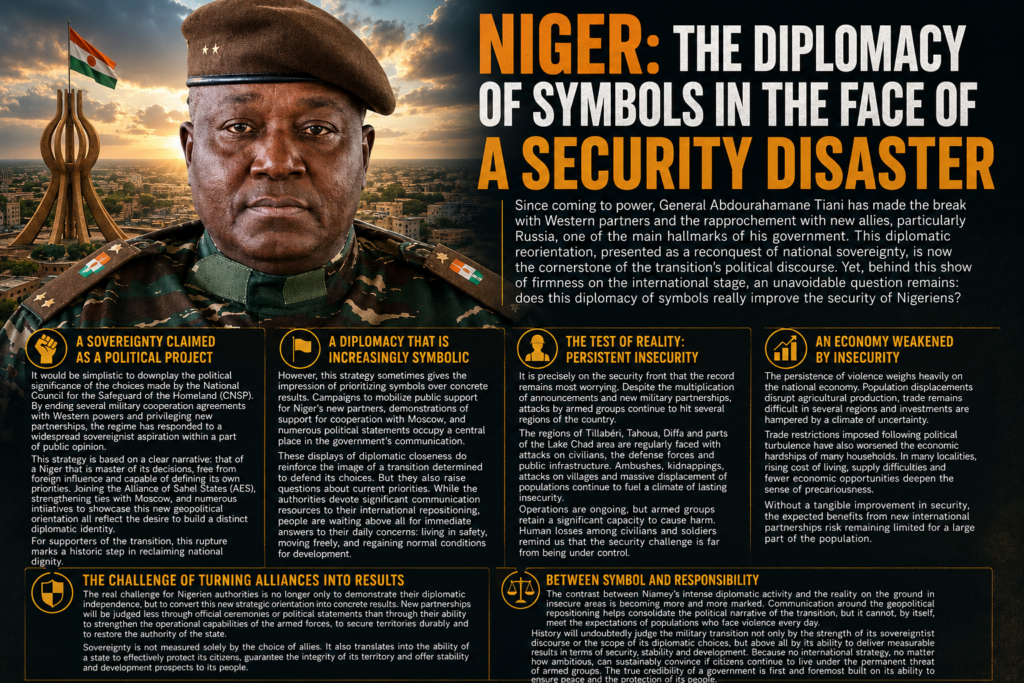
Since assuming leadership, General Abdourahamane Tiani has positioned the reconfiguration of Niger’s international alliances—particularly the severing of ties with Western partners and the forging of new ties with Russia—as a cornerstone of his administration. This diplomatic pivot, framed as an assertion of national sovereignty, now underpins the political narrative of the transitional government. Yet, the pressing question remains: does this strategy of symbolic diplomacy translate into tangible improvements in security for the people of Niger?
Sovereignty as a political project
The National Council for the Safeguard of the Homeland (CNSP) has implemented decisions that reflect a broader sovereignist ambition, resonating with a significant segment of public opinion. By terminating multiple military cooperation agreements with Western nations and prioritizing alternative partnerships, the regime has aligned itself with a deeply rooted desire for self-determination.
The political narrative is unambiguous: Niger must reclaim control over its destiny, free from external pressures, and define its own priorities. Membership in the Alliance of Sahel States (AES), deepened relations with Moscow, and a series of diplomatic initiatives are all designed to project a distinct geopolitical identity. For supporters of the transition, this break from decades of dependency represents a historic step toward reclaiming national dignity.
The limits of symbolic diplomacy
While these measures bolster the government’s image as resolute and independent, they often prioritize symbolic gestures over substantive outcomes. Public mobilization campaigns celebrating new international partnerships, rallies in support of collaboration with Russia, and high-profile political declarations dominate the state’s communication strategy. These displays reinforce the narrative of a determined leadership but raise concerns about shifting priorities.
The population’s immediate needs—security, freedom of movement, and the restoration of normalcy—remain unmet. As the government invests heavily in redefining its diplomatic alliances, citizens continue to grapple with the realities of persistent insecurity, where daily life is disrupted by violence and instability.
The harsh reality of ongoing insecurity
The security landscape remains dire, despite the proliferation of military partnerships and strategic announcements. Regions such as Tillabéri, Tahoua, Diffa, and parts of the Lake Chad area continue to endure relentless attacks by armed groups. Civilians, defense forces, and public infrastructure are frequent targets, with ambushes, abductions, village assaults, and mass displacements creating a climate of enduring fear.
Military operations persist, yet armed factions maintain significant operational capacity. The human toll—among both civilians and soldiers—underscores the magnitude of the challenge. For those living in the most affected areas, geopolitical debates feel distant from their daily struggles, which center on survival, safe passage on roads, reopening schools and health centers, and resuming agricultural and commercial activities.
Economic strain amid persistent violence
The human cost of insecurity is compounded by severe economic repercussions. Population displacements disrupt agricultural productivity, trade routes remain perilous, and investment flows are stifled by uncertainty. Political upheavals have further strained household economies, with rising living costs, supply shortages, and dwindling economic opportunities exacerbating precarity.
Without a tangible improvement in security, the anticipated benefits of new international alliances risk being confined to rhetoric rather than tangible progress for the majority of Nigeriens.
From alliances to action: the critical test
The true challenge for Niger’s leadership is no longer merely to assert diplomatic independence but to convert this strategic reorientation into measurable results. The success of these new partnerships will not be judged by ceremonial events or political declarations but by their capacity to enhance the operational capabilities of the armed forces, secure territories sustainably, and restore state authority.
Sovereignty, in its truest sense, is not defined solely by the choice of allies but by a state’s ability to protect its citizens, safeguard its territory, and offer stability to its people.
Symbolism vs. responsibility
The stark contrast between Niamey’s diplomatic activism and the lived experiences of those in insecure zones grows increasingly evident. While the government’s communication efforts strengthen its sovereignist narrative, they cannot, in isolation, address the urgent needs of citizens facing daily threats.
The legacy of the military transition will ultimately hinge not on the strength of its diplomatic discourse or the boldness of its international choices, but on its ability to deliver measurable progress in security, stability, and development. No international strategy, no matter how ambitious, can endure without tangible improvements in the lives of its people. The true measure of a government’s credibility lies in its capacity to ensure peace and protection for its citizens.


More Stories
Mali: près de 80 soldats tués dans l’attaque de Dioura
Côte d’Ivoire : le Burida prépare une distribution record de 795,4 millions FCFA
Paris FC vs Lyon: kick-off time and TV channel for the Ligue 1 matchday 4 clash