
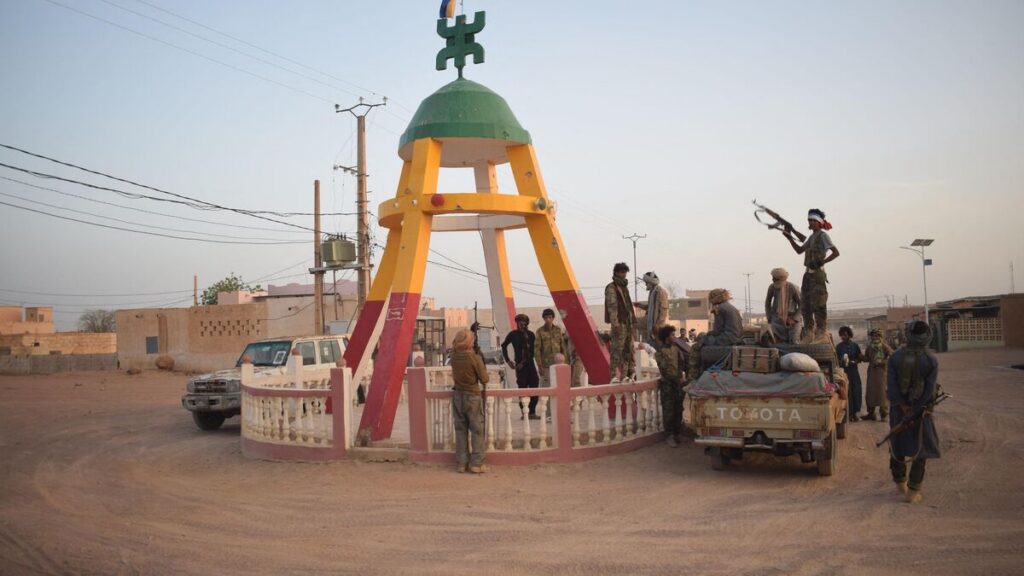
Tuareg rebels of the Azawad Liberation Front (FLA) coalition gather at the Kidal roundabout in Kidal, on April 26, 2026. April 25, 2026's shock attacks, synchronised by Tuareg rebels of the Azawad Liberation Front (FLA) coalition and the jihadist Group for the Support of Islam and Muslims (JNIM), targeted several areas in the vast arid country. Fighting resumed on April 26 in several areas, including Kita near Bamako, Kidal, Gao and Severe. Tuareg rebels meanwhile announced an agreement allowing Russian forces backing Mali's army to withdraw from the northern city of Kidal, which they claimed was "totally" under their control. (Photo by abdollah Ag Mohamed / AFP)
Africa Corps, Russia’s latest paramilitary arm in Africa, has been forced to abandon a key stronghold in Mali after a coordinated offensive by jihadist and Tuareg rebel forces. The withdrawal from Kidal, a strategic city under Moscow’s control for years, marks a significant shift in the Sahel’s shifting security landscape.
The group, considered one of Russia’s most clandestine military outfits abroad, continues to serve as a vital proxy for the Kremlin despite this setback. Its operations extend beyond Mali, reaching Burkina Faso, Libya, Sudan, the Central African Republic, and Niger, where it is quietly consolidating influence.
From shadowy origins to strategic expansion
Russia’s Africa Corps emerged in late 2023, following the decline of the infamous Wagner Group. While Wagner operated with relative autonomy, its successor is tightly controlled by Moscow, with oversight from Deputy Defense Minister Yunus-bek Yevkurov. The transition was formalized after Wagner’s founders, oligarch Yevgeny Prigojine and former intelligence officer Dmitri Utkin, perished in a suspicious plane crash in August 2023.
The new force’s name is no coincidence—it draws inspiration from the Nazi-era Afrikakorps, a historical reference that underscores its aggressive expansionist ambitions. Unlike Wagner, which was often accused of brutal tactics, Africa Corps presents itself as a more disciplined and state-aligned entity, focusing on military support for allied governments.
military and political ambitions in the Sahel
Moscow’s objectives for Africa Corps are clear: to challenge Western influence, secure resource-rich territories, and strengthen pro-Russian regimes. Igor Korotchenko, a Kremlin-linked military analyst, has described the group’s mission as helping African nations break free from neocolonial dependence while eliminating foreign military presence.
In Mali, Africa Corps has deployed hundreds of fighters since 2024, working alongside the junta to suppress rebel movements. The group’s presence aligns with Russia’s broader strategy to fill the void left by Western forces, particularly following France’s withdrawal from the region.
While Africa Corps avoids the overt brutality associated with Wagner, it has not escaped international scrutiny. In 2024, the UK sanctioned the group for alleged human rights abuses and exploitation of natural resources, signaling growing global concern over its expanding footprint.
a calculated shift in tactics
The recent loss of Kidal, a longtime stronghold, highlights the challenges Africa Corps faces in maintaining control. Yet, its ability to adapt—by integrating former Wagner operatives and forging new alliances—demonstrates its resilience. Whether through military muscle or political maneuvering, Africa Corps is steadily embedding itself as a defining force in Africa’s evolving power struggles.

More Stories
Is Chad truly heading towards political appeasement?
Bradley Barcola will adapt faster than Florian Wirtz at Liverpool, says Jermaine Pennant
Togo eyes nuclear power to secure future energy sovereignty