
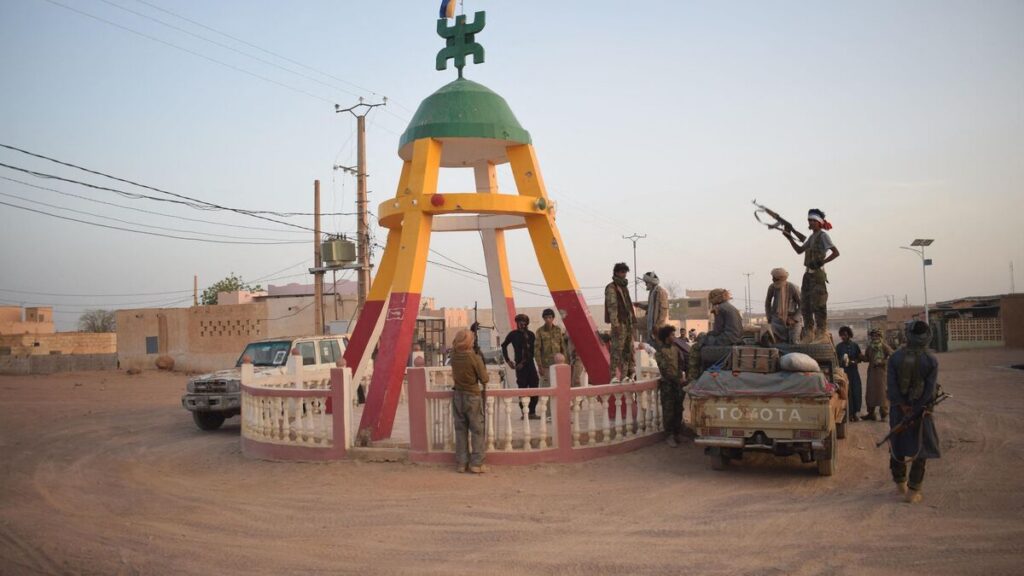
Tuareg rebels of the Azawad Liberation Front (FLA) coalition gather at the Kidal roundabout in Kidal, on April 26, 2026. April 25, 2026's shock attacks, synchronised by Tuareg rebels of the Azawad Liberation Front (FLA) coalition and the jihadist Group for the Support of Islam and Muslims (JNIM), targeted several areas in the vast arid country. Fighting resumed on April 26 in several areas, including Kita near Bamako, Kidal, Gao and Severe. Tuareg rebels meanwhile announced an agreement allowing Russian forces backing Mali's army to withdraw from the northern city of Kidal, which they claimed was "totally" under their control. (Photo by abdollah Ag Mohamed / AFP)
In a dramatic turn of events in Mali, rebels aligned with Tuareg separatists have reclaimed the strategic stronghold of Kidal, a territory long held by the Africa Corps—a shadowy Russian paramilitary unit. The retreat marks a significant shift in the balance of power, though Moscow’s influence in the Sahel remains unshaken.
The Africa Corps, often described as one of Russia’s most clandestine military outfits, emerged in 2023 as a successor to the Wagner Group. Its creation was first hinted at by military blogger Deux Majors on Telegram, who cited statements from Igor Korotchenko, a former Russian colonel and Kremlin-affiliated journalist. The organization is reportedly overseen by Deputy Russian Defense Minister Yunus-bek Yevkurov, signaling direct Kremlin control over its operations.
From Wagner to Africa Corps: a strategic pivot
The Africa Corps was unveiled amid the decline of the Wagner Group, a once-dominant Russian paramilitary force accused of atrocities across Africa. After the mysterious deaths of Wagner’s founders, oligarch Yevgeny Prigojine and ex-intelligence officer Dmitri Utkin, in a 2023 plane crash, the Kremlin sought a more centralized and disciplined alternative. Africa Corps was designed to absorb Wagner’s assets and personnel while maintaining a lower profile to avoid the controversy that plagued its predecessor.
A name steeped in historical controversy
The choice of name was deliberate. Unlike Wagner, which paid homage to a German composer, Africa Corps draws inspiration from the Afrikakorps, the Nazi-aligned military force that operated in North Africa during World War II. The parallel has not gone unnoticed, with critics and analysts drawing connections between the two entities despite Moscow’s attempts to present Africa Corps as a legitimate arm of Russian foreign policy.
Expanding influence across the Sahel
Since its inception, Africa Corps has rapidly expanded its footprint beyond Mali. The group has established a presence in Burkina Faso, Libya, Sudan, the Central African Republic, and Niger, offering military support to allied governments in exchange for political and economic concessions. While its tactics are less overtly violent than Wagner’s, Africa Corps has faced international condemnation. In 2024, the United Kingdom accused the group of “widespread human rights abuses” and “exploiting natural resources for profit.”
Africa Corps in Mali: stakes and ambitions
In Mali, Africa Corps has played a pivotal role in bolstering the junta’s grip on power, particularly in countering Tuareg rebellions and jihadist groups. The group’s withdrawal from Kidal, a key northern city, follows weeks of intense clashes and negotiations, but its influence in the region remains formidable. Analysts suggest Moscow’s objectives extend beyond stability: securing control over migration routes and critical mineral resources, such as gold and uranium, are high on the agenda.
The Africa Corps’ mission is explicitly framed as a campaign to “liberate Africa from neocolonial dependence” and “cleanse Western presence”, according to Korotchenko. By providing military training, weapons, and logistical support to friendly regimes, the group positions itself as a counterbalance to Western powers, including France, which has significantly reduced its military footprint in the region.
Sanctions and scrutiny
Despite its efforts to present a more professional image, Africa Corps has not escaped sanctions. The group’s operations have drawn international condemnation, with reports of human rights violations and resource exploitation. However, its centralized command structure—directly tied to the Russian Ministry of Defense—allows it to operate with greater efficiency and discretion than Wagner ever could.
The Africa Corps may be Russia’s latest weapon in its African strategy, but its long-term success hinges on its ability to navigate Mali’s volatile political landscape and broader regional conflicts. As the junta clings to power in Bamako, the Africa Corps remains a critical, if controversial, player in the Sahel’s evolving power dynamics.

More Stories
China expands military footprint in Gabon with strategic defense ties
How Cameroon’s leadership is shaped by a single hand
Exploring abéché’s sudanese soul in Chad’s heartland