
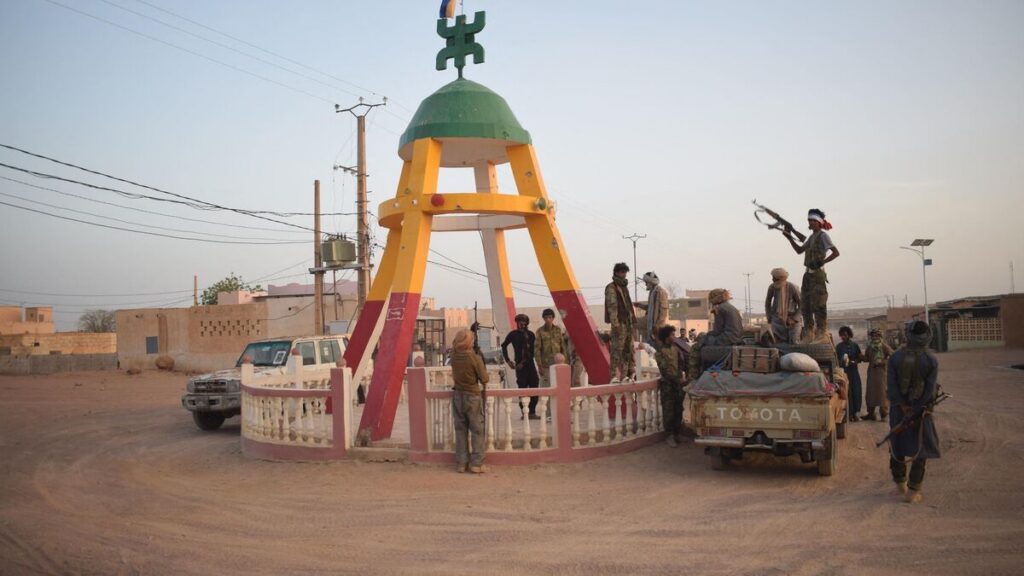
Tuareg rebels of the Azawad Liberation Front (FLA) coalition gather at the Kidal roundabout in Kidal, on April 26, 2026. April 25, 2026's shock attacks, synchronised by Tuareg rebels of the Azawad Liberation Front (FLA) coalition and the jihadist Group for the Support of Islam and Muslims (JNIM), targeted several areas in the vast arid country. Fighting resumed on April 26 in several areas, including Kita near Bamako, Kidal, Gao and Severe. Tuareg rebels meanwhile announced an agreement allowing Russian forces backing Mali's army to withdraw from the northern city of Kidal, which they claimed was "totally" under their control. (Photo by abdollah Ag Mohamed / AFP)
A dramatic shift unfolded in the Malian conflict this past weekend as rebel forces, allied with Tuareg separatists, launched coordinated strikes against key junta positions. The assault targeted Bamako and other strategic cities, resulting in the death of the country’s Defense Minister. In the eastern region, rebels reclaimed the stronghold of Kidal—a key military base long held by Africa Corps, a shadowy Russian paramilitary group.
While Africa Corps has withdrawn from Kidal after intense clashes and negotiations, its influence across Africa remains intact. The group continues to serve as Moscow’s primary instrument for projecting power into the Sahel and North Africa, even as its predecessor, Wagner, fades from the scene.
Origins of a secretive fighting force
First established in 2023, Africa Corps emerged under Kremlin oversight following the decline of Wagner. According to military analyst Igor Korotchenko—former Russian colonel and Kremlin-aligned commentator—the new formation is directly supervised by Deputy Defense Minister Yunus-bek Yevkurov. Its creation was publicly announced by the Two Majors military blogger on Telegram in November 2023.
This transition came as Wagner’s founder, oligarch Yevgeny Prigojine, and his top commander, Dmitri Utkin, died in a suspicious plane crash in August 2023. Prigojine had previously attempted an armed rebellion against the Russian government, further destabilizing the group’s future.
From ideology to influence
The name Africa Corps is no coincidence—it mirrors the infamous Afrikakorps of Nazi Germany, which fought in North Africa during World War II. This deliberate naming reflects a broader strategy: to present Africa Corps as a force dedicated to helping African nations break free from Western dominance and reclaim full sovereignty.
Korotchenko outlined the group’s stated mission: to conduct large-scale military operations in Africa, removing neocolonial dependencies and clearing Western presence from the continent. Unlike Wagner, which operated with relative autonomy, Africa Corps is tightly controlled from Moscow, prioritizing state interests over profit.
Africa Corps in the Sahel: stronger, but less visible
Since replacing Wagner in Mali in 2024, Africa Corps has deployed hundreds—possibly thousands—of fighters. Many former Wagner operatives and their units have integrated into its ranks. The group’s role is twofold: to prop up Mali’s military junta against Tuareg rebels and to secure Russian influence over regional migration routes and mineral resources, particularly gold and uranium, following the withdrawal of Western powers like France.
Though less publicly violent than Wagner, Africa Corps has faced international condemnation. In 2024, the United Kingdom sanctioned the group for alleged widespread human rights abuses and exploitation of natural resources across the continent.
Expanding footprint across Africa
Mali remains the group’s central hub, but its operations stretch from Burkina Faso and Libya to Sudan, the Central African Republic, and Niger. Rather than direct combat, Africa Corps focuses on strengthening ties with allied governments by providing military support, training, and equipment. This approach has allowed it to expand influence with minimal public scrutiny.
As Africa Corps consolidates its position, it signals Moscow’s long-term strategy to embed itself deeply within African security structures—reshaping power dynamics across the Sahel and beyond.
More Stories
Is Chad truly heading towards political appeasement?
Bradley Barcola will adapt faster than Florian Wirtz at Liverpool, says Jermaine Pennant
Togo eyes nuclear power to secure future energy sovereignty