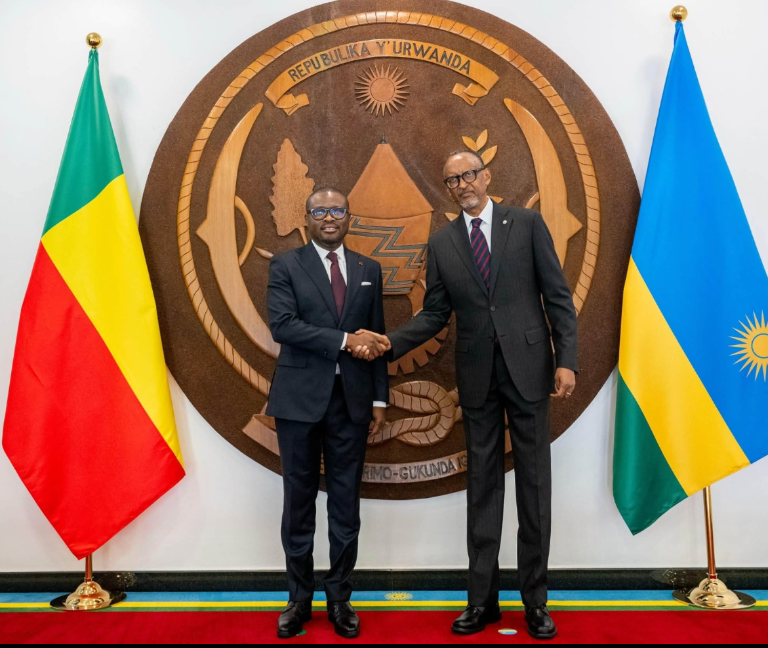
KIGALI — Benin’s President Romuald Wadagni began a two-day official visit to Rwanda on Wednesday, September 16, 2026, his first diplomatic trip of this kind since taking office in May. The visit has direct implications for Benin’s economy and its citizens, as it opens the door to deeper cooperation in technology, public services, urban planning, agriculture, and security — sectors that could translate into jobs, investment, and improved public services back home.
A high-stakes welcome in Kigali
Upon arrival, Wadagni and his delegation were greeted by crowds eager to welcome the new Beninese leader. He was then received by his Rwandan counterpart, Paul Kagame, at the Urugwiro Village presidential compound. That meeting formed the centerpiece of the first day and comes as Cotonou and Kigali seek to expand ties in several areas. Existing cooperation frameworks already cover information and communication technologies, modernization of public services, urban planning, agriculture, and peace and security.
Why the Gisozi memorial stop matters for Benin
Beyond political talks, Wadagni’s trip includes a solemn memorial component. He is expected to visit the Kigali Genocide Memorial in the Gisozi district, where the remains of more than 250,000 victims of the 1994 genocide against the Tutsi are laid to rest. The site serves as a place of remembrance, an education center, and a repository of memory.
The 1994 genocide claimed more than one million lives in about 100 days, according to Rwandan authorities. Annual commemorations, known as Kwibuka, have since become central to Rwanda’s national life, aiming to preserve victims’ memory, pass history to new generations, and teach the lessons of that tragedy.
The Gisozi memorial holds a special place in this effort. Inaugurated in 2004, it houses exhibitions on the genocide, archives, survivor testimonies, and a space dedicated to child victims. It is also the burial site of hundreds of thousands of people.
For Wadagni, the expected tribute at Gisozi fits the protocol of high-level official visits to Rwanda while adding a human dimension to the diplomatic trip — a signal that Benin values memory and reconciliation alongside economic interests.
Kagame-Wadagni summit: building on institutional dialogue
The meeting between Kagame and Wadagni comes months after the Beninese president’s inauguration. Rwanda was represented at that ceremony by its Prime Minister, Justin Nsengiyumva, a sign, according to Rwandan authorities, of the importance attached to relations between the two countries. Kigali then highlighted the growing ties between Rwanda and Benin.
This visit allows the two leaders to continue a dialogue already underway at the institutional level. Discussions are expected to focus on ways to strengthen bilateral cooperation and foster new partnerships — deals that could eventually benefit Beninese businesses and workers.
The broader African context could also give the talks wider significance. Rwanda and Benin are each pursuing economic transformation, administrative modernization, and infrastructure development. Kigali emphasizes investment, entrepreneurship, and digital technologies among its development priorities — areas where Benin could seek know-how and partnerships.
Memory and cooperation: a dual message
Including the Gisozi memorial in the visit gives the trip a particular tone. In contemporary Rwanda, memorial sites are not only for mourning victims; they also work to transmit history and raise awareness about the consequences of discrimination and mass violence.
The Gisozi site preserves testimonies, documents, and archives related to the genocide. The Genocide Archive of Rwanda, housed within the memorial, gathers documents from survivors and partner organizations.
For Kigali, the memory of the genocide remains closely tied to national unity, reconciliation, and prevention of mass violence. For foreign visitors, passing through Gisozi is traditionally a solemn moment, marked by contemplation before the tombs and the testimonies kept on site.
Wadagni’s visit thus sits at the crossroads of two dimensions: strengthening Benin-Rwanda relations and recognizing the memory of a tragedy that continues to deeply mark Rwandan society.
What comes next for Cotonou-Kigali ties
After the first day, centered on the official welcome and talks with Kagame, the rest of the stay is expected to allow the Beninese president to continue discussions with Rwandan authorities. The two-day visit is set to lay the groundwork for a new phase in relations between Cotonou and Kigali, with a stated desire to consolidate political ties and cooperation between the two states — an outcome that could have tangible effects on trade, investment, and opportunities for citizens in both countries.

More Stories
Benin’s month in Paris: what the Fnac Saint-Lazare program means for business, diaspora and memory
Sankara mausoleum’s impact on Burkina Faso: a family’s ordeal and a nation’s memory
Burkina Faso’s 85% administrative efficiency claim: the real burden on citizens and the economy