
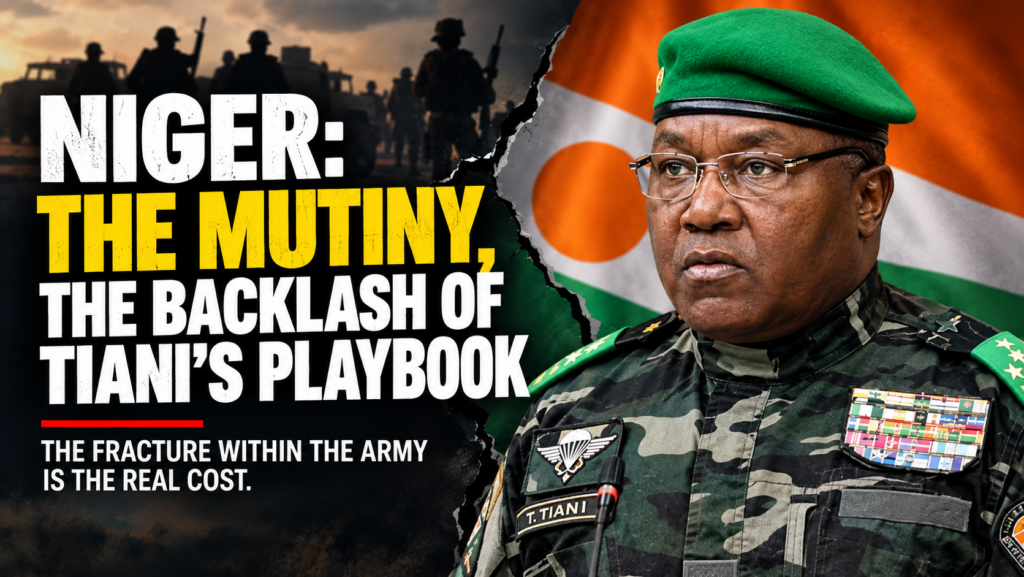
The aftermath of the recent mutiny highlights a deeper crisis under the leadership of General Abdourahamane Tiani. Since taking control, Tiani has systematically reshaped the military, converting it from a national defense force into an instrument of political security. By prioritizing personal loyalty over professional merit, sidelining independent officers, and favoring loyalists, the regime has disrupted the delicate internal balance that once maintained military unity. This shift from institutional neutrality to personal allegiance has fostered deep suspicion throughout the ranks.
This political interference within the chain of command has produced inevitable consequences. When soldiers realize that promotions depend on political compliance rather than performance, resentment spreads. The resulting accumulation of grievances and internal rivalries has severely eroded trust between different command levels. Consequently, the rebellion of August 28 and 29 cannot be dismissed as a minor disciplinary breakdown; it represents a visible symptom of deep-seated frustrations and systemic mistrust within the armed forces.
Security risks in a divided military
This internal divide is particularly dangerous for a nation grappling with persistent external threats. To defend the country effectively against active armed groups on multiple fronts, the army must rely on a unified and credible command structure. When soldiers view their peers with suspicion, operational efficiency collapses. Any fracture within the defense apparatus directly compromises the protection of Niger’s territory.
Furthermore, the government’s silence regarding the detained soldiers is a deliberate strategy. By withholding details on who was arrested, where they are held, and what charges they face, the administration uses opacity as a tool of psychological control. This atmosphere of uncertainty ensures that fear spreads among the troops, leaving everyone wondering who might be targeted next.
This lack of transparency prevents any constructive resolution. Instead of clarifying responsibilities, the official silence fuels rumors and deepens divisions. Families are left in limbo, soldiers remain guarded, and the military leadership continues to lose credibility, transforming a localized military issue into a broader crisis of confidence.
Media displays and systemic contradictions
To control the narrative, the regime has broadcasted images of seized military vehicles and weaponry on national television, presenting them as evidence of a conspiracy. However, these public displays fail to address the fundamental questions: What were the actual demands of the mutineers? Who is legally responsible, and what judicial processes are being followed? Most importantly, why did such a crisis emerge within the very institution tasked with protecting the state?
This theatrical communication serves to validate the arrests rather than provide transparent answers. Without verifiable facts and open procedures, the government’s public relations effort does little to resolve the country’s growing concerns.
This strategy exposes a fundamental contradiction in the administration’s approach. While claiming to strengthen the state, the leadership governs through internal paranoia. A professional army cannot sustain its effectiveness when any sign of disagreement is treated as treason. True military discipline relies not only on obedience but also on trust in the fairness of the hierarchy and a shared national mission.
The high cost of internal purges
The ongoing purges and dismissals carry a heavy operational price. Sidelining experienced commanders weakens units and drains the military of essential expertise. In a complex conflict against highly adaptable armed groups, Niger cannot afford to degrade its command structures to resolve internal political disputes.
A troubling paradox has emerged: while the administration’s rhetoric heavily emphasizes national sovereignty and defense, significant energy is diverted toward monitoring and neutralizing internal dissent. This focus on regime survival directly undermines national security. Soldiers preoccupied with internal rivalries and the threat of political purges cannot fully commit to their primary mission of protecting the population.
The August mutiny ultimately raises critical questions about how Tiani manages authority and military loyalty. Using a national army to secure a political regime inevitably generates destructive friction. By prioritizing the pursuit of internal rivals over military cohesion, the leadership compromises the very institution holding the country together. While dividing the armed forces may offer short-term political control, it presents a severe strategic risk to Niger’s long-term stability.
More Stories
Niger barracks rumbling after mutiny
Sahel sports festival kicks off in Ouagadougou
Dakar: empty baskets march marks new phase in Senegal cost-of-living protests