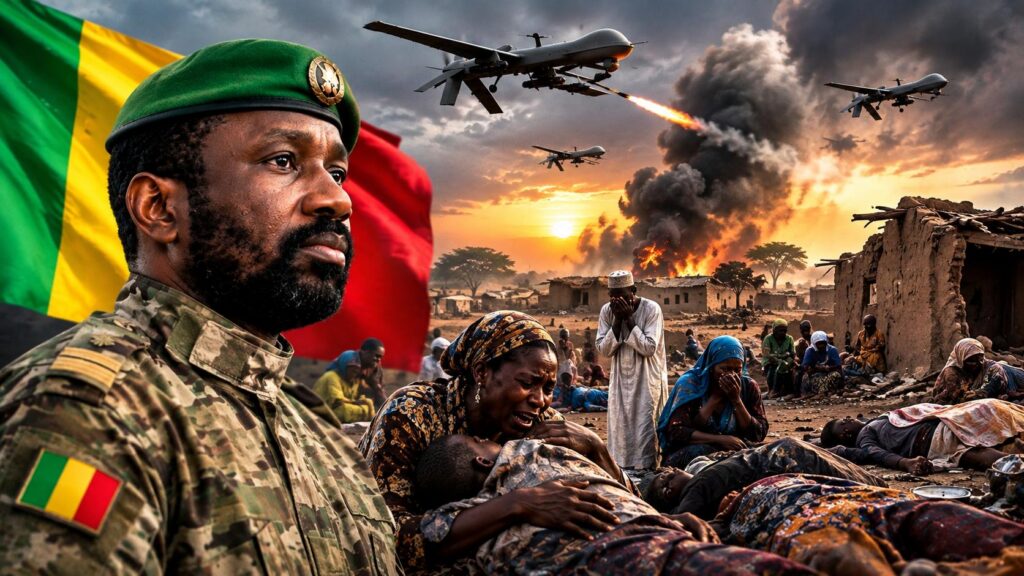
The use of drones in Mali’s conflict has brought devastating consequences for ordinary people, with hundreds of families torn apart as airstrikes fail to distinguish between armed fighters and civilians. In the north and centre of the country, the distant hum of an unmanned aircraft has become a dreaded sound, signalling yet another attack that could claim innocent lives. A joint investigation, drawing on field evidence and conflict data, has documented the scale of this crisis: between September 2023 and September 2026, 731 civilians were killed in 199 strikes, according to figures from ACLED cited in the inquiry. These are not just numbers; they represent fathers, mothers and children whose lives were cut short in a war that shows no sign of ending.
When precision weapons fail to protect the innocent
Mali’s armed forces have significantly expanded their aerial capabilities in recent years, deploying Turkish-made Bayraktar TB2 and Akinci drones, as well as combat aircraft, in operations against armed groups. These tools are marketed as precision weapons capable of striking identified targets with minimal risk to soldiers. Yet on the ground, the reality is far more complex. The investigation, which analysed nearly 60 strikes and independently reconstructed 12 of them using satellite imagery, video footage, photographs, munition debris, witness testimony and geolocation data, identified 146 civilian deaths in those twelve cases alone. The broader data points to a pattern: 199 strikes that primarily hit civilians, resulting in 731 civilian fatalities over three years. While not every victim has been individually identified, nor legal responsibility for each strike established, the figures provide a stark measure of the human toll of this air campaign.
Children among the dead
Perhaps the most disturbing finding concerns what operators knew before firing. In some of the examined cases, witness accounts and collected evidence raise serious questions about whether civilians were visible at the time of the strike. One particularly chilling phrase reported during the investigation encapsulates the accusation: “They saw the children, and they fired anyway.” If substantiated, such actions would constitute grave violations of international humanitarian law, particularly the principles of distinction between combatants and civilians and the obligation to take all feasible precautions to spare non-combatants. But the issue extends beyond those pressing buttons to the entire chain that enables a strike: intelligence gathering, target identification, operational approval, munition selection and the final order to fire.
Unravelling the chain of command
Determining responsibility is further complicated by the multiple actors involved in Mali’s air war: Malian forces, Russian Africa Corps personnel, and various entities linked to the acquisition and operation of Turkish drones. This entanglement makes it exceedingly difficult to answer basic questions: Who identifies the target? Who confirms its military nature? Who authorises the strike? Who monitors the operation at the moment of firing? And crucially, who is held accountable when civilians are killed? These questions carry particular weight in a conflict where Malian authorities consistently portray their air operations as actions against armed groups.
Technology does not eliminate human error
The introduction of drones is often associated with the promise of more precise warfare. An operator can observe an area remotely, track a target and choose the moment to attack without exposing troops to enemy fire. But technology does not erase human error, nor does it guarantee accurate intelligence. In a region where armed groups move among civilian populations, villages are isolated and information is often fragmentary, distinguishing a fighter from a civilian can be extraordinarily difficult. The investigation highlights the contrast between the sophistication of the weapons used and the vulnerability of those living in conflict zones. For residents, a drone in the sky cannot necessarily tell a combatant from a shepherd, a trader or a child.
A war that leaves deep scars
The available data reveals a significant escalation in Mali’s air war. According to figures cited in the inquiry, the number of strikes causing civilian casualties has risen sharply compared to previous years. This increase comes as violence against civilians remains a major problem across the Sahel. Armed groups themselves are responsible for numerous attacks on civilians and are also acquiring growing drone and explosive device capabilities. For Malian families, however, the distinction between different technologies and different chains of responsibility makes no difference to the end result: when a strike hits a village, lives are lost. The question raised by these revelations is not merely about the military effectiveness of drones, but about the limits that must govern their use.
As Sahelian armies continue to acquire ever more sophisticated aerial assets, the issue of accountability becomes unavoidable. A weapon capable of striking from several kilometres away does not absolve its operator of the duty to verify the target. In Mali, the hundreds of deaths documented in the data serve as a stark reminder: in any technological war, the distance between the person who presses a button and the person who dies may be vast, but responsibility does not vanish with distance.

More Stories
What Mali’s US-Russia balancing act means for citizens and the economy
Nigeria’s police security promises for the presidential election: what it means for voters, businesses and the economy
Benin’s online tax expansion: how Parakou, Comè and Lokossa businesses will feel the shift from 21 September 2026